New City Trenchless explains sewer camera inspections for buyers under contract in Rockland County. A general home inspection usually does not include the sewer lateral, even though a major defect there can become one of the property’s most expensive hidden repairs.
The General Inspection Stops at the Drain
A home inspector runs the fixtures, watches water leave the trap, notes anything slow, and reports on the plumbing he can see. That is a genuine test of the system inside the walls. It is not a test of the lateral, the buried pipe running from the foundation wall out to the tap at the sewer main, and buried private pipe falls outside a standard inspection scope.
The gap matters because the failure modes that hurt buyers are all invisible to a flow test. A cast iron line half closed with scale still drains a bathroom sink. A root mat two joints past the foundation passes a ten minute check and then dams up the first time the household runs three loads of laundry. A bellied section holding standing water moves low volumes fine and backs up at high ones.
| What gets checked | Standard home inspection | Sewer camera inspection |
|---|---|---|
| Fixtures and visible supply lines | Yes | No |
| Drain flow at the fixture | Yes, briefly | Not the measure used |
| Buried lateral out to the main | No | Yes, the full run |
| Pipe material identified | No | Yes, on camera |
| Defect located and depth measured | No | Yes, with a locating sonde |
| Repair scoped and priced | No | Yes |
Neither inspection replaces the other. They answer different questions, and only one of them answers the five-figure question.
The Cost Gap Is the Entire Argument
A pre-purchase sewer inspection runs $250 to $500 and is often credited back against repair work if you buy the house and have the job done. Here is what sits on the other side of that decision.
| Finding | Typical repair |
|---|---|
| Nothing significant, line sound on camera | $0, and you close with a baseline recording |
| One failed joint in an otherwise sound run | $1,500 to $4,000, sectional spot repair |
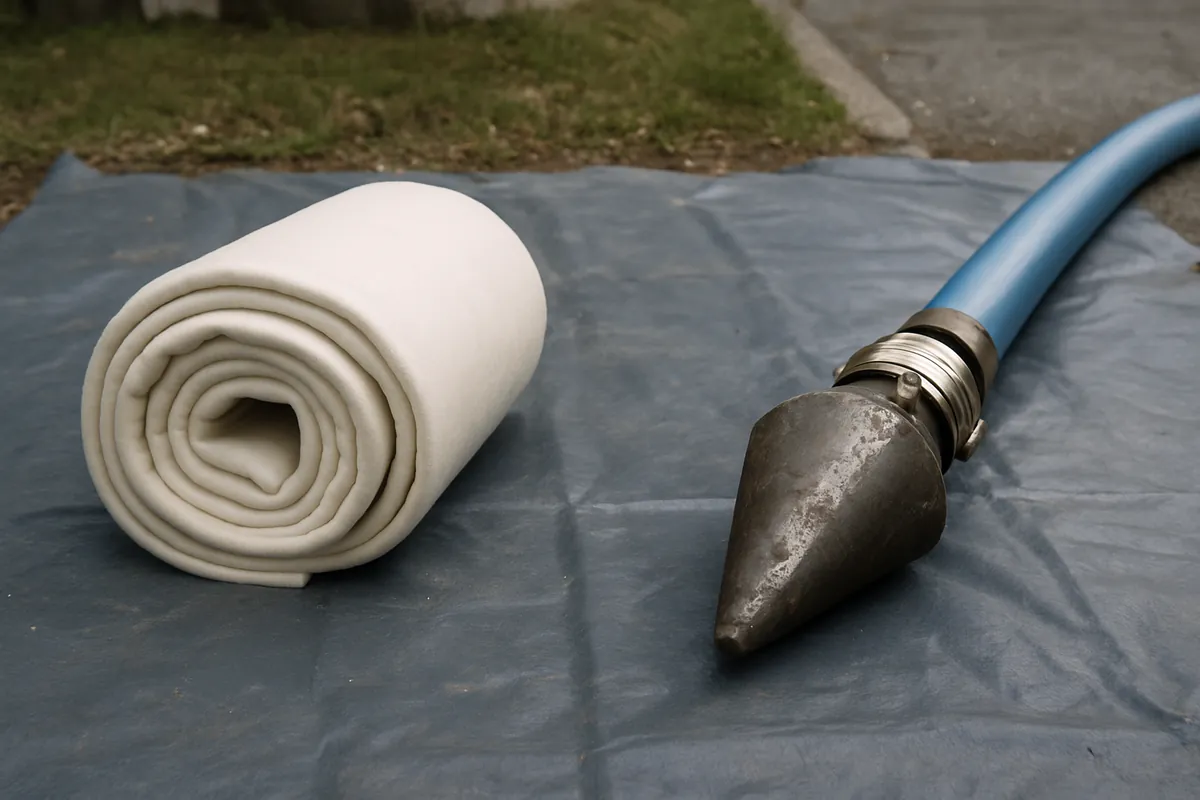
| Roots or scale along the length of the run | $4,000 to $12,000, full lateral lining |
| Collapsed, deformed or back-pitched line | $6,000 to $15,000, pipe bursting replacement |
| Any of the above dug rather than lined | Often 1.5x to 2x the trenchless price once excavation and landscape restoration are counted |
The ratio is what to notice. The inspection costs somewhere between two and six percent of the worst case it is looking for. Buyers routinely spend more than $500 on a radon test, a chimney scan and a pest report combined, all of which are worth doing, and none of which carry a downside of this size.
The other thing the ranges show is why a scope is worth doing even when it comes back clean. A clean result is not a wasted fee. It is a documented condition on a known date, which is exactly what you want on file the first time something goes wrong three winters from now.
Build Dates That Should Trigger a Scope
Rockland County has an unusually concentrated housing history, and the construction date on a listing tells you a great deal about what is buried in the yard. County level housing age data through the American Community Survey shows the same clustering that a camera confirms one property at a time.
1945 to 1972, the Orangeburg window
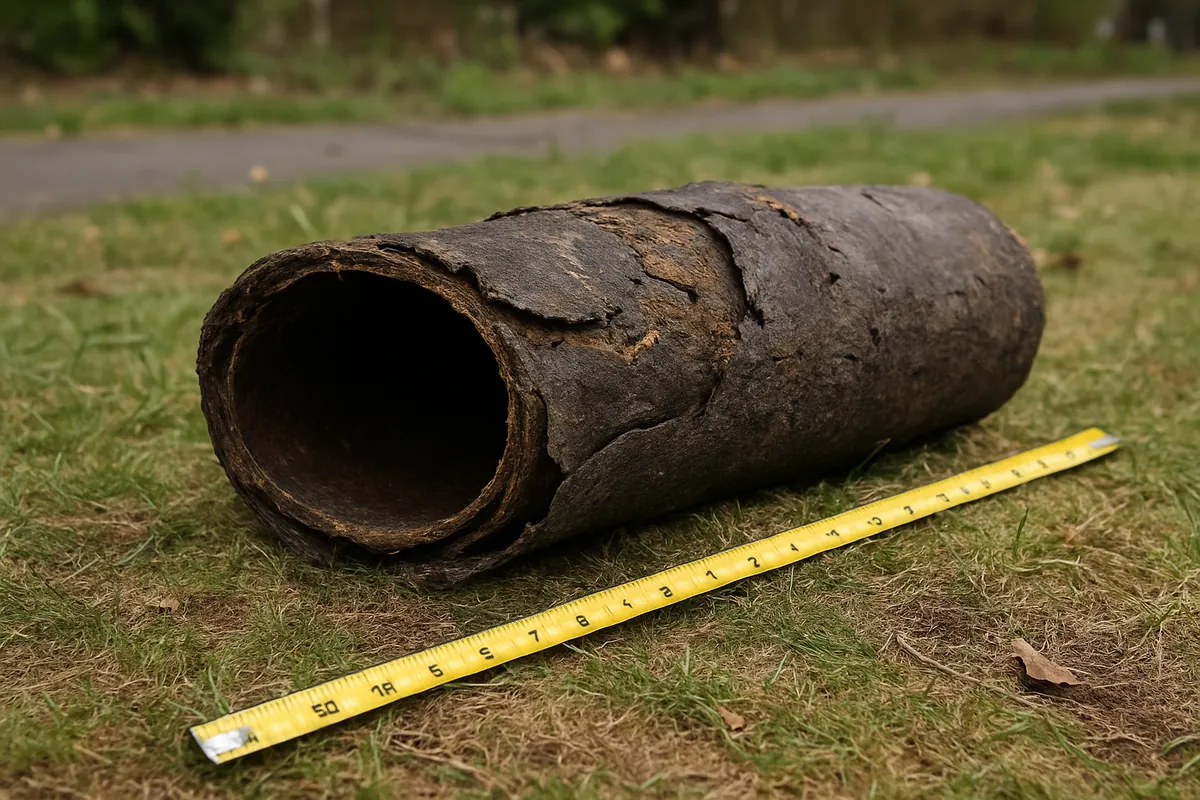
Orangeburg pipe, properly bituminized fiber, is tar impregnated wood pulp wound into a tube. It was manufactured in Orangeburg, New York, about ten miles from New City, so the local product went into local trenches by the mile between 1945 and 1972. It delaminates from the inside and it deforms out of round under soil load.
That second failure mode is the one that changes a buyer’s math. A pipe that has gone oval cannot host a liner, because lining needs a stable host wall to cure against. Once Orangeburg has deformed, the only real option is replacement, which is why Orangeburg pipe replacement lands at the top of the cost table rather than the middle of it. Finding that before closing rather than after is the whole point of the exercise.
The postwar clay tile belt
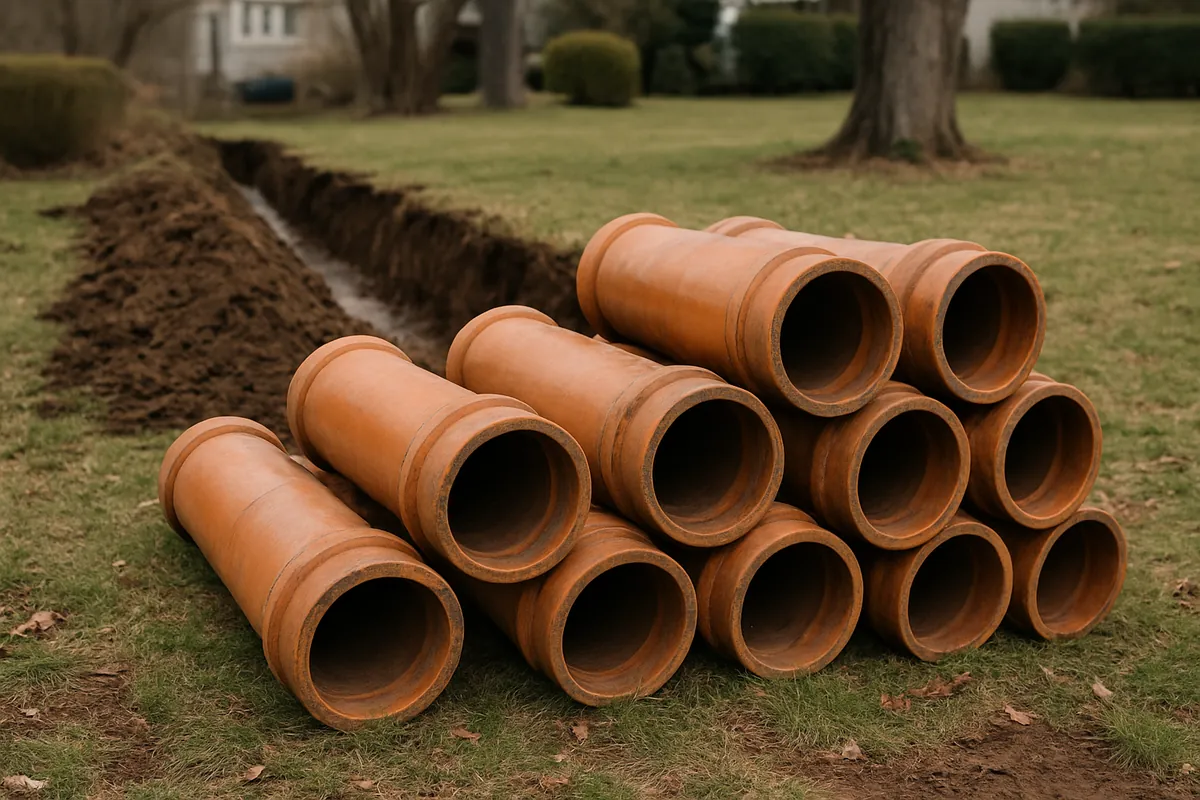
The subdivision build-out that followed the opening of the Tappan Zee Bridge in 1955 filled New City, Nanuet, Bardonia, Congers and Valley Cottage with tract housing on vitrified clay laterals. Clay is durable material, but a run assembled from short sections carries a joint every few feet, and sixty-plus years of freeze and thaw cycling has worked every one of those joints loose enough for a root tip. The good news for a buyer is that round clay is an excellent host for a liner, so a clay finding is usually a mid-range repair rather than a top-range one.
Pre-1940 river village housing
Haverstraw, Nyack, Piermont and Tappan hold nineteenth century and prewar housing on laterals older than anything in the tract neighborhoods. Runs tend to be longer and deeper, materials are frequently mixed where a previous owner patched a section, and the transition collars where two materials meet are rarely documented anywhere. Low lying ground near the river also carries a high water table, so groundwater standing above the pipe pushes into every open joint, and a line that reads merely damp in a dry New City yard can be actively taking on water down by the river.
What the Camera Can and Cannot Tell You
A sewer camera inspection reads the inside surface of the pipe. That gets you material identification, root intrusion, offset and separated joints, cracks, standing water indicating a belly or back pitch, infiltration at the joints, and the exact footage distance and depth of each one. It is a lot.
What it does not get you is remaining wall thickness. A cast iron line can look serviceable on camera and still be thin enough to fail within a few years, because a lens cannot measure what it cannot see through. The honest reading of a clean scope is that the pipe was sound on the day, not that it is warranted for a decade.
Access limits matter too. If the property has no exterior cleanout and the camera enters through a house trap or a roof vent, part of the run may go unseen. A report should state which route was used and what was not reached, and a buyer should treat a partial pass as a partial result rather than a clean bill of health.
Turning a Defect Log Into a Credit
The negotiation runs on documentation, not adjectives. Three things carry weight with a seller’s attorney: the recorded video, a written log tying each defect to a footage distance, and a firm repair number for the specific fix rather than a range pulled off a website. Inspection reports written to the coding standard maintained by NASSCO describe each defect in a format another contractor can read and verify, which is what stops the conversation turning into two opinions.
Most buyers ask for a credit at closing rather than a seller managed repair. A credit lets you choose the contractor and the method. A seller managed repair means whoever quoted cheapest under time pressure gets to decide what happens to the pipe you are about to own, and the cheapest quote on a deformed lateral is usually the one that lines something it should not have.
Worth knowing before you argue about scope: Rockland County Sewer District No. 1 maintains the mains in the street, and you can confirm district contacts through Rockland County directly. Everything from the foundation to the tap is the property owner’s pipe, including the stretch running under the road. There is no public authority to bill for it after closing.
Timing It Inside the Contingency Window
Sequence decides leverage. Book the scope in the same week as the general home inspection, while the inspection contingency is still open and your attorney still has room to act on what comes back. The scope itself takes about an hour and the footage and defect log should reach you the same day, which leaves time to get a repair number and put it on the table.
Run it after the contingency closes and you have bought yourself knowledge with no remedy attached. That is still better than not knowing, because you can budget and plan the repair, but it costs you the only window in which someone else might share the bill.
If a seller refuses the scope, treat the refusal as information. The pass is non-invasive, it goes in through an existing cleanout, and it leaves no mark on the property. On a sixty year old house there are very few innocent reasons to say no.
Your Next Step
Get the sewer camera inspection booked as soon as your offer is accepted, alongside the general inspection rather than after it. For $250 to $500 you get the pipe material, a defect list tied to footage, a depth reading, and a straight answer on whether the lateral needs work now, needs watching, or is fine. If it does need work, you will also know whether it can be lined or has to be replaced, and that single distinction is the difference between a $4,000 conversation and a $15,000 one. Have it before you close, not after.
Related Rockland County Sewer Guides
See what the camera footage should show, learn who is responsible for the sewer lateral, and understand Rockland County sewer permit questions before closing.
Common Questions
Is a sewer inspection included in a standard home inspection?
No. A standard home inspection covers fixtures and visible plumbing, not the buried lateral running out to the sewer main. The inspector watches water leave a trap for a few seconds, and that test cannot detect scale, root intrusion, an offset joint or a belly holding water. The sewer scope is a separate service booked separately, at $250 to $500.
How much does a pre-purchase sewer scope cost in Rockland County?
$250 to $500, and it is often credited against the repair if you buy the house and have the work done. Set that against what it can uncover: $1,500 to $4,000 for a sectional spot repair, $4,000 to $12,000 for full lateral lining, $6,000 to $15,000 for pipe bursting. The inspection is the smallest number in the transaction.
Which build dates are red flags around here?
Anything from 1945 to 1972 sits inside the window when Orangeburg bituminized fiber pipe was installed, and that product was manufactured in Orangeburg, New York, roughly ten miles from New City. The same era used vitrified clay tile with a joint every few feet. Pre-1940 housing in the river villages sits on older pipe still.
Can I actually use the findings to renegotiate?
Yes. A recorded video with a footage-referenced defect log is far more persuasive than a verbal opinion, because it is checkable. Most buyers ask for a credit at closing rather than a seller-arranged repair, since a credit lets you choose the contractor and the method instead of inheriting the cheapest patch the seller could find.
When should I schedule the scope?
Inside your inspection contingency window, ideally the same week as the general home inspection. The scope takes about an hour and the footage reaches you the same day, which leaves room to get a repair number and raise it with the seller before the window closes. Booking after the contingency expires gives you information and no leverage.