New City Trenchless handles burst pipe repair in New City, NY, from a split supply line spraying in a basement to a cracked service line soaking a front lawn. A burst is a pressure failure, not a clog, so the sequence never changes: stop the water, work out which pipe gave way, then read the line before a wall or the ground is opened. Call 845-507-6985 and the first thing we will talk about is the shutoff.
This page covers the pressurized side of a plumbing emergency, a supply or service line that has split and is losing clean water under street pressure. If instead dirty water is rising at a basement floor drain, that is a gravity backup and a different job, handled in relief-first order on our emergency sewer repair page. For general service information, see the New City service area page.
How Burst Pipe Repair in New City, NY Works
Burst pipe repair in New City, NY is better understood as a short, fixed sequence than as a single fix, because the early steps stop the damage before anything permanent is decided. It runs the same way every time:
- Close the main. Shut the water where the service line enters the house, or the curb stop at the property line if the inside valve will not hold. Nothing else starts until the flow has stopped.
- Make it safe. Cut power to anything the water can reach without standing in water to do it, move what can be moved, and open low faucets to bleed the pressure left in the lines.
- Trace the split. The leak is located to a point rather than guessed from the stain, so a pinhole hidden in a wall or under a slab is pinned down before anything is cut.
- Identify the pipe. The repair hinges entirely on what failed: an indoor supply run, a fixture connection, or the buried service line out to the street each lead somewhere different.
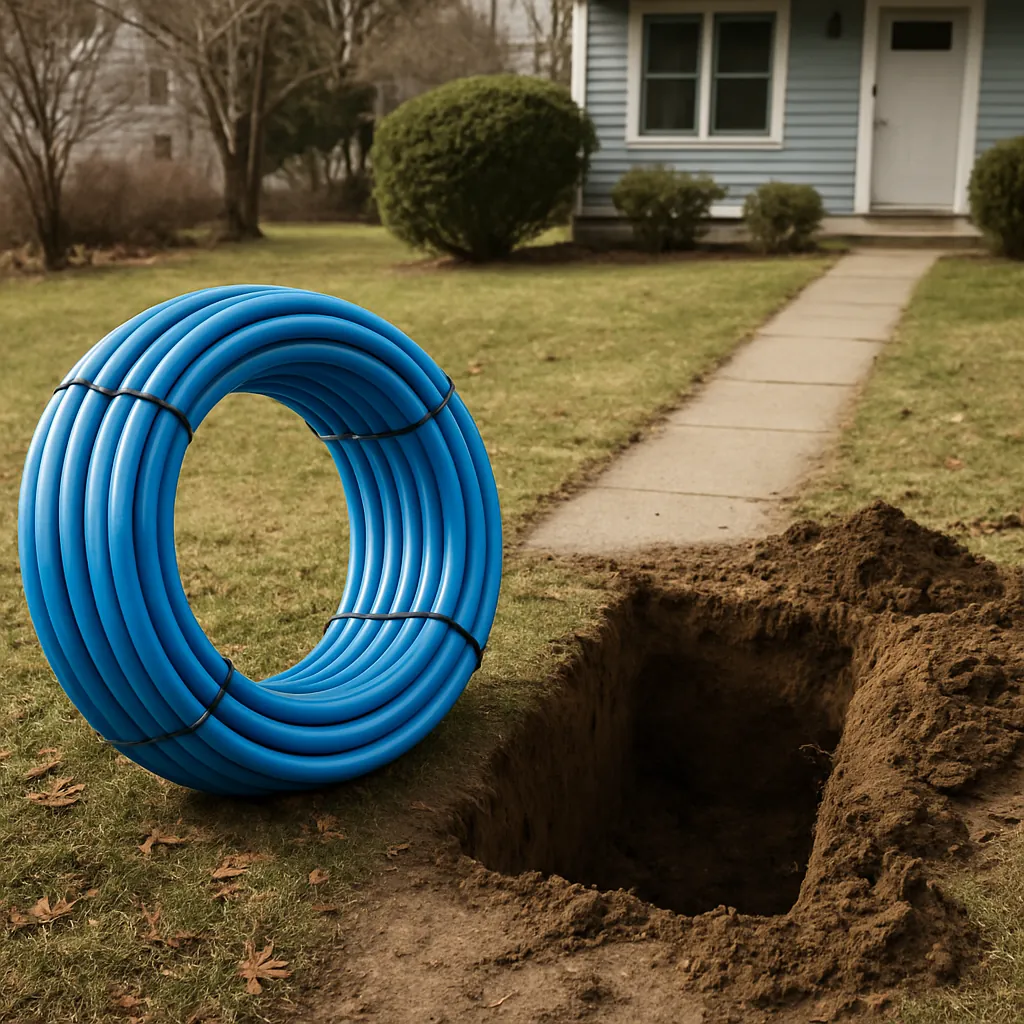
- Repair to match. An accessible joint or exposed run is mended in place; a failed buried service line is renewed, often by a trenchless pull-in instead of a trench down the yard.
- Pressurize and check. The line is brought back up to pressure and watched before any wall or pit is closed, so the fix is proven rather than assumed.
The aim of the first visit is a dry, pressurized house. Everything past that follows from what the line actually shows, not from the pressure of the moment.
Clean Water Under Pressure or a Rising Sewer Backup
The quickest way to steer a repair correctly is to read the water itself. A burst is clean water under pressure: it sprays or runs with every tap shut, the sound does not stop when you close a faucet, and the meter keeps creeping with the whole house off. That is the pressurized supply side, and it is what this page is about.
A sewer backup sends the opposite signal. Dirty wastewater rises slowly at the lowest openings in the house, a basement floor drain or a laundry sink, and it worsens each time water runs upstairs rather than easing when it stops. That is gravity, not pressure, and it belongs on the emergency sewer repair track instead.
When it is genuinely unclear, the safe move is identical either way: stop using water, close the main, and describe where the water appears and whether it is clean or dirty. That single detail usually separates the two before anyone is dispatched.
Early Warning Signs a Pipe Has Split
A burst does not always arrive as an obvious flood. Some splits weep behind finish for days before they surface. Watch for a sudden drop in pressure at the taps, a hiss or a running sound inside a wall or floor with no fixture open, and a water meter that keeps turning when the whole house is shut off. A spreading ceiling stain, bubbling paint, or a warm or cold stripe on a wall all point to water tracking behind the surface. Outside, a soft or unusually green patch over the service line path, water surfacing in the lawn, or a wet spot that reappears on the first thaw each point to a buried split. A fixture that worked yesterday and now gives little or nothing may be fed by a line that froze and failed upstream. Any of these is reason enough to shut the water and look, because a small split only grows under constant street pressure.
Repair Paths After the Shutoff Is Closed
With the water stopped, the repair sorts into a few clear paths, and which one fits depends on which pipe failed and where it sits. A split on an exposed indoor run, at a valve, or beneath a fixture is a contained repair reached through a small opening. A pinhole or crack hidden inside a wall or under the slab has to be reached, but the leak is pinpointed first so the opening stays no larger than the fix requires.
The bigger fork is the buried water service line between the curb and the house. That run can be dug and replaced, or in some yards it can be renewed by a trenchless pull-in that draws a new line along the existing path through access pits, sparing the lawn, driveway and walk. Our trenchless water line replacement page explains how that method is planned and sized. If the pipe that failed turns out to be a cracked drain or sewer line rather than a pressurized supply line, the logic shifts to the structural side on the sewer line repair and replacement hub, and a sewer camera inspection reads the line before any method is chosen.
What Drives the Scope of a Burst Pipe Repair
Bursts that look identical at the faucet can be very different jobs behind the wall or under the lawn. What moves the scope, with no figure attached:
- Which pipe failed. An exposed indoor run is the simplest case; a line inside a finished wall adds access and patching; a buried service line adds locating and either a pit or a trench.
- Where the split sits. A failure at a reachable joint is short work; one mid-run in finished space, under a slab, or out near the curb stop pulls in more to reach it.
- How it let go. A single freeze split is one repair; a line that froze in several bays, or an older run thinned by corrosion, can mean more than one weak point to address at once.
- Pipe material and age. Copper, galvanized steel and newer plastic each behave differently, and an aging run that has already split once is a candidate to renew rather than patch again.
- Access to the work. A clear path to the shutoff, the meter and the run shortens the job; a finished basement, a tight crawl space, or a buried curb stop adds time to reach it.
- Buried-line access. The route and depth of a buried service line affect how it can be reached. The repair plan should account for the access available in the yard.
Burst Pipes Across New City and the County Seat
New City is an unincorporated hamlet and the county seat of Rockland County in the Town of Clarkstown. Homes of different ages can have different pipe materials and layouts. Older homes may have aging supply runs, while exposed pipes in any home can be vulnerable to freezing. The condition and location of the damaged pipe guide the repair, so the work begins with an assessment of the affected line.
The triage order does not shift from one New City street to the next, or from the county seat to a neighboring Clarkstown hamlet, because the physics of a pressurized split do not care about the address. Owners comparing notes with family in nearby Nanuet, Bardonia, Valley Cottage or Congers, or with the same situation across town in West Nyack, get the identical sequence: water off first, find the split, then fix the pipe that actually failed. Across all of Rockland County NY the first call stops the damage, and the permanent repair is read from the line rather than sold under pressure.
Water off first, then the repair the line actually calls for. Call 845-507-6985 to get a burst pipe handled in New City or anywhere in Rockland County.
For a property in the Town of Haverstraw hamlet, our burst pipe repair in Thiells page explains how leak location and access shape the repair.
For a property in the Town of Orangetown hamlet, see burst pipe repair in Blauvelt for guidance on defining the damaged section and planning access.
Frequently Asked Questions
New City is the county seat. Does that mean the county fixes a burst pipe?
County seat status does not establish who maintains a particular pipe. If a line bursts, close the main shutoff and contact your water provider to confirm the ownership boundary and who should handle the repair.
How fast does a burst pipe really need attention?
A split on a pressurized line does not pause. It keeps losing clean water at street pressure every minute the main stays open, so the first job is always to close the main shutoff and stop the flow. Once the water is off and contained, the actual repair is not an emergency and should not be scoped in a panic. The urgent part is the shutoff; the fix is planned afterward from what the line shows.
A pipe froze and split over the winter. Can the leak be found without tearing the wall open?
Usually yes. A freeze split is traced to a point before anything is cut, so the opening stays as small as the repair needs. A frozen pipe can begin leaking as the ice thaws and water flows through the crack. Pinpointing that crack first is what keeps a hidden repair from turning into a long guesswork hole in the finish.
Is the buried water line out to my New City house mine or the utility's?
Responsibility for a buried service line depends on the water provider and the applicable ownership boundary. Confirm which section you maintain with your provider before planning work near the street or curb stop.
What determines whether a buried burst needs a trench?
The pipe condition, route and access determine the repair method. Some yards allow a trenchless replacement through access pits; others need excavation to reach the damaged section. An on-site assessment should guide the choice.
How do I tell a burst pipe from a slow sewer backup over the phone?
Describe the water. A burst is clean water under pressure that sprays or runs even with every faucet closed, and the meter keeps turning with the whole house shut off. A backup is dirty wastewater rising slowly at a basement floor drain or laundry sink, worse each time someone upstairs runs water. That one detail, clean and pressurized versus dirty and rising, usually sorts the two before anyone is sent out.