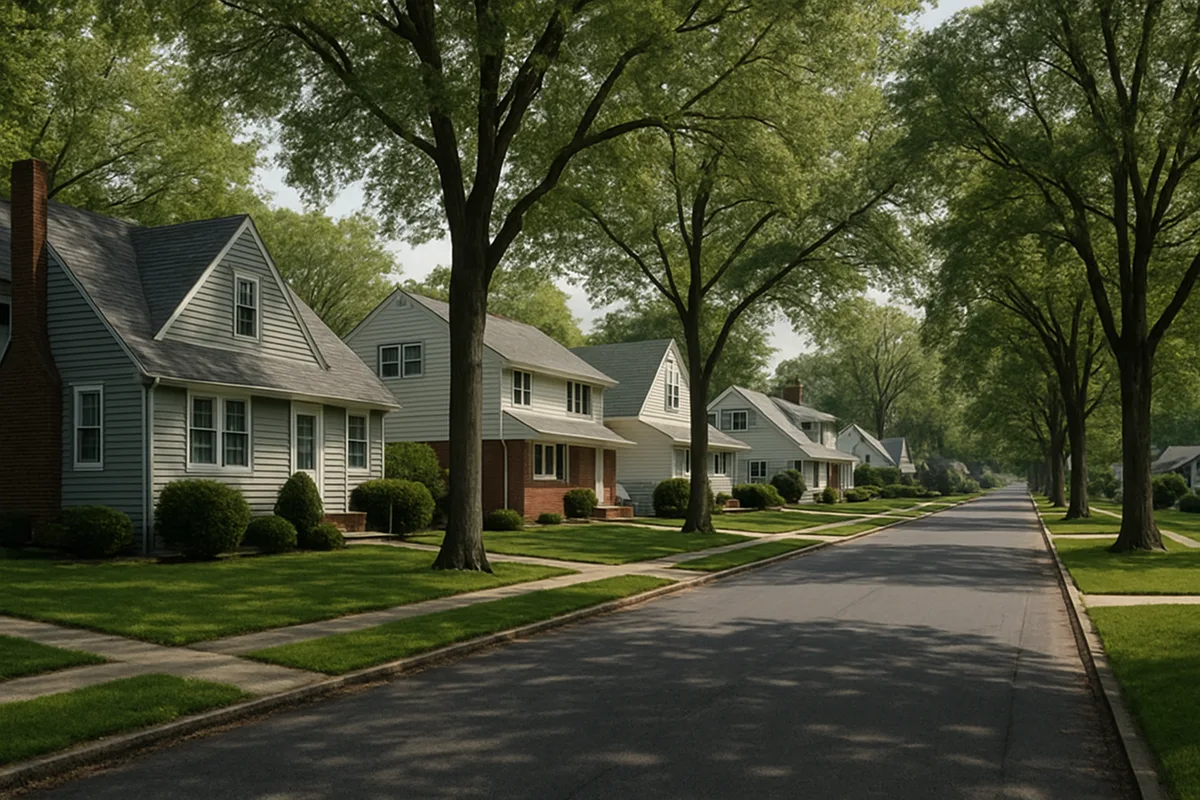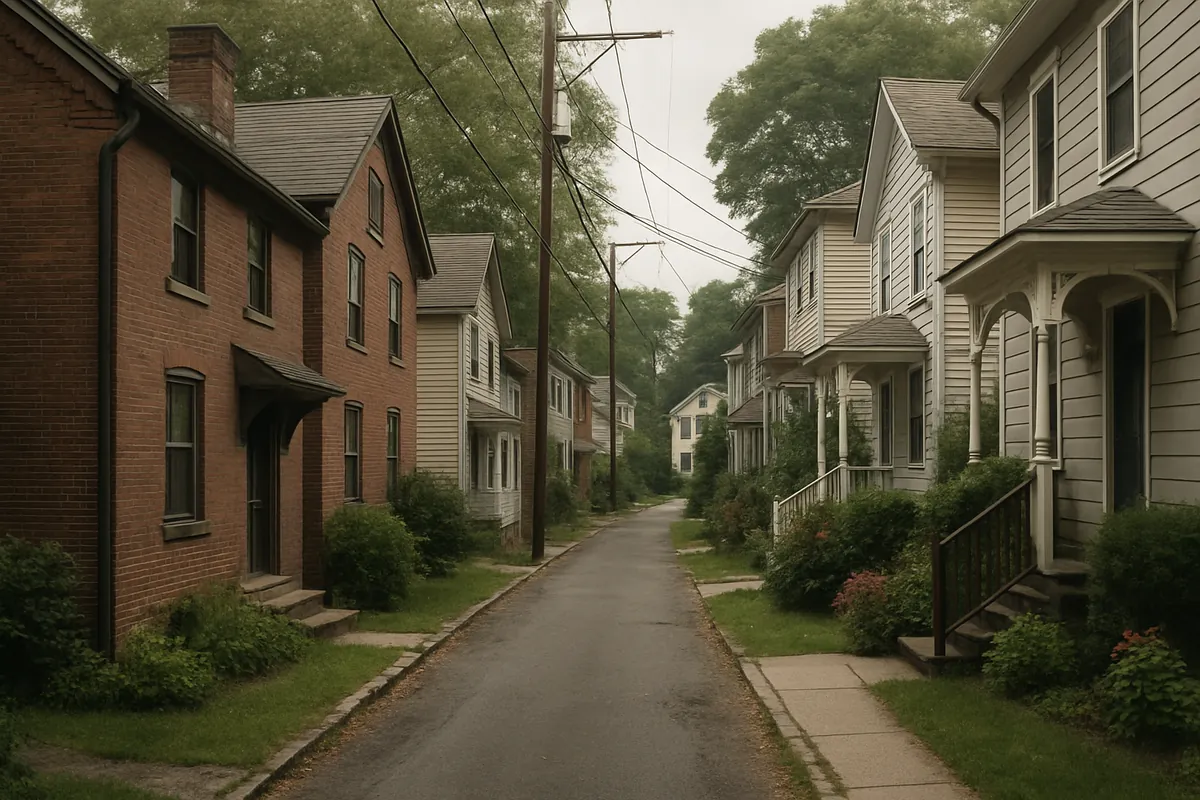
New City Trenchless covers renewal options for pre-1960 sewer laterals across Spring Valley, where some of the oldest sewered streets in the Town of Ramapo carry dense housing. The village incorporated in 1902 and built out block by block around its railroad depot, decades ahead of many postwar subdivisions, so the pipe under these streets often skews older than elsewhere in the county.
A Village That Was Finished Before the Suburbs Started
Most of Rockland was farmland until the mid 1950s. Spring Valley was not. By the time the Tappan Zee Bridge opened, the village already had a street grid, a commercial Main Street, a rail depot that is still the northern end of NJ Transit’s Pascack Valley Line, and block after block of houses on narrow lots.
That head start is the whole story underground. A tract house in a neighbouring hamlet has a lateral from roughly 1960. A house three streets off Main Street here may be draining through pipe laid before the Second World War, and in the oldest pockets, before the First.
Pipe that old was also installed to a different standard. Vitrified clay came in short sections, so a fifty foot run can carry twenty five or more joints. Cast iron of the same vintage was heavy wall and has lasted, but it has been narrowing from the inside since the day it went in.
Springs, Shallow Groundwater and Joints That Leak Both Ways
The village is named for the springs on the site, and that is not just a pleasant origin story. Groundwater sits high here, and a high water table around an old lateral works against the pipe in both directions.
Wastewater leaks out through open joints and washes soil away from the bedding, which is what produces the soft spots and slow sinkholes people notice in a front yard. Groundwater then leaks in through the same joints, carrying fines with it and loading the system with clear water it was never sized to carry. Once a joint is doing both, the failure accelerates, because the void around the pipe keeps growing and the pipe loses the support that keeps it in line.
Freeze-thaw cycling through a Hudson Valley winter finishes the job on shallow runs. Every cycle shifts a joint fractionally, and a joint that has moved a quarter inch is a joint a root can find.
Pipe Sized for One Household Carrying Three
Age is only half the problem in Spring Valley. Many houses here now hold two or three households where one lived when the lateral was sized. A pipe specified for a single 1940s kitchen and bathroom carries several times that fixture load today, and the first symptom is almost always recurring grease blockage rather than a dramatic collapse.
What happens physically is straightforward. Grease cools and deposits on a rough interior wall, scale gives it something to grip, the effective bore narrows, and each subsequent flush moves slower and deposits more. Snaking punches a hole through the middle of that and the hole closes again. Hydro jetting actually strips the wall back to pipe, and lining afterwards leaves a smooth bore that has nothing for grease to hold on to.
Where a backup has already reached a finished basement, sewer backup repair covers both halves of the problem: clearing and renewing the line, and fitting a backwater valve while it is open. Any basement sitting below the grade of the street main is exposed to a surcharged main regardless of how good the private lateral is, and the New York State Department of Health is clear that sewage in a living space is a health exposure and not just a cleanup job.
No Room to Dig on a Village Lot
Spring Valley’s lots leave no room for an excavator. Houses sit a few feet apart, driveways are shared, front yards are short and often paved, and street parking is full. Open-cut replacement needs trench access, a machine, and somewhere to pile spoil for a day or two. These blocks have none of the three.
Trenchless work needs an existing cleanout or a single small pit. Where the run cannot be inverted from one end, pull-in-place lining installs the liner between two openings and leaves everything between them untouched, including the neighbour’s half of a shared driveway.
Matching Method to Cast Iron, Clay and Decades of Patching
| What you are seeing | Usual cause on a village lateral | The fix that lasts |
|---|---|---|
| Backups every few months after snaking | Roots or scale returning through joints that were never sealed | Clean the line, then line the run |
| Two apartments draining slowly at once | Grease and scale narrowing a shared lateral | Hydro jetting, then lining to a smooth bore |
| Water at the floor drain in heavy rain | Groundwater infiltration, or the street main surcharging | Lining plus a backwater valve |
| Soft ground or a dip in the yard | A broken section losing soil into the void | Spot repair, or bursting if the run is gone |
Sound-walled cast iron is descaled first, then lined with an epoxy resin liner cured to ASTM F1216, the standard published by ASTM International that governs the trenchless pipe lining process. Where the metal has channeled through at the invert, cast iron pipe lining is off the table and the run is burst and replaced with fused HDPE instead. Clay is cleared of roots and lined so the joints stop admitting them. A single failed joint in a serviceable host pipe takes a sectional point repair rather than a full-length job.
Why the Quote Follows the Camera, Not the Phone Call
Every trenchless sewer repair quote in Spring Valley follows a CCTV inspection, because the closer a house stands to the old core around Main Street, the older its lateral tends to be and the more likely the camera finds two or three materials spliced together by decades of partial fixes. That mix is what pushes a job to the top of a range. Filming first means the number you get reflects the pipe you actually own.
Permits and district questions for work in the right of way run through the village and the county, and should be clarified in the contractor’s written scope. Similar pipe eras appear on the dense blocks in neighbouring Monsey and up the hill in Airmont.
Frequently Asked Questions
How much does trenchless sewer repair cost in Spring Valley?
Typical published planning ranges are $1,500 to $4,000 for spot repairs, $4,000 to $12,000 for full lining, and $6,000 to $15,000 for pipe bursting. A camera inspection and site-specific quote are needed before work starts.
Can you replace my sewer line without digging up a shared driveway?
Yes. Lining works through an existing cleanout and pipe bursting needs only small pits at each end of the run, so a shared driveway sitting over the lateral stays intact.
My drains back up every few months even after snaking. Why?
Recurring backups on an old village lateral usually mean scale, roots or a structural defect rather than a one-off clog. A camera inspection for $250 to $500 shows which, and fixing the defect ends the cycle instead of managing it.
Does a multi-family conversion need a bigger sewer lateral?
Not always. Clearing scale and grease and lining the pipe smooth restores most of its capacity. If the flow check says the line genuinely needs upsizing, pipe bursting can pull in a larger diameter than the original.
Who pays when a Spring Valley lateral fails under the sidewalk or apron?
The homeowner. The main under the road is public infrastructure, but the lateral is private for its whole length, including the part under the sidewalk, the apron and the strip between them. Work in the right of way normally needs a permit, which should be included in the contractor's scope.