New City Trenchless explains how failed sewer laterals can be replaced by pulling a hardened bursting head through the old line, fracturing clay or cast iron outward while towing a new fused HDPE pipe behind it. It is the trenchless option for pipes past lining: collapsed sections, Orangeburg squeezed out of round, and laterals that need to come back larger than they went in.
How the Bursting Head Does Its Work
Static bursting threads a rod string through the existing lateral from a small receiving pit to a launch pit. The bursting head, a hardened cone larger than the host pipe’s bore, is drawn back through under hydraulic pull. Vitrified clay pipe and cast iron fracture outward and the fragments stay in the soil as the new pipe takes the old alignment.
Two things happen at once. The cone splits the host, and the trailing expander pushes the fragments and the surrounding soil outward far enough to open a bore for the new pipe. That displacement is why the ground has to be able to give. In dense, well compacted material the expander works harder and the required pull force climbs. In the loose backfill of a trench dug in the 1950s it goes easily, because the soil around the pipe was never as tight as the undisturbed ground beside it.
Pneumatic bursting uses a percussive hammer inside the head instead of pure static pull, driving forward in blows while a winch keeps tension on the string. Static is the usual choice on residential laterals: quieter, effectively no ground vibration, and it gives the operator a live pull force reading that says immediately when something in the line is not fracturing.
Before any pull, the run is surveyed by sewer camera inspection and traced with a locating sonde so pit positions and depth are known and utility mark-outs are complete.
Locating, Pits and What Gets Exposed by Hand
A sonde in the camera head broadcasts a signal that a surface receiver follows, so the line’s path and depth are painted on the lawn before a shovel moves. That trace sets pit location, and it also shows where the lateral runs under a patio, a retaining wall or a mature root plate that should not be disturbed.
Public utility mark-outs cover gas, water, electric and telecom. Where a marked utility crosses close to the sewer path, that crossing is exposed by hand before the pull. The fracture zone around a bursting head is small, but it is not zero, and a water service laid into the same trench as the sewer sixty years ago has no clearance to spare.
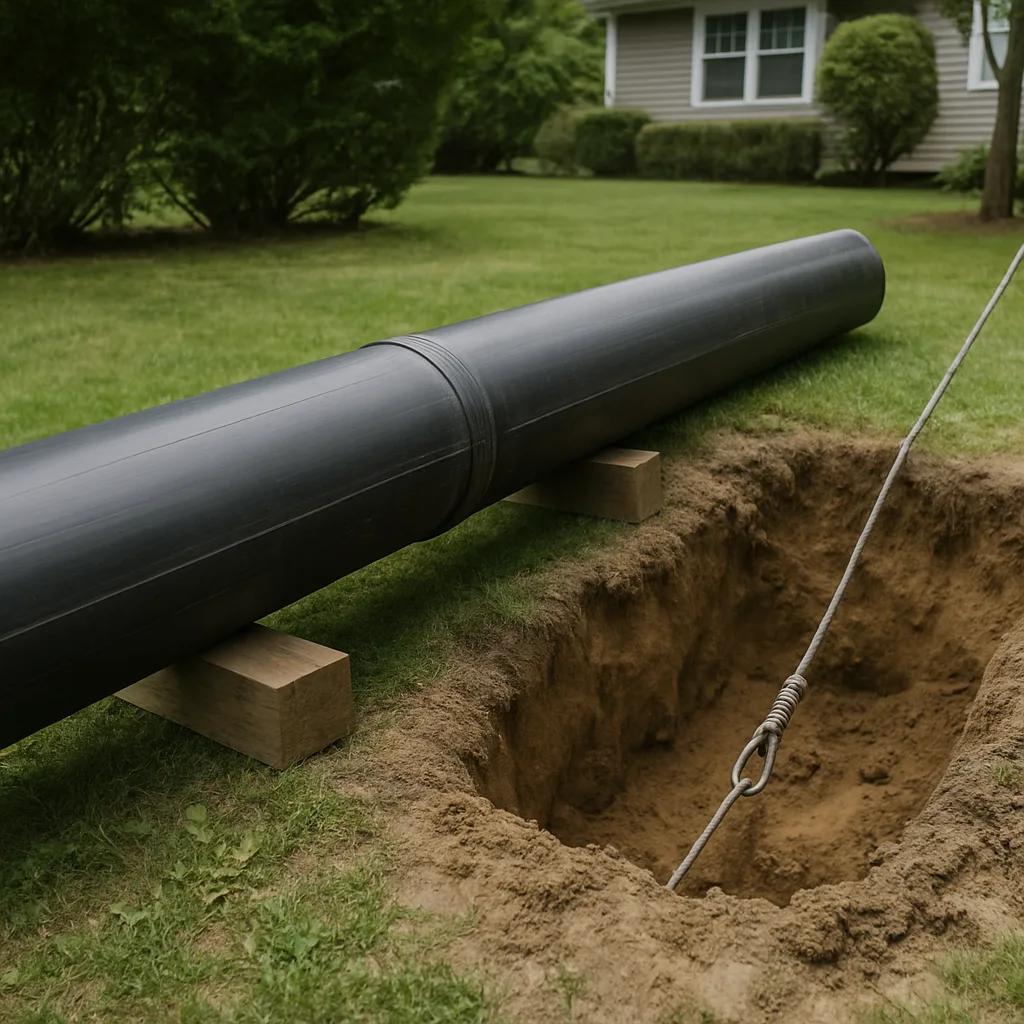
Pits are sized for the pulling rig and for the entry angle of the new pipe, which needs a shallow ramp rather than a vertical drop so the HDPE is not kinked going in. Both pits are opened, worked and backfilled inside the same one to two day visit. A deep pit gets shored, and in saturated ground it gets a pump running for the duration.
When Bursting Beats Lining
Collapsed and impassable pipe
A cured-in-place liner needs an open, roughly round host to press against. If the camera cannot pass, trenchless pipe lining is off the table. Bursting only needs enough of a path to thread the rod string.
Orangeburg past its shape
Orangeburg, the bituminized wood fiber pipe pressed and tarred ten miles away in Orangeburg NY and laid throughout Rockland into the early 1970s, fails by ovaling and blistering inward. The material is wood pulp bound with coal tar pitch, so it does not crack the way clay does. It softens, delaminates and takes a permanent oval under soil load. Once deformation passes what a liner can bridge, the pipe has to come out of service entirely, which is why Orangeburg pipe replacement around here is mostly a bursting job.
Undersized laterals that need upsizing
The head can be sized to upsize the run, typically 4 inch to 6 inch. Expanded postwar ranches in Monsey and Spring Valley carry far more fixture load than their original laterals were sized for, and bursting is the one trenchless method that hands back a bigger pipe.
Back-pitched and bellied runs
The new HDPE goes in under tension and bridges minor sags better than a liner, which simply copies the host’s shape. A severely back-pitched line still needs its grade reset by excavation at the low section.
Host Material and How It Bursts
| Host pipe | Behavior under the head | Verdict |
|---|---|---|
| Vitrified clay | Fractures cleanly into shards | Ideal |
| Orangeburg | Tears and folds outward | Good, the standard local case |
| Cast iron | Splits along the wall, wants a cutter-style head | Workable |
| Thin wall PVC or ABS | Deforms rather than splitting, may need a blade head | Case by case |
| Ductile iron, or a length encased in concrete | Will not fracture predictably | Expose and remove that section |
The concrete encasement case is the one that catches people out. A short length of newer pipe set in a concrete cradle during a repair decades ago will stop a bursting head cold. Repaired sections show as a material change on video, so they get planned around rather than discovered halfway through a pull.
The Pipe That Goes In: Fused HDPE
Lengths of high-density polyethylene are butt-fused into a single jointless string before the pull. The fusion machine faces both pipe ends square, heats them against a plate to melt temperature, then presses them together under controlled pressure and holds them while the joint cools, following the butt fusion procedure standardized by ASTM International. Each fusion is as strong as the pipe wall around it.
No gaskets, no bells, nothing for root intrusion to work open. That separates it from open-cut work, where SDR-35 PVC goes in with a gasketed joint at every stick. HDPE also tolerates minor ground movement, which matters in trench backfill that has been settling since the 1950s, and it carries the tensile load of the pull itself without pulling apart at a joint, which a gasketed pipe simply cannot do.
Wall thickness is specified as a dimension ratio. A heavier wall resists the scoring and drag of being towed through fractured clay. A lighter wall is cheaper and pulls more easily. That choice is made against pull length, host material and depth, not against price alone.
Bursting Under High Groundwater West of New City
West Nyack and the low ground along the Hackensack River wetlands sit on a high water table. Open trenches there need dewatering pumps running for the whole job and shoring against saturated walls. Bursting confines excavation to two pits that can be pumped fast and closed the same day, which is why the wet side of the county is where trenchless replacement pays off hardest.
The same saturated soil is what kills old pipe in the first place. Groundwater infiltration through cracked joints washes fines out of the bedding, the pipe loses its support, and bellied sections form. Seasonal swing in the water table is a normal feature of this landscape rather than an anomaly, as the USGS water science material on groundwater sets out, and a lateral sitting in and out of that water table since the Eisenhower administration has been loaded and unloaded thousands of times.
What Bursting Cannot Do
It cannot fix fall. The new pipe follows the old alignment, so a run laid at bad grade in 1958 comes back at bad grade in HDPE. Where the survey shows real back-pitch, the low section is opened and reset while the rest of the run is still burst.
It cannot work with no clearance. Bursting displaces soil outward, so a line running tight against a footing, a slab edge or another utility needs that stretch handled differently, usually by exposing it.
It cannot substitute for good connections. The foundation entry and the tap at the sewer main are remade as part of the job. A new pipe joined badly at either end is a new pipe with the old failure point still in it.
Pipe Bursting Cost in Rockland County
| Item | Typical range |
|---|---|
| Camera inspection and locate | $250 to $500, often credited against the work |
| Pipe bursting replacement | $6,000 to $15,000 |
| Sectional spot repair, where the rest of the line is sound | $1,500 to $4,000 |
| Open-cut replacement of the same line | Often 1.5 to 2x the trenchless price |
Length and depth set the baseline, since deeper pits mean more excavation and shoring. Upsizing, pavement over a pit location, and adding a two-way cleanout while the launch pit is open all move a job up the range. Aging buried infrastructure is a national problem, and the ASCE Infrastructure Report Card grades wastewater systems accordingly, but the piece a homeowner actually pays for is the lateral. A trenchless sewer replacement quote should be a fixed number produced by the camera pass, not an hourly guess.
Frequently Asked Questions
How big are the access pits?
Two pits, one at each end of the run, sized for the pulling rig and the pipe entry angle. Both are typically opened and closed within the one to two day job.
Can pipe bursting damage water or gas lines nearby?
The fracture zone around the head is small, but utility mark-outs and a sonde trace of the sewer's exact path and depth should come first. A crossing utility tight to the line must be exposed by hand before the pull.
Can you burst a line that has fully collapsed?
Usually, if a rod string can still be threaded through. Where the collapse is total, that point can be exposed to restore a path before bursting the rest of the run.
How much does pipe bursting cost in Rockland County?
$6,000 to $15,000 for most residential replacements, driven by length, depth and whether the line is upsized. Open-cut on the same line often runs 1.5 to 2 times more once excavation and restoration are counted.
How long does the job take?
One to two days including pit excavation, the pull, reconnection at the foundation and at the lateral tap connection to the sewer main, and the closing camera pass.