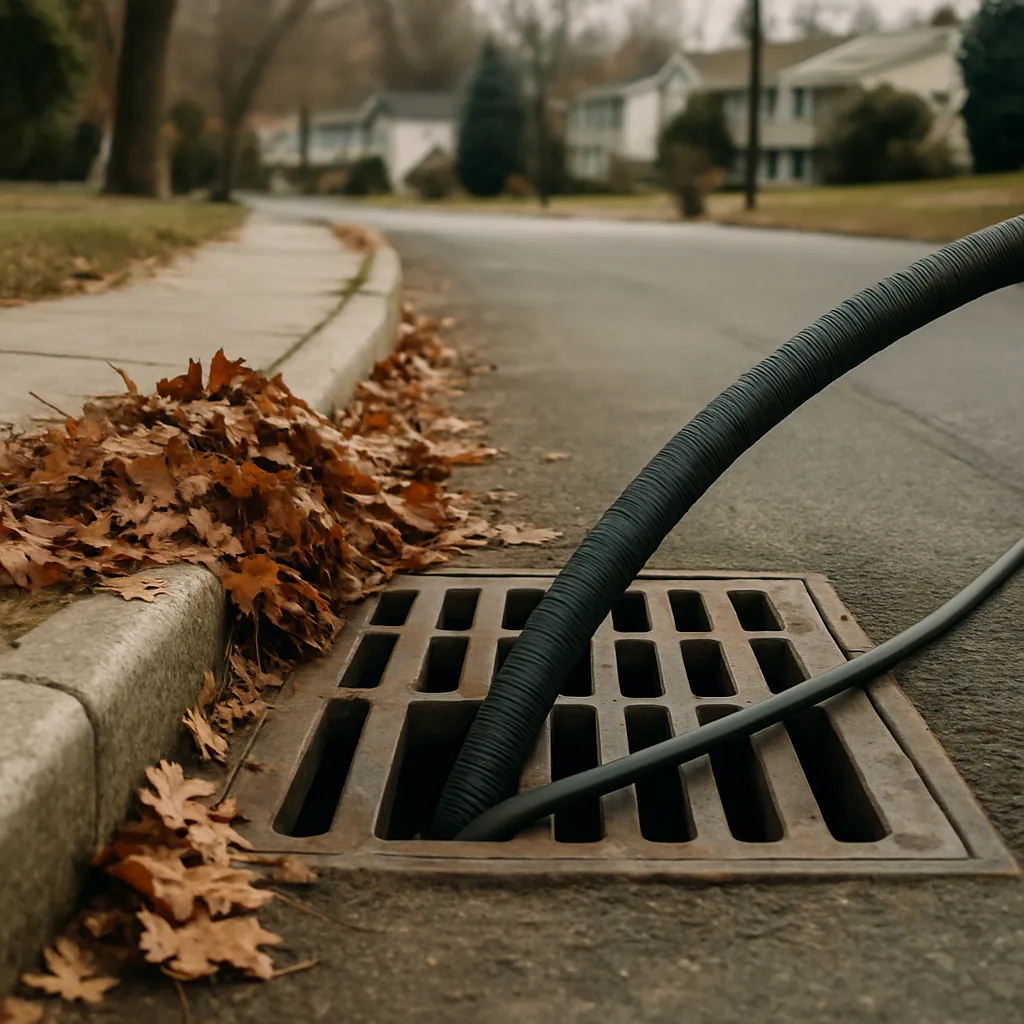
New City Trenchless explains repair options for failed storm drainage across Rockland County, including corrugated metal culverts, clay yard drains and buried downspout lines. Trenchless storm drain repair can use the same lining and bursting methods as sanitary work, applied to pipe that only carries flow when it rains.
The Storm Pipes Buried Under Rockland Properties
A typical property here carries more storm pipe than its owner knows about. Downspout leaders run roof water away from the foundation in corrugated poly or, on older homes, small-bore clay. Yard drains and catch basins collect low spots and feed buried laterals downhill. Driveway culverts, most often corrugated metal pipe, carry roadside ditches under the apron.
Newer installs use SDR-35 PVC or dual-wall corrugated HDPE. Because these lines sit empty most of the month, they can be half failed for years before a big storm makes it obvious, which is the opposite of a sanitary lateral that tells you about itself the first week it narrows.
Volume is the reason failures show up all at once. A 2,000 square foot roof sheds roughly 1,250 gallons of water in a one inch rainfall, and rainfall intensity in this part of the Hudson Valley regularly puts a large share of that through the leaders in under an hour. The National Weather Service rainfall records for the region are the reason drainage sized decades ago struggles now.
Storm Pipe Materials and How Each One Ends
| Material | Where it shows up | How it fails |
|---|---|---|
| Corrugated metal pipe (CMP) | Driveway culverts, road crossings | Rusts through along the invert first, then the barrel deforms |
| Vitrified clay | Pre-1960 yard drains, older village properties | Joints open, roots enter, sections shear on settlement |
| Single-wall corrugated poly | Downspout leaders, 1970s onward | Crushes under vehicle loads it was never rated for |
| Dual-wall corrugated HDPE | Modern yard and site drainage | Joint separation at couplings, deformation if poorly bedded |
| SDR-35 PVC | Modern laterals and area drains | Cracks at point loads, offsets where bedding washes out |
| Reinforced concrete pipe | Larger municipal storm runs | Joint failure and invert erosion over long service |
Knowing the material before the camera goes in changes the plan, because a rusted CMP invert and a rooted clay joint sit at opposite ends of the repair menu.
How Storm Lines Fail When Sanitary Lines Do Not
There is no grease blockage in a storm line. Its cargo is silt, roof grit, shingle granules and leaf litter, which settles out in any bellied pipe and packs hard. Corrugated metal culverts rust through along the invert first, the bottom arc where water stands between storms, and once the invert is gone the pipe is a half-round trough holding soil rather than carrying water.
Corrugated poly crushes under vehicle wheels it was never rated for. Roots hunt storm pipe aggressively, since a line that is damp at the joints but rarely full is exactly what root intrusion favors. And on Rockland’s sloped lots, settling fill pulls joints apart into offsets that snag debris on every storm.
Freeze-thaw does the rest. Storm pipe is shallow by design, often only twelve to eighteen inches of cover on a yard drain, which puts it inside the frost zone rather than below it. Every winter the ground lifts and drops around a pipe that has no flexibility left in its joints.
Cleaning Before Lining: Silt, Not Grease
A liner bonds to what it is pressed against, so a storm line has to come back to bare wall before anything is installed. The problem here is volume of solids rather than film on the wall. A partially failed culvert can hold hundreds of pounds of washed-in sand and gravel, and none of it dissolves.
Hydro jetting with a high-flow nozzle moves that material back to an open end where it is collected rather than pushed downstream into a catch basin someone else has to dig out. Where soil has washed into the line through a break, cleaning also tells you something important: the volume recovered is a direct measure of the void now sitting above the pipe, and that void is what eventually shows at the surface as a dip.
Lining and Bursting at Storm Diameters
The method set transfers from the sanitary side with two differences: diameters run larger, commonly 12, 15 and 18 inch on culverts against 4 and 6 inch laterals, and there is no flow to bypass, since the work simply gets scheduled between rains.
After cleaning, the line is inspected by sewer camera inspection with a locating sonde to map depth and position. A structurally sound run takes a full-length liner, and UV-cured fiberglass suits culvert work because it cures fast and predictably in cold pipe where ambient cure epoxy is slow. Liner wall thickness is still a design calculation, and for a culvert under a driveway the governing case is the wheel load above rather than groundwater outside.
One crushed barrel section takes a sectional point repair. A run collapsed beyond lining gets pipe bursting, with new HDPE pulled through the old alignment, which is the only trenchless option once the host pipe has lost its shape. Where the barrel is sound but the invert has rusted out, invert paving restores the bottom arc without a full liner.
When a Failed Storm Drain Looks Like a Landscape Problem
Most storm pipe failures get blamed on the landscape first. A soft dip or small sinkhole tracking above the pipe run means soil is washing into the line through a break. Ponding in a corner that used to drain, gravel washing out at the culvert ends, or a sheet of ice across the driveway every winter where a crushed leader forces roof water to the surface all point underground. So does a wet basement wall on the uphill side of the house.
Rockland’s short steep watersheds drop water fast toward the Hackensack headwaters and the Hudson, and the US Geological Survey explanation of runoff and infiltration is a fair description of what a broken storm line does to a lot: water that should have left in a pipe instead moves through the soil beside it. A camera inspection is the cheap way to learn whether your problem is grading or a broken pipe doing the ponding for you.
Keeping Storm Water Out of the Sanitary Lateral
The worst arrangement to inherit on a property is a downspout or sump line tied into the sanitary lateral. It looks like a solution and it is a fault, because clean water in a sanitary system is inflow: it fills the mains during exactly the storm hours when they have no spare capacity, and the surcharge comes back up somebody’s basement floor drain.
New York State drainage and water quality rules administered by NYSDEC treat storm water as its own stream for good reason, and municipal sewer codes here prohibit the connection. If your property has one, separating it is usually a modest job and it protects both your own lateral and the street.
Getting it right also matters on the older housing in the river villages. Properties in Nyack and Haverstraw commonly predate any organized storm system, so their roof water was discharged to a dry well, a splash block or the street, and later owners piped it into whatever line was closest. Sorting out which buried pipe is which is often the first useful hour of a drainage job.
What Storm Drain Work Costs
| Work | Typical range |
|---|---|
| Camera inspection and sonde mapping | $250 to $500, often credited against repair |
| Sectional point repair, one crushed section | $1,500 to $4,000 |
| Full-length lining of a culvert or yard line | $4,000 to $12,000 |
| Bursting a collapsed run in new HDPE | $6,000 to $15,000 |
Diameter, length, access at both ends and how much silt has to come out first decide where a job lands. Open-cut replacement of the same line generally runs 1.5 to 2x the trenchless price once excavation, driveway or patio removal and landscape restoration are counted.
Frequently Asked Questions
Can a driveway culvert be relined without breaking the driveway?
Usually, yes. If the culvert still holds its shape it is cleaned, then lined end to end working from the two open ends, with nothing above it touched. A section crushed fully flat cannot take a liner and needs bursting or a dig at that one spot.
Are downspout and yard drain lines worth lining?
It depends on what sits above them. Under a patio, walkway or mature tree, lining can avoid expensive restoration. A shallow line under open lawn may be cheaper to replace in an open trench.
What does it cost to find out what is wrong?
The same type of camera inspection used on sanitary lines, commonly $250 to $500. Storm lines are usually dry between rains, which can make for clear footage and a quick answer.
Can I tie my sump pump or downspouts into the sewer lateral?
No. Clean water piped into a sanitary lateral is inflow, it surcharges the mains during storms and it is prohibited in most municipal sewer codes. Roof and sump water belongs in a storm line or a dispersal point on your own property, and if a previous owner made that connection it is worth separating.
The town culvert at the road is failing. Is that mine to fix?
It depends where the failure is. The pipe under a residential driveway apron is generally the property owner's to maintain, while the roadway crossing and the ditch itself usually sit with the highway department. Confirm it with your town or village before spending anything, because the answer varies by municipality.