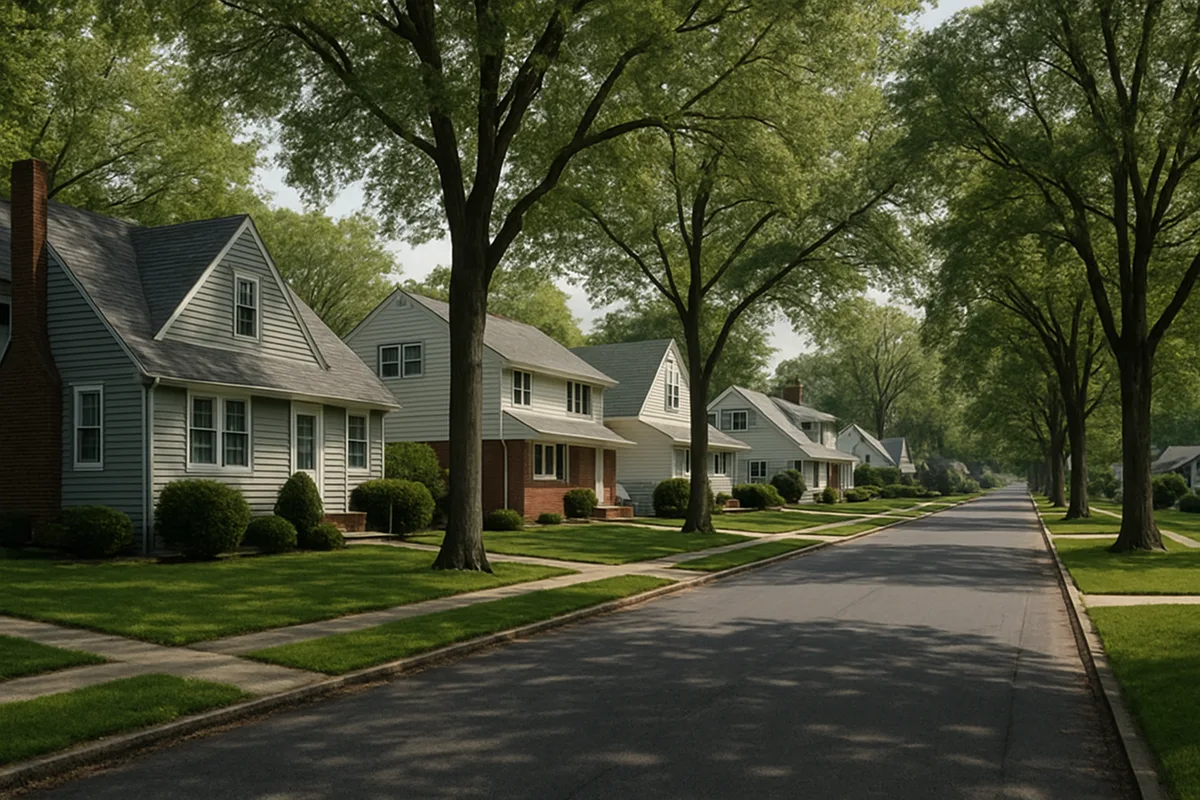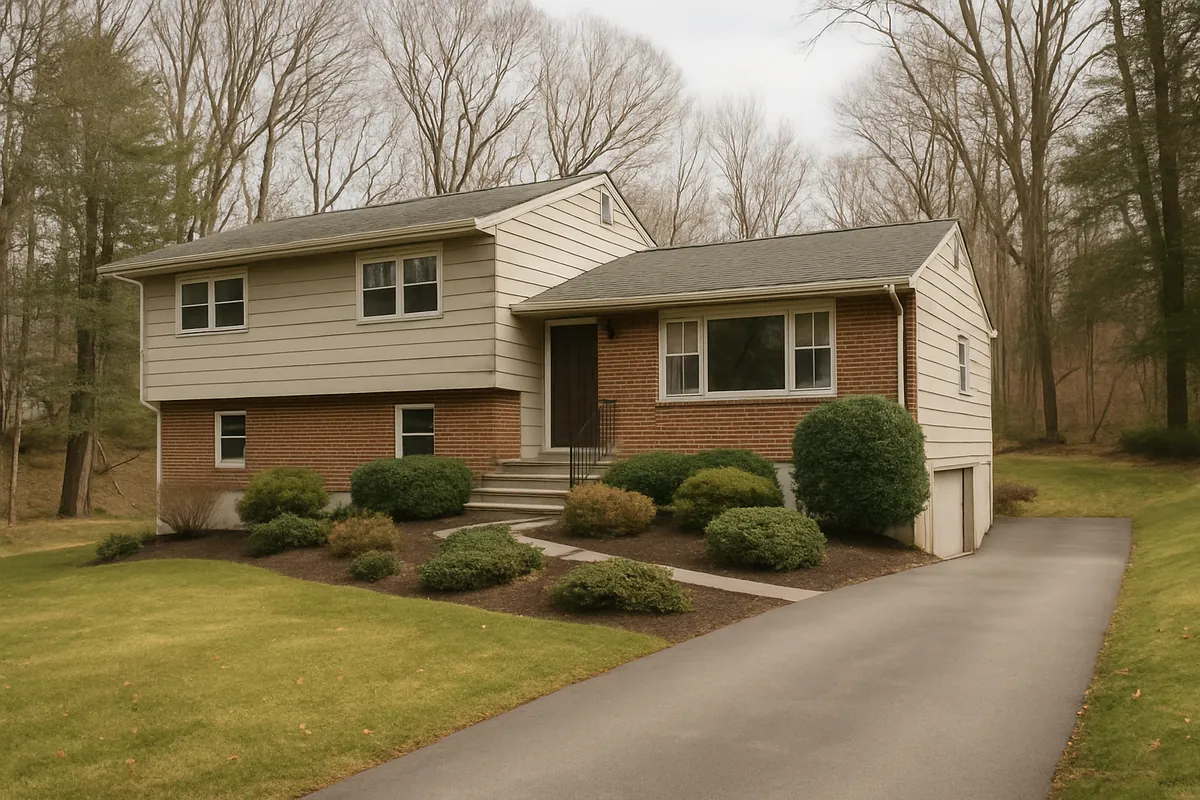
New City Trenchless covers replacement and upsizing options for overloaded sewer laterals in Monsey. Many 1950s and 60s ranches along the Route 59 and Route 306 corridors have been expanded while the original 4 inch clay lateral stayed unchanged. The mismatch between today’s houses and yesterday’s pipe is a defining sewer problem in this hamlet.
Ranches That Doubled While the Lateral Stayed Put
Monsey was farmland and summer bungalow colonies well into the 1940s, and the tract housing that filled it in afterward was modest by any standard. Three bedroom ranches and split levels, one full bathroom, one kitchen, and a builder’s 4 inch clay lateral run out to the street at whatever slope cleared the tap.
Almost none of those houses are still that house. The same lots now carry rear additions, second storeys, finished basements with their own bathrooms, and frequently a second kitchen. The framing changed. The electrical service was upgraded. The boiler has been replaced twice. The buried lateral is the one system nobody touched, because nobody could see it.
Plumbing codes size drains in fixture units, and an expanded Monsey home routinely pushes two or three times the fixture load the original run was sized, sloped and bedded for. The pipe did not get worse. The demand outgrew it.
Household Size Is a Hydraulic Fact Here, Not a Statistic
Monsey’s average household size runs far above the county and New York State averages, and census data makes that plain. That matters underground for a mechanical reason.
A buried lateral does not care how many square feet sit above it. It cares about gallons per day, solid load, and whether the run has enough carrying velocity in reserve to move that load to the main. Ten showers, several loads of laundry and a kitchen working most of the day is a completely different service condition from the two bathroom household the pipe was laid for, even though the pipe itself is identical.
That is why the same 1958 clay lateral behaves perfectly on a quiet street two blocks over and backs up monthly here. Diagnosing Monsey lines as if they were ordinary suburban lines is the mistake that produces four snaking visits a year.
Route 59 and Route 306: Built Out With Nowhere Left to Dig
The corridors along Route 59 and Route 306 hold Monsey’s most heavily developed parcels, and the practical consequence for sewer work is access. Front yards have been paved over for parking. Additions sit close to the side lot lines. Shared driveways, retaining walls, mature plantings and utility runs crowd the exact strip of ground an open-cut crew would need to occupy for a week.
Open-cut replacement on a lot like that often lands at 1.5x to 2x the trenchless price once excavation, restoration, repaving and landscape repair are counted, and the disruption outlasts the plumbing work by a wide margin. Trenchless replacement needs two small pits, one near the foundation and one near the tap, and leaves the ground between them alone. On the tightest Monsey lots that is not a preference. It is the only workable method.
Why Bursting Usually Beats Lining on an Overloaded Run
Cured-in-place lining is the default fix across much of Rockland County, and trenchless pipe lining is the right call on a sound, lightly loaded clay run. It has one property that matters here: the cured liner slightly reduces the host pipe’s inside diameter. On a line already running at its hydraulic limit, taking capacity away is backwards.
Pipe bursting is the one trenchless method that can make the pipe bigger. The bursting head fractures the old vitrified clay outward into the surrounding soil while towing in fused HDPE of the same or one larger diameter, so a 4 inch lateral can come back as a 6 inch lateral through the same two pits. Most residential pulls run $6,000 to $15,000 and take one to two days, and the house is back in service the day the new line is connected.
Where the camera finds a single failed joint on an otherwise adequate run, a sectional point repair may be more appropriate than replacing the full lateral.
What the Camera Rules Out Before Anyone Mentions Upsizing
Not every recurring Monsey backup is a capacity problem, and quoting an upsize before checking would be indefensible. Root intrusion at clay joints, a bellied section holding solids, heavy scale in the cast iron stub under the slab, or a broken tap connection out at the main can each produce symptoms that look exactly like an undersized line.
A sewer camera inspection at $250 to $500, usually credited against the work, takes about an hour and separates a load problem from a defect problem before any method is priced. Where the line is dirty enough to hide its own condition, hydro jetting goes in first so the camera reads bare pipe wall instead of grease.
Houses with no accessible cleanout get a two-way cleanout added as part of the work. In a household that cannot spare a day of guesswork access, that is the difference between a future inspection taking an hour and taking an afternoon.
Monsey Build Era and the Pipe You Probably Have
| Build era | Likely lateral material | Usual failure mode |
|---|---|---|
| 1945 to 1960 | Vitrified clay tile, some bituminized fiber | Root intrusion at every mortared joint, offsets |
| 1960 to 1972 | Clay tile, fiber pipe on budget builds | Fiber deforms out of round, clay cracks and sags |
| 1972 to 1990 | Cast iron stub under the slab, plastic to the street | Cast iron channeling and scale, bellies in poorly bedded plastic |
| 1990 onward, and most additions | SDR-35 PVC | Offset gasketed joints, settlement bellies |
The row that catches people out is the last one. A 2005 addition was plumbed in modern PVC, but that new branch was almost always tied into the original 1958 lateral a few feet outside the foundation. New pipe upstream does not upgrade old pipe downstream.
Who Owns Which Pipe, and What Actually Helps
Monsey sits in the Town of Ramapo, and the sewer main under the street is maintained by Rockland County Sewer District No. 1. The lateral from your foundation out to the tap on that main is the property owner’s, tap connection included, and that is where most residential repair questions arise.
Trimming indoor water use buys a marginal line some time, and the fixture guidance at EPA WaterSense is a reasonable starting point, but it does not fix a pipe that has run out of capacity. Work in neighboring Spring Valley, Airmont and Nanuet runs on the same county main and the same ownership rule, on housing that mostly was not expanded the way Monsey’s was.
Frequently Asked Questions
Can you increase my sewer line size without digging up the yard?
Yes. Pipe bursting pulls in new HDPE of the same or one size larger diameter while breaking the old pipe outward, working from two small pits. A 4 inch lateral typically comes back as 6 inch, at $6,000 to $15,000 for most residential lines.
Why does my line back up again a few weeks after snaking?
A snake pokes a hole through the blockage but leaves grease and scale on the wall, and on an undersized or flat-sloped lateral the deposits rebuild fast. Hydro jetting cleans further, but only upsizing or repairing the pipe changes the pattern.
Does a home addition require a bigger sewer lateral?
Not automatically. It depends on the total fixture load and the condition of the existing line. A camera inspection plus a fixture count gives a real answer before anyone proposes work.
Is the sewer line my responsibility or the Town of Ramapo's?
The main under the street is maintained by Rockland County Sewer District No. 1. Everything from your foundation wall out to the tap at that main, including the tap connection itself, belongs to the property owner. Most residential repair questions involve that private lateral.
My front yard is fully paved for parking. Can you still work on the line?
Often, yes. Trenchless work needs an entry pit near the foundation and an exit pit near the tap, so the paving between them can remain in place.