New City Trenchless explains sewer line repair under a slab by rebuilding the pipe from its ends: an epoxy-saturated liner installed through a cleanout or one small access pit, so the finished floor over the run may not need to be opened. In Rockland County’s split-levels and ranches, the pipe under the slab is often original cast iron that has been inaccessible since the floor was poured.
Why the Slab Comes Up Last, Not First
A finished basement sits on top of that pipe: tile, laminate, a workshop slab, in newer pours sometimes radiant heat loops. Chasing a failure by breaking concrete means demolition dust through the whole floor, spoil carried out through the house, and a patch that never quite matches the surrounding slab.
The concrete itself is the cheap part. A 4 inch residential slab comes out with a hammer and a saw in a morning. What costs money is everything above it and the fact that the pipe usually sits two to three feet below the underside, so the opening has to be wide enough to work a trench in, not just wide enough to see the pipe.
Trenchless flips the order of operations. Prove exactly where and what the failure is first, repair through existing openings second, and cut the floor only if the pipe’s geometry forces it.
Mapping the Run Before Anything Is Cut
The camera goes in first, carrying a locating sonde broadcasting at 512 Hz, a standard frequency used through concrete and fill. From above, a technician traces the line’s path and depth while logging the house trap, wye fittings and lateral connection.
Footage counters on the reel tie every defect to a distance from the cleanout, and defects get coded to NASSCO’s PACP scheme so a crack, a fracture and a full break are not all filed as “bad pipe”.
The map is what turns “the pipe is somewhere under the family room” into a mark on the floor accurate enough to plan around. Our full sewer camera inspection process is the same one used for scheduled work, and the $250 to $500 fee is often credited against the repair.
What Is Actually in the Concrete Above the Pipe
Before anyone cuts, it matters what is in the pour. Postwar basement slabs here are typically 3.5 to 4 inches of concrete over a gravel base, often with no vapor barrier at all. Slabs poured from the 1990s on usually have polyethylene sheeting underneath and welded wire mesh or fiber reinforcement in the mix.
Newer finished basements and additions can carry PEX radiant heat loops, and some slabs have electrical conduit run through them. A blind cut over a heat loop turns a sewer job into a heating job. Scanning the cut line and knowing where the manifold runs is part of the work, not an extra.
Below the slab, the news is better. The drain was laid in an open trench and bedded in sand or stone before the pour, so once the concrete is off, the pipe is sitting in loose granular bedding rather than in the compacted native clay you fight out in the yard.
Repairing a Pipe You Can Only Reach from Its Ends
Inverted lining through a cleanout
A felt liner tube saturated with epoxy resin is turned inside-out into the line from an inversion drum, pressed against the host pipe by a calibration tube, then cured. The cured wall is a standalone structural pipe designed under ASTM F1216, the standard that governs cured-in-place rehabilitation, so it does not lean on the old cast iron for strength.
Pull-in-place between two access points
Where both ends of the failed section can be reached, the liner is winched into position between them and cured. This suits the common case where only the run between the stack and the foundation wall has failed and the rest of the lateral is sound.
Sectional point repair
One bad joint under the footprint takes a short sleeve over that joint alone, cured in place without touching the rest of the run. After any cure, a robotic reinstatement cutter reopens branch connections from inside the pipe, on camera, with no digging over the fitting.
Cure Methods Indoors, and Why Steam Changes the Day
Soil under a Rockland basement slab sits near 50 degrees year round, and cold pipe slows an ambient cure badly. Ambient works fine on a short sectional sleeve. On a full run it can hold the drain out of service far longer than a household wants.
Steam cure circulates hot vapor through the calibration tube and brings a full lateral to strength in hours, which is what makes a one-day under-slab job realistic. UV-cured fiberglass liners cure faster still with no heat and no steam venting to manage, at higher material cost, which is why they show up more on commercial work than in a house.
Indoor work adds one thing yard work does not: ventilation. Curing resin has an odor, so the work area gets air moved through it and open drain connections get capped.
Where the Access Pits Actually Go
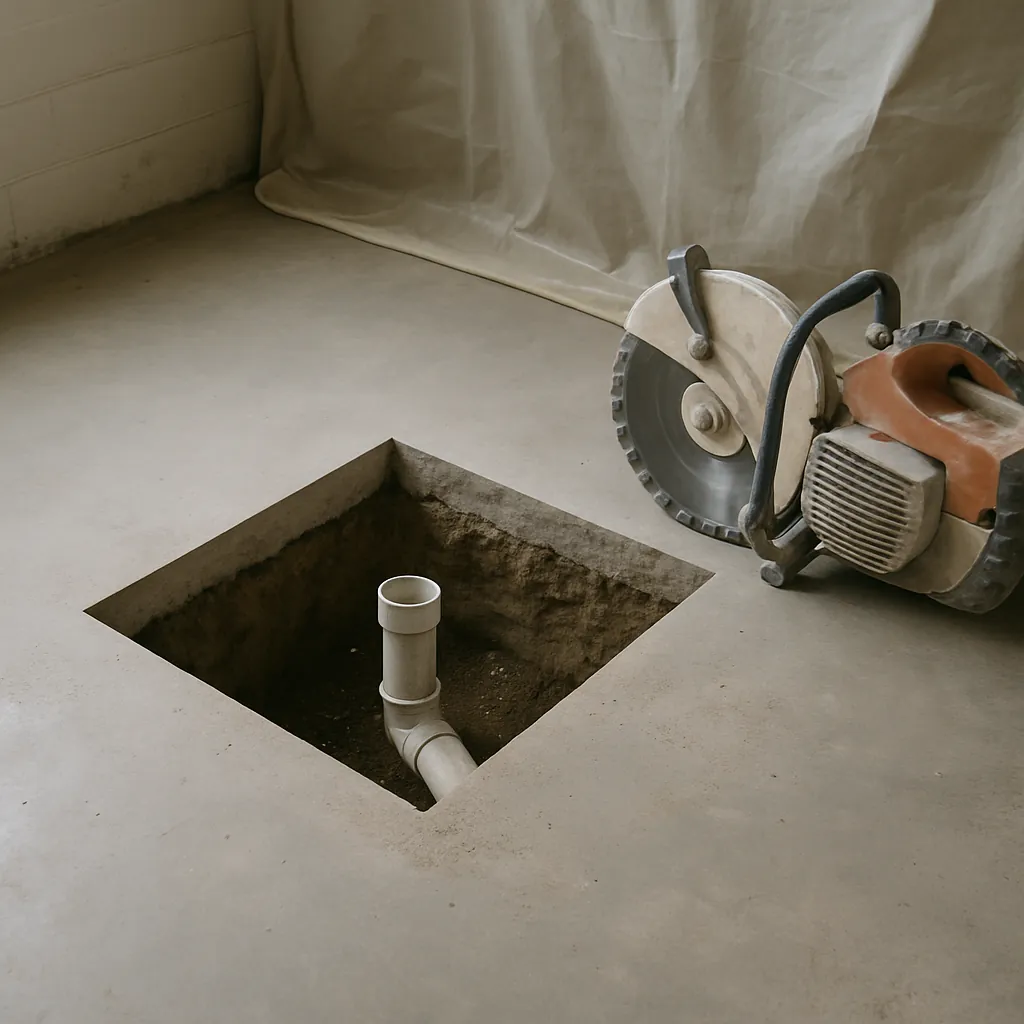
First choice is no pit at all: an existing cleanout or two-way cleanout is the entry. Second choice is a small pit outside the foundation wall, at the marked point where the interior pipe exits the footprint. Last resort is a single precise floor opening over a fitting, a couple of feet square, cut where the sonde says and nowhere else.
Pit placement comes off the map, never off a guess. An exterior pit in Bardonia or Congers also has to clear the footing and stay out of the frost-heave zone, which is why the depth reading matters as much as the position.
Cast Iron Under Rockland Slabs, Orangeburg Beyond Them
Postwar builders here ran cast iron pipe under the footprint and switched materials at the foundation wall, to clay tile or to Orangeburg pipe from the factory ten miles away in Orangeburg NY. Under the slab, cast iron fails by channeling: the invert erodes away along the waterline while the visible crown still looks sound, and scale buildup narrows what remains. That is a wall-loss failure, not a joint failure, and it is exactly what cast iron pipe lining rebuilds in place.
Out in the yard, the Orangeburg run fails on its own schedule, deforming out of round and delaminating rather than cracking. A deformed Orangeburg lateral cannot hold a liner, so it gets burst. That is why a common under-slab job in New City is a hybrid: line the interior cast iron with trenchless pipe lining, then use pipe bursting to pull new HDPE through the yard section in the same mobilization. One crew, one day, two different failures answered correctly.
What Lining Cannot Fix Under a Slab, and What It Costs
A liner follows the host pipe exactly, so a bellied pipe or a run that has lost its fall stays that way inside the new liner. When the camera shows standing water in a low spot under the footprint, the honest recommendation is a targeted floor opening at that section, not a liner over the problem.
| What the camera shows | Correct answer | Floor opened? |
|---|---|---|
| Channeled or scaled cast iron, shape intact | Full-length lining | No |
| One cracked or offset joint | Sectional point repair | No |
| Belly holding water under the footprint | Open that section, regrade the pipe | Yes, at that section only |
| Collapsed or crushed run | Bursting, or open-cut if under the footprint | Depends on location |
Ownership is worth knowing before you spend anything. Rockland County Sewer District No. 1 maintains the mains, and the lateral from the house to the tap is yours, including every foot of it under your own concrete.
| Job | Typical range |
|---|---|
| Camera inspection and sonde mapping | $250 to $500, often credited against repair |
| Sectional point repair | $1,500 to $4,000 |
| Full lateral lining | $4,000 to $12,000 |
| Pipe bursting the yard run | $6,000 to $15,000 |
Open-cut through a finished floor typically lands at 1.5 to 2x the trenchless price for the same line once concrete removal and floor restoration are counted.
Frequently Asked Questions
Can you fix a sewer pipe under a slab without breaking the concrete?
Usually, yes. If the pipe still holds its shape and grade, a liner installed through a cleanout or a small exterior pit rebuilds it in place and the floor never gets opened. The cases that need concrete cut are geometry problems: a belly or a back-pitched run that a liner cannot correct.
How do you know where the pipe runs under the slab?
A camera carrying a locating sonde travels the line while a technician traces its signal from above. The route, fittings and failure point should be marked on the slab before any decision about access is made.
What if the camera shows a belly under the slab?
Then lining is the wrong answer. A liner follows the host pipe exactly, so a low spot holding water stays low inside the new liner. A bellied section under the footprint calls for a targeted floor opening and regrading.
Does under-slab repair cost more than repair out in the yard?
The trenchless ranges are the same, $1,500 to $4,000 for a sectional repair and $4,000 to $12,000 for full lining, because the work happens from the ends of the pipe either way. The difference only appears if the floor has to be opened, which is exactly what the method is built to avoid.
Can we stay in the house while the pipe under the slab is lined?
Yes in most cases. The drain is out of service for the working day, so plan around that, and the work area gets ventilated because resin has an odor while it cures. If a section of floor does have to be opened, that room gets sealed off for dust control and the rest of the house stays usable.