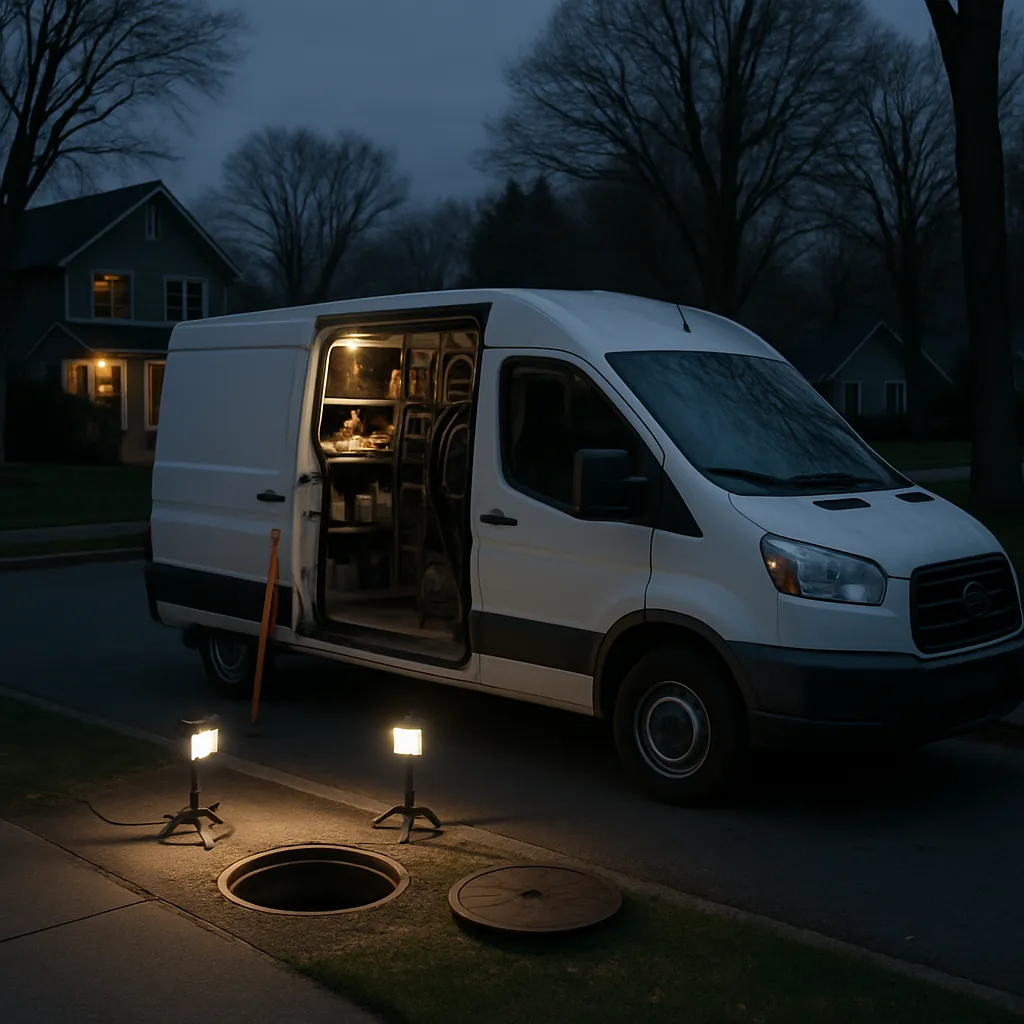
New City Trenchless explains the safer order for emergency sewer repair: open the blocked lateral with a drain auger or hydro jetter, restore flow, then run a CCTV camera through the line before anyone discusses replacement. That order protects against authorizing an urgent excavation for a problem a sectional point repair might solve.
What Counts as a Sewer Emergency and What Can Wait for Daylight
Sewage coming up is the line. If wastewater is rising in the lowest fixtures in the house, usually a basement floor drain, laundry sink or ground-floor shower, the lateral is fully blocked and everything used upstairs ends up on the basement floor. The same goes for sewage surfacing in the yard over the pipe run, or a house trap overflowing in an older basement.
One slow sink, an occasional gurgle, or a single fixture backing up while the rest drain fine is a problem, not an emergency. Book it for daytime and skip the after-hours pricing.
Reading the Fixtures Before Anyone Arrives
Where the water shows up narrows where the blockage is, and it costs nothing to check. Wastewater always surfaces at the lowest opening upstream of the obstruction, so a basement floor drain filling while the upstairs toilets still flush normally means the blockage sits downstream of everything, out in the main lateral.
A few patterns are worth knowing:
- Flush a toilet, the tub gurgles or backs up. Two fixtures sharing a branch, blocked below where they join. Usually a branch line, not the lateral.
- Every fixture on the ground floor is slow, upstairs is fine. The lateral is restricted but not sealed. Often roots or grease narrowing the bore rather than a hard plug.
- Nothing drains anywhere and water rises when the washing machine discharges. Full lateral blockage. Stop using water immediately, because a washer dumps thirty gallons in a couple of minutes.
- It only backs up during or after heavy rain. That points at groundwater getting into the system or the main surcharging, not at a clog in your pipe.
What to Do While the Water Is Still Rising
- Stop all water use. No flushing, no laundry, no dishwasher. The blockage is downstream of every fixture in the house.
- Keep people and pets away from standing sewage and anything it has soaked. Wastewater carries bacteria and viruses, and the New York State Department of Health guidance on contaminated water applies indoors as much as it does after a flood.
- Kill power to anything the water can reach, and do not stand in it to do so.
- Find your cleanout if you know where it is, usually a capped pipe near the foundation or out in the front lawn, and clear access to it.
- Ask the neighbors. If houses on both sides are backing up at once, the problem is the sewer main, not your lateral, and the call goes to the town or to Rockland County Sewer District No. 1 through Rockland County rather than to a contractor.
- Photograph the damage before cleanup starts, because most insurers want it.
Relief First, Diagnosis Second, Repair Last
The first job on site is flow. A drain auger handles a soft stoppage such as a grease blockage or a root mat near the cleanout, and on a 4 inch lateral it is run with a full-size cutter head rather than a small drum machine, because a small cable punches a hole through a root mass and leaves the mass in place.
Heavier work goes to a hydro jetting unit, which strips scale and packed roots off the full circumference of the wall and flushes the debris downstream instead of boring a channel through it. Either way, the goal of the emergency visit should be a working line, not a signed replacement contract.
The camera comes next, in daylight if the line is holding. A CCTV inspection with a locating sonde shows exactly why the lateral blocked, and the failure gets marked for depth and position from the surface so any repair is priced on facts.
| What the camera shows | Why it blocked | The permanent answer |
|---|---|---|
| Root mass at a clay joint | Open joint feeding roots water | Lining, or spot repair at that joint |
| Grease and scale on cast iron | Rough, narrowed bore | Descaling then lining |
| Offset joint snagging solids | Ground movement or settlement | Sectional point repair |
| Belly holding water | Lost fall, solids settle out | Excavate and regrade that section |
| Orangeburg squeezed out of round | Material delamination | Pipe bursting, lining will not hold |
| Full collapse | End of service life | Bursting or open-cut replacement |
Why Replacements Should Not Be Sold at Midnight
A blocked line at 2 a.m. is the classic setup for pressure sales, and homeowners routinely agree to full excavations that footage would never have justified. No permanent repair should be quoted until the camera has run, and the ranges on the sewer line repair cost page do not change because the call arrived after midnight.
If the footage shows one failed joint, the answer is a sewer spot repair, not a whole-line project. If it shows a collapsed pipe, you will see the collapse on screen before deciding anything. You should also expect to be told when the correct next step is not ours to sell, which is regularly the case when the problem turns out to be in the main.
Why Rockland Emergencies Cluster in Certain Weeks
Backups are not evenly spread across the calendar here, and the pattern is physical rather than mysterious.
Late summer and early autumn bring the root calls. Rockland’s mature street trees are drawing hard in dry weeks, and a leaking clay joint is the wettest, warmest thing in the soil column, so root intrusion accelerates exactly when rainfall is lowest and flow in the lateral is thinnest.
Heavy rain brings the second cluster. On low-lying streets in the river villages, from West Nyack down to Piermont, a high water table and a surcharged main can push flow back up a lateral that has nothing wrong with it at all. Groundwater entering a collection system through cracked pipe and open joints is the mechanism behind the overflows tracked under the EPA’s discharge permit program, and your basement is simply the lowest opening it can find.
Deep winter brings the third. Frost depth in Rockland runs to roughly the standard 42 inch footing depth used in the region, and freeze-thaw cycling moves shallow bedding, which is what turns a joint that was merely open into a joint that is offset. Holiday cooking grease then arrives at the newly narrowed pipe on schedule.
When the Same Emergency Keeps Coming Back
A backup that returns weeks after each snaking is a pipe problem wearing a clog costume. Roots that regrow mean open joints that lining would seal for good, which is the whole point of our tree root removal work being followed by a structural repair rather than a repeat visit.
Repeated basement flooding during heavy rain can mean the main is surcharging and pushing flow back up your lateral, which calls for a backwater valve on the building drain rather than any pipe repair at all. A valve is a mechanical device with a flapper that has to be accessible and serviced, so it gets installed with a proper access chamber, not buried.
The camera tells these situations apart in one visit, and because the correct fix for each is different, guessing is the expensive option. Recurring backups also carry a cost the invoice never shows, since every episode that reaches finished space is another cleanup of the same room.
Frequently Asked Questions
Is a sewage backup in the house dangerous?
Treat it as contaminated. Keep children and pets away, avoid skin contact, and disinfect or discard anything porous it touched. Stop using water until flow is restored; every flush upstairs adds to the flood.
Will you replace my sewer line the same night?
No, and be wary of anyone who will. The emergency visit restores flow. A permanent repair should be scoped from camera footage and scheduled after you have reviewed the evidence.
What does an emergency sewer call cost?
The relief work depends on what it takes to open the line. The camera inspection that follows runs $250 to $500 and is often credited against repair work. Permanent repairs follow the same ranges as scheduled work, from $1,500 to $4,000 for a spot repair up to $6,000 to $15,000 for pipe bursting.
My neighbors are backing up at the same time. Is that still my problem?
Probably not. Simultaneous backups on several houses point to the sewer main, which belongs to the municipality or to Rockland County Sewer District No. 1, so report it to them. A quick camera pass can confirm your own lateral is clear if there is any doubt.
The line was snaked last month and it has backed up again. Why?
Because a cable clears the blockage, not the defect that caused it. Roots regrow through the same open joint, grease recoats the same rough wall, and solids resettle in the same belly. When the interval between backups is shrinking, the pipe is telling you it has a structural problem that cabling cannot reach.