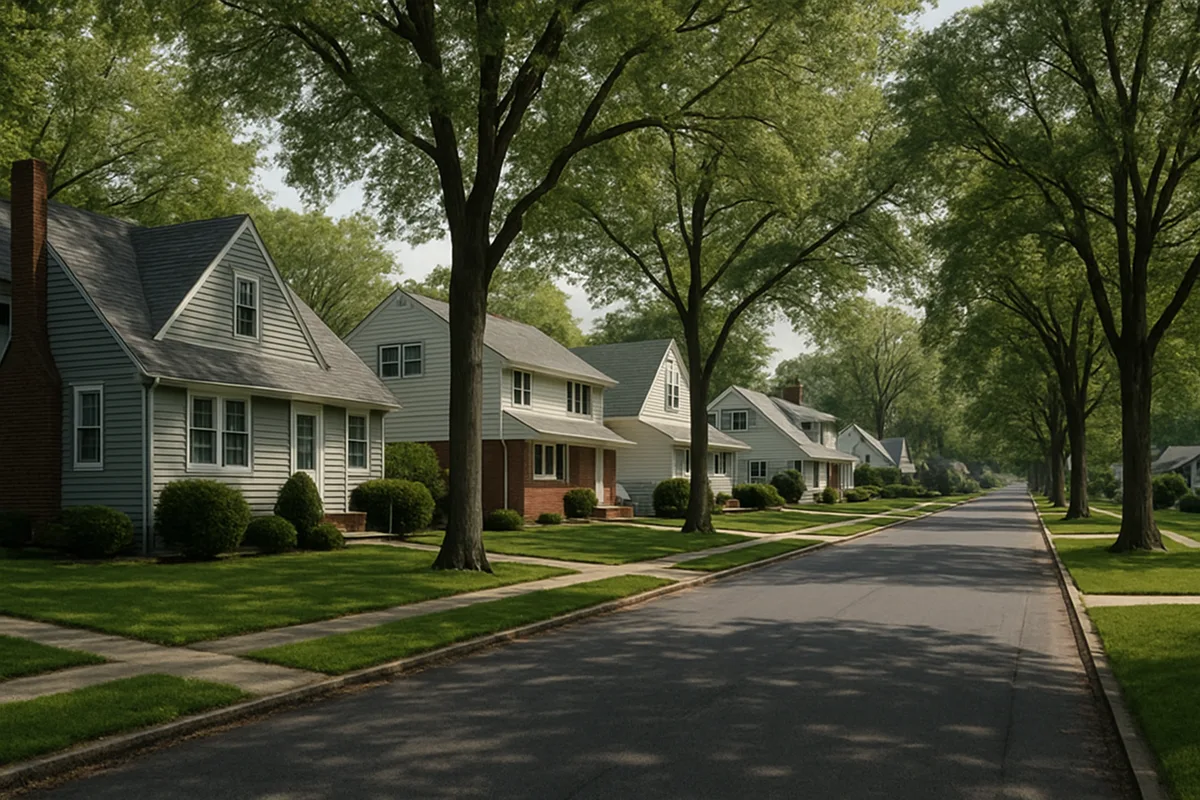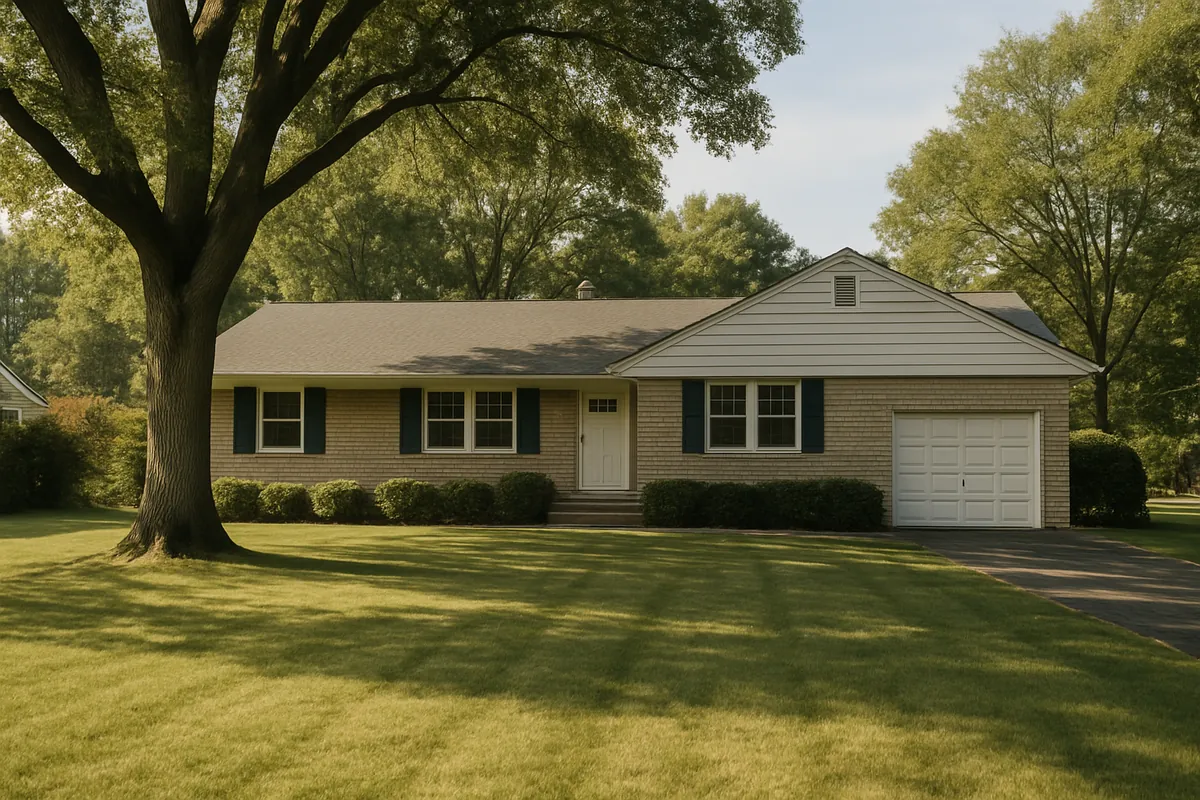
New City Trenchless covers trenchless sewer repair for the incorporated Village of Chestnut Ridge, home to roughly 11,000 residents within the Town of Ramapo in Rockland County. The village’s housing stock is a mix of mid-century ranches, splits and later additions, and the laterals underneath split mainly between vitrified clay and cast iron. Both materials respond well to trenchless methods, which is the main reason a camera-first approach, rather than an assumption about age, drives most repair decisions here.
A Village Built in Waves
Chestnut Ridge grew up as part of the broader postwar expansion of the Town of Ramapo, with ranch and split-level construction filling in through the 1950s and 60s and additional building continuing well past that. The result on the ground today is a village where a single street can hold a 1958 ranch beside a 1978 addition-heavy colonial, and the sewer lateral under each one was sized and installed to the standards of the decade it was built in, not the decade a later addition arrived in.
That matters because a house that has been expanded, with an added bathroom, a finished basement or a rear addition tied into the original line, is often carrying more fixture load than the builder’s clay or cast-iron run was sized for. A camera inspection is what separates a capacity problem from a simple joint or material defect before any repair gets priced.
Clay Joints, and Cast Iron That Fails From the Inside
Vitrified clay tile under Chestnut Ridge’s postwar housing was laid in short sections with a mortared joint every few feet, and those joints are where almost every clay failure starts: a joint separates slightly, lets in moisture and root hair, and over years the gap widens into an entry point. Trenchless pipe lining is the standard fix for a clay run that is still structurally round, since the cured-in-place liner seals every joint in the run at once rather than patching one point and leaving the rest of the line exposed.
Cast iron shows up under older portions of the village and under additions from eras when iron stub pipe was still standard practice closer to the foundation. It does not fail at joints the way clay does; it fails from the inside, as tuberculation and scale build inward and channeling wears a trough along the pipe’s invert. Cast iron pipe lining restores a structurally sound cast-iron run without removing it, as long as the pipe still holds its round shape and enough wall thickness to bond a liner to. Cast iron that has channeled through the wall or lost its shape has nothing left to line against, and that is a pipe bursting job instead.
Protecting Driveways and Established Landscaping
Chestnut Ridge lots tend to carry mature landscaping and, on many properties, a paved driveway running close to the path a lateral would naturally take to the street main. Open-cut replacement needs a continuous trench the length of that run, which on a developed lot usually means removing some of the driveway, cutting through root zones under established trees, and rebuilding whatever sat in the trench’s path, at 1.5 to 2 times the trenchless price once excavation and restoration are counted.
Trenchless lining and bursting both need only two small access pits, one near the foundation and one near the tap connection at the main, leaving the ground between them, driveway included, untouched. On a lot where the driveway and landscaping represent a real investment, that is usually the deciding factor in choosing a trenchless method over an open trench.
Symptom Patterns That Point at Clay vs. Cast Iron
| Symptom pattern | More likely clay | More likely cast iron |
|---|---|---|
| Backs up on a predictable schedule, worse after rain | Root intrusion at joints | Less common, iron has no joints to leak through |
| Slow drains that never fully clear | Belly holding standing water at a sagged joint | Scale narrowing the bore from the inside |
| Multiple fixtures slow at once, gradually worsening | Root mass growing across a joint | Tuberculation building up along a long run |
| Sudden total stoppage | Collapse at a crushed or offset section | Channeling has worn through the invert |
That table is a starting point, not a diagnosis. Both materials can produce overlapping symptoms, especially once an addition has changed the fixture load on an older run, and the camera is what actually confirms which pattern applies to a given house.
Additions and the Fixture Load They Add
A number of Chestnut Ridge homes have grown since their original construction: a finished basement with its own bathroom, a second kitchen, a rear addition with an extra half bath. Each of those adds fixture units to a lateral that was sized, sloped and bedded for the household the builder expected, not the household living there now.
The pipe itself does not need to have failed for this to matter. A sound clay or cast-iron run that was adequate for a three-bedroom ranch with one bathroom can run close to its hydraulic limit once a house has doubled its fixture count, and a line running near its limit backs up far more easily from an ordinary grease or paper buildup that a less-loaded line would carry through without incident. Where that is the pattern, pipe bursting can both replace an aging run and upsize it in the same pass, since the bursting head fractures the old pipe outward while towing in new HDPE of the same or a larger diameter through the same two pits.
The Camera Comes Before the Method, Every Time
A sewer camera inspection at $250 to $500, usually credited against the repair, reads the pipe’s actual material, its depth, its cross-section and the footage of any defect. That is the only reliable way to know whether a Chestnut Ridge lateral is clay or cast iron, whether it still holds its shape, and whether the problem is a single failed joint or a pattern of distributed defects along the run.
From there, the method follows the footage, all under the umbrella of sewer line repair and replacement. A single failed joint on an otherwise sound line is a sectional spot repair at $1,500 to $4,000. A structurally round clay or cast-iron run with distributed joint failure or interior scale is a candidate for lining at $4,000 to $12,000. A line that has collapsed, gone out of round, or needs more capacity than the original run provides goes to pipe bursting at $6,000 to $15,000. Every figure here is a typical planning range, not a bid; the actual quote follows the camera footage.
Chestnut Ridge in Rockland County Sewer District No. 1
Chestnut Ridge sits inside Rockland County Sewer District No. 1, which maintains the mains under the village’s streets. The lateral from your foundation out to the tap connection on that main, tap included, is the property owner’s responsibility, and that is where nearly every residential repair question in the village actually starts.
Housing patterns in neighboring Monsey and Suffern run on the same county main and the same ownership rule, and Pomona a short drive west shares much of the same clay-and-Orangeburg lateral mix on more wooded, sloped ground. A camera inspection is the fastest way to find out which pattern applies to a specific Chestnut Ridge lot. Nearby Tallman shares the same clay-and-cast-iron lateral mix on smaller, more open mid-century tract lots inside the Town of Ramapo, and the older village core down the hill calls for sewer line repair in Spring Valley on pre-1960 pipe older than most of Chestnut Ridge’s.
Frequently Asked Questions
What kind of sewer pipe is typically under a Chestnut Ridge home?
Most of the village's mid-century housing sits on vitrified clay tile, laid in short sections with a mortared joint every few feet. Some older stock and a number of additions carry cast iron instead, which fails from the inside out as it channels and scales. A camera inspection identifies which one is under a given house before any method is priced.
Can a driveway or mature landscaping stay in place during trenchless work?
Usually, yes. Both lining and pipe bursting need only two small access pits, one near the foundation and one near the tap at the main, so a paved driveway, a retaining wall or established plantings between those two points can stay undisturbed.
How much does trenchless sewer repair cost in Chestnut Ridge?
Typical planning ranges are $250 to $500 for the camera inspection, $1,500 to $4,000 for a sectional spot repair, $4,000 to $12,000 for a full lateral lining, and $6,000 to $15,000 for pipe bursting. Those are ranges, not bids; the camera footage determines the actual quote.
Is the sewer lateral my responsibility or the village's?
The main under the street is maintained by Rockland County Sewer District No. 1. The lateral from your foundation out to the tap connection on that main is the property owner's responsibility, tap included, and that private section is where most residential repair questions come from.
Does cast iron under my house need to be replaced, or can it be repaired trenchlessly?
Cast iron that still holds its round shape and has enough sound wall left to bond to is a strong candidate for cast iron pipe lining. Cast iron that has channeled through the wall or lost its shape has nothing left to line against and needs pipe bursting instead. The camera makes that call before a price is set.