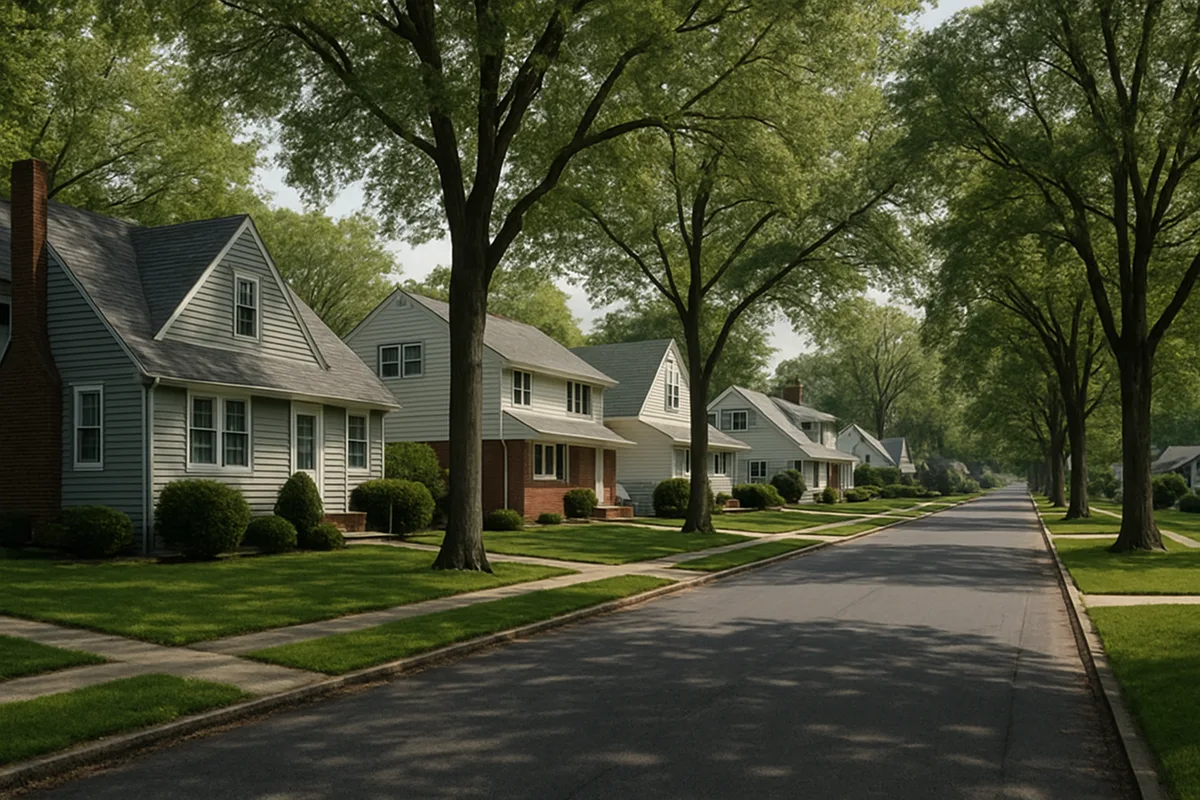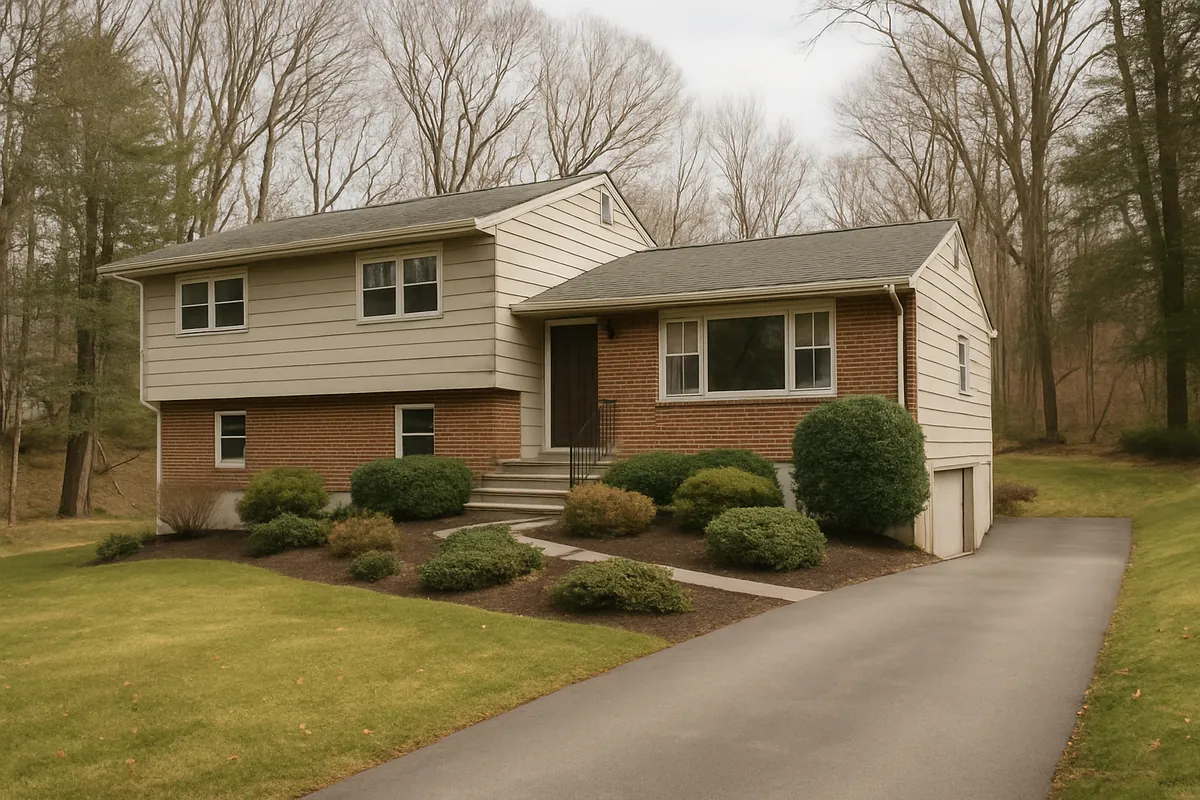
New City Trenchless covers replacement options for the Orangeburg and vitrified clay laterals installed under Bardonia’s capes and ranches during the hamlet’s 1950s and 60s build-out. Trenchless sewer repair in Bardonia is comparatively predictable because many laterals share a similar age, installation method and trench condition.
One Build Wave Means One Failure Wave
Bardonia is not an old hamlet with a historic core and suburbs stuck to the edges. It is a postwar subdivision hamlet, filled in along Route 304 and Germonds Road after the Tappan Zee Bridge opened in 1955 turned Clarkstown into commuter country. The capes and ranches arrived in a burst, and the laterals underneath them are reaching end of life in the same burst.
Contrast that with Nanuet to the south, which grew around a rail depot and carries genuinely older housing near its center, so its pipe ages are scattered across a century. In Bardonia the ages cluster. When one house on a street has a failed lateral, the neighbors are usually a few years behind it rather than a few decades. That is the single most useful thing to know about sewer work here.
Higher and Drier Than the Hamlets Either Side
Bardonia sits on the upland shoulder between the Hackensack River valley to the west and the flatter Nanuet plain to the south. The soil is firmer glacial till rather than the wet silt that makes West Nyack laterals settle and belly. That changes which defects dominate.
Because trench backfill here is better drained and more stable, deep bellies and running infiltration are less likely than on the valley floor below. What this ground produces instead is the dry-ground failure set: root intrusion at clay joints, and Orangeburg pipe collapsing under sustained soil load rather than floating in saturated ground. It also means freeze-thaw matters more to the repair than to the pipe. An open-cut trench dug in February on a Bardonia lot has to reach below frost depth and be backfilled and compacted in cold weather, and that backfill settles badly. Working from two pits sidesteps the whole problem.
The Orangeburg Problem Was Made Ten Miles Away
Orangeburg pipe, the bituminized fiber product made from wood pulp and coal tar pitch, was manufactured in Orangeburg NY, about ten miles down the county from here, and it was cheap, light and everywhere in the exact decades Bardonia was built. Its working life in good conditions was on the order of 50 years. Bardonia’s installs are now 60 to 70 years in the ground.
Orangeburg does not crack like clay. The fiber plies delaminate and the wall slumps inward until the pipe goes oval and finally shuts. That failure mode is what forces the method decision, because a cured-in-place liner needs a round host pipe to press against. Once the fiber has deformed, lining is off the table and the answer is Orangeburg pipe replacement by bursting.
| Bardonia house type | Likely lateral material | What usually fails | Usual fix |
|---|---|---|---|
| Late 1940s to early 1970s cape or ranch | Orangeburg | Wall delamination, pipe goes oval | Pipe bursting |
| 1950s to 60s ranch or split | Vitrified clay tile | Root intrusion at joints every few feet | Full lateral lining |
| Any era, house-side stub | Cast iron under the slab | Scale buildup, channeling along the invert | Descale, then line |
| Post-1975 additions and rebuilds | PVC | Usually sound, occasionally crushed | Spot repair |
Reading a Bardonia Lateral on Video
A CCTV sewer camera inspection with a locating sonde settles which of those rows you are actually in, and it does so before anyone spends money. Defects get graded consistently rather than by eye: the pipe assessment standards published by NASSCO are the reference most operators score against, which is what makes one report comparable to another.
In clay the camera mostly finds fine roots at offset joints, thickening into mats that catch everything flowing past, plus mortar loss and clear water tracking in on a dry day. In Orangeburg it finds the pipe wall itself sagging inward, often with an auger’s scrape marks confirming somebody has already tried to snake past it. The inspection runs $250 to $500 and is often credited against repair work.
Short Lots Make the Method Choice Simpler
Bardonia’s postwar lots keep laterals short and straight, typically a direct run from the foundation to the main under the street with one bend or none. Short runs work in your favor on price and on risk, because there is less pipe to renew and fewer places for a burst head or a liner to snag.
Where the clay is still holding its shape and grade, trenchless pipe lining builds a new jointless pipe inside the old one and every root entry point on the run disappears at once, for $4,000 to $12,000. Where the Orangeburg has deformed, pipe bursting fractures the old shell outward and tows in continuous fused HDPE, $6,000 to $15,000. A single failed joint in an otherwise sound clay run is a $1,500 to $4,000 sectional repair. Open-cut on the same line commonly costs 1.5 to 2 times the trenchless price once excavation, driveway and landscape restoration are added.
Sewer District No. 1 Stops at the Main
Bardonia drains to Rockland County Sewer District No. 1, the county system serving Clarkstown. As across most of the district, everything from the house out to the tap connection at the main is the homeowner’s to maintain. The county is not going to camera your front lawn or replace the pipe under it.
That private ownership is why aging laterals stay invisible until they fail. Buried private pipe gets no inspection cycle and no capital program, which is a large part of why wastewater infrastructure keeps scoring badly on the ASCE infrastructure report card even in well run districts. On a Bardonia street where every lateral shares a birthday, the cheapest hour you can spend is the one with a camera in the line before the pipe decides for you.
Frequently Asked Questions
How do I know if my Bardonia house has an Orangeburg lateral?
If the house went up between the late 1940s and the early 1970s and the lateral has never been replaced, it is a real possibility. A camera inspection, $250 to $500, identifies the material on video and shows how much deformation has already happened.
What does it cost to replace an Orangeburg sewer line in Bardonia?
Pipe bursting a failed lateral typically runs $6,000 to $15,000 depending on length and depth. If the pipe is still round enough to line, cured-in-place lining runs $4,000 to $12,000.
Will the work tear up my front yard along Route 304?
No. Trenchless work runs through one or two small access pits, so lawns, driveways and mature plantings over the line stay put. Most Bardonia jobs finish in one to two days.
My neighbor just replaced their lateral. Should I worry about mine?
It is worth a look. Bardonia went up in effectively one build wave, so the houses on a street usually share an install year, a pipe material and a trench. A neighbor's failure is a reasonable prompt to camera your own line rather than a coincidence.
Why do so many Bardonia houses have no outside cleanout?
Cleanouts were not standard practice on modest capes and ranches of this era, so the only access is often a roof vent or a pulled toilet. Adding a two-way cleanout near the foundation during repair can make future inspection and jetting easier.