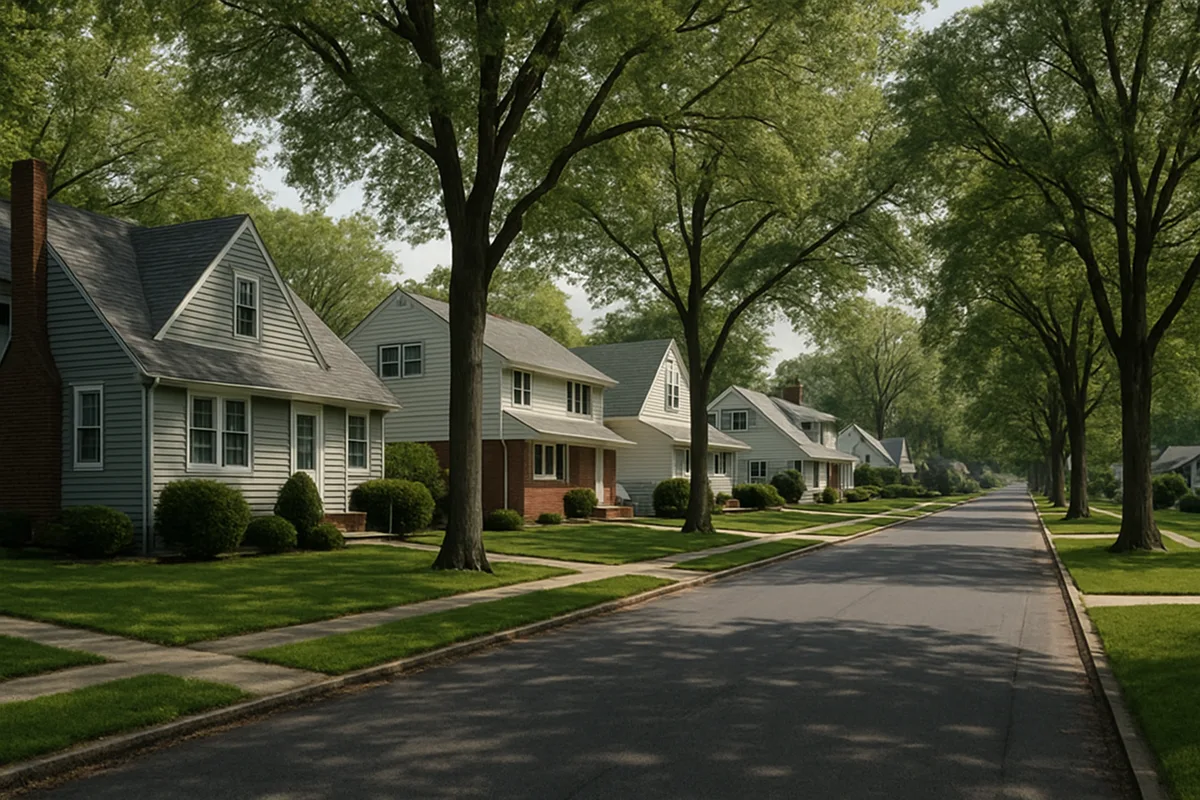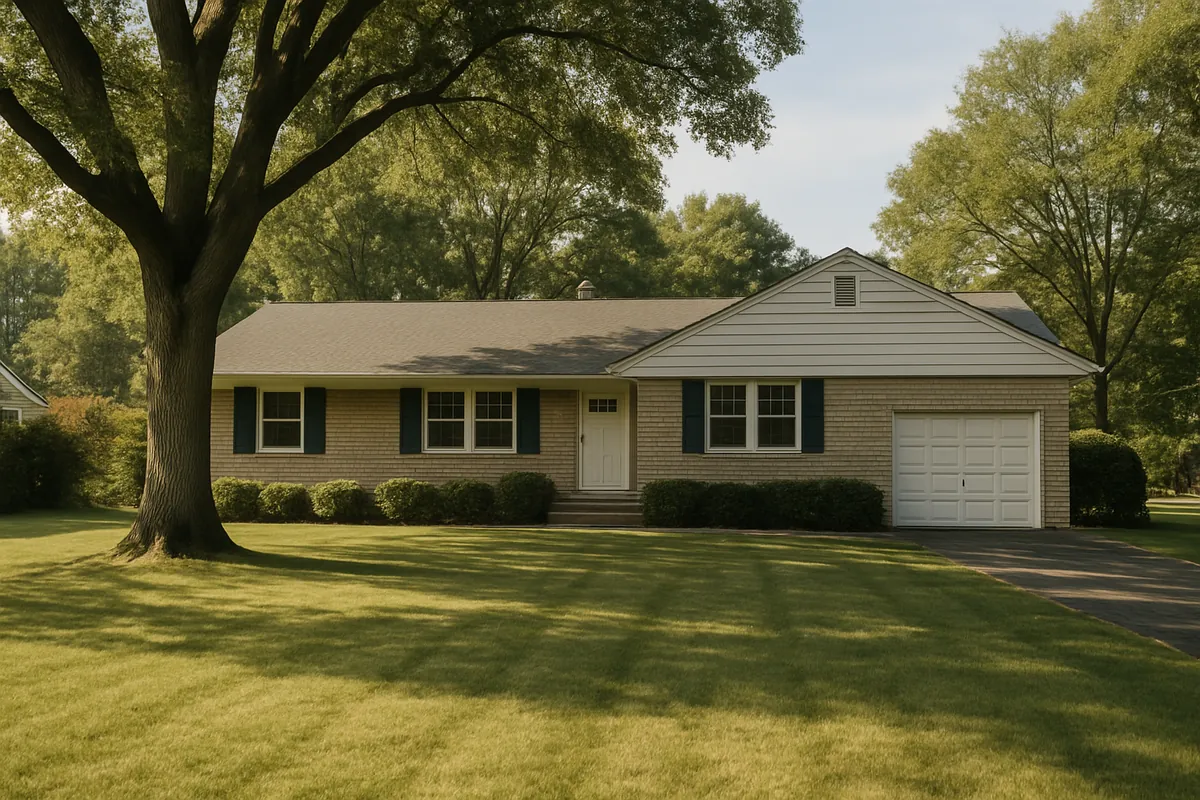
New City Trenchless covers trenchless sewer repair for Hillcrest, a census-designated place of several thousand residents in the Town of Ramapo, sitting east of the Wesley Hills and New Hempstead cluster. The postwar tract construction that filled this neighborhood followed the same builder’s playbook as its neighbors, a four-inch clay or Orangeburg lateral run out to the street at a modest grade, but the lots here sit noticeably closer together than the wooded, larger parcels a few miles away. That tighter spacing changes how a root problem spreads and how an access plan has to be drawn, even when the pipe itself is the same material a camera finds across much of eastern Rockland County.
A Denser Tract Neighborhood Inside Ramapo
Hillcrest grew up as part of the same postwar building wave that filled in Monsey, Wesley Hills and New Hempstead, but the parcels here were platted smaller and closer together than the more generous lots found toward Montebello’s wooded hill country. Ranches and modest colonials sit on lots where the side yard between one house and the next can be barely wide enough for a service vehicle, and the street trees planted along the curb at the same time as the original construction now shade several properties at once rather than just one.
That density is not a defect in the neighborhood. It simply means the underground picture is more crowded. A single mature oak’s root system can realistically reach two or three adjoining laterals rather than just the lateral belonging to the house it was planted in front of, and a locating sonde run during a camera inspection sometimes turns up a second property’s service line running closer to the surveyed path than a homeowner expects.
Clay and Orangeburg on the Same Block
A camera inspection in Hillcrest most often finds vitrified clay tile, laid in short jointed sections the way it was across nearly every Ramapo tract built in the 1950s and 60s. Clay fails where its mortared or compression joints have opened after decades of settling and frost cycling, giving roots and groundwater a point of entry while the pipe body itself typically holds its shape.
Orangeburg shows up often enough in this same neighborhood to warrant checking for directly rather than assuming it away. Bituminized fiber pipe was a budget alternative during the same building years, and a Hillcrest home built on a tighter lot is no less likely than its neighbors to have had a run of it installed at the original construction. The two materials call for different judgments on camera: a clay joint that has separated can often be sealed in place, while an Orangeburg section that has softened or gone oval needs its condition assessed before lining is recommended, since curing a liner inside a deformed host does not restore the shape underneath it.
Why Tight Lot Lines Change the Root Problem, Not Just the Yard Work
On a wider lot, a root intrusion problem is largely a conversation between one homeowner and one tree. On a Hillcrest lot, the street tree closest to a given property may be roughly equidistant from two or three laterals at once, and the joint that opens first on any one of those runs is often a matter of which section of pipe happened to settle unevenly rather than which house is closest to the trunk.
That pattern means a Hillcrest street can see several reported backups within a short span, not because one failure caused the others, but because the same root system had multiple nearby entry points to find at roughly the same stage of its growth. Clearing roots out of one lateral with a jetter’s rotary head does not affect a neighbor’s line, since each service remains a separate, privately owned run even where the below-ground spacing is close.
Access Planning on a Narrow Side Yard
A continuous trench is a difficult proposition on many Hillcrest lots, where the gap between a house and the property line can be too narrow to stage equipment, store spoil, and still leave room to protect a fence or a neighbor’s planting bed. Open-cut replacement under those conditions usually means routing through the front yard instead, which adds distance and often crosses a driveway or walkway that would otherwise be left alone.
Trenchless methods avoid most of that by needing only two small access pits, one near the foundation and one near the tap at the street main, with the run between them left undisturbed. On a lot where the side yard is the only practical path to the lateral, that narrow footprint is frequently the deciding factor in choosing pipe lining or pipe bursting over open-cut digging.
Camera Inspection Before Lining or Bursting
Every Hillcrest job starts with a sewer camera inspection, which identifies the pipe material, the condition of each joint, and whether the host pipe still holds a shape suitable for lining before any method gets proposed. A line that is dirty with grease or root fragments gets a pass of hydro jetting first, so the camera reads the actual pipe wall instead of guessing at what lies beneath the buildup.
From there, sewer line repair and replacement covers the decision. A single open clay joint on an otherwise sound run is usually a sectional spot repair. A run with distributed joint failure, or a confirmed Orangeburg section that still holds a usable shape, is a strong candidate for trenchless pipe lining, which seals the entire length in one pass rather than one joint at a time. A collapsed or badly deformed section moves to pipe bursting instead, replacing the pipe outright through the same two small pits, which matters most on the lots here where a continuous trench simply is not a realistic option. Where an Orangeburg lateral needs a closer look before either method is chosen, the Orangeburg pipe replacement guide walks through what that assessment covers.
Hillcrest Among Its Ramapo Neighbors
Hillcrest sits within Rockland County Sewer District No. 1 along with the rest of the Town of Ramapo, which maintains the mains under its streets while the private lateral, tap connection included, remains the homeowner’s responsibility from the foundation out to that main. The tighter lot spacing here sets Hillcrest apart from the flatter, more open tracts of Wesley Hills just to the west, even though both neighborhoods share the same postwar building era, the same clay-and-Orangeburg lateral mix, and the same county main system.
To the south, New Hempstead covers a similarly careful, camera-first approach to clay and Orangeburg questions on its own streets, while Monsey just beyond shares Hillcrest’s dense postwar footprint but carries its own distinct problem, laterals outgrown by expanded households rather than tight lot spacing alone. A camera inspection remains the fastest way to confirm which of those patterns, root intrusion through a crowded root zone, Orangeburg deformation, or something else entirely, actually applies to a given Hillcrest lateral.
Frequently Asked Questions
Why do Hillcrest sewer problems seem to involve neighboring yards more than in less crowded towns?
Lot lines here sit closer together than on the wooded, larger parcels nearby, so a lateral, a neighbor's lateral, and the shared street tree roots can all occupy a narrower band of soil. A root or joint problem on one property is more likely to have a visible counterpart just a few feet away on the next lot, which is less common on the wider, more spaced-out lots in parts of Montebello or Pomona.
Does Hillcrest have Orangeburg pipe under its homes?
It turns up often enough to check for. Hillcrest's postwar tract construction overlaps the years bituminized fiber pipe was commonly used on budget-conscious builds, so alongside the vitrified clay tile a camera inspection usually finds here, an occasional Orangeburg stub or full run is not unusual on an individual property.
Should a Hillcrest lateral be lined or burst?
That depends on what the camera shows, not on the neighborhood. A clay or Orangeburg run that still holds a round, intact shape is a strong candidate for lining, which seals every joint without disturbing the tighter lot. A section that has gone out of round, flattened, or collapsed needs pipe bursting to actually replace it, still through two small access pits rather than a trench across a narrow side yard.
My side yard is barely wide enough to walk through. Can trenchless work still happen there?
Usually, yes. Trenchless methods need two small pits, one near the foundation and one near the tap, not a continuous trench down the yard's length. On Hillcrest's tighter lots, that narrow footprint is often the only practical way to reach a lateral that runs between a house and a close property line without disturbing a neighbor's fence or plantings.
Is the sewer line my responsibility or the Town of Ramapo's?
The main under the street is maintained by Rockland County Sewer District No. 1, which covers Hillcrest along with the rest of Ramapo. The lateral running from the foundation out to the tap connection, tap included, is the homeowner's private pipe, and that private section is where almost every residential sewer call in the neighborhood begins.