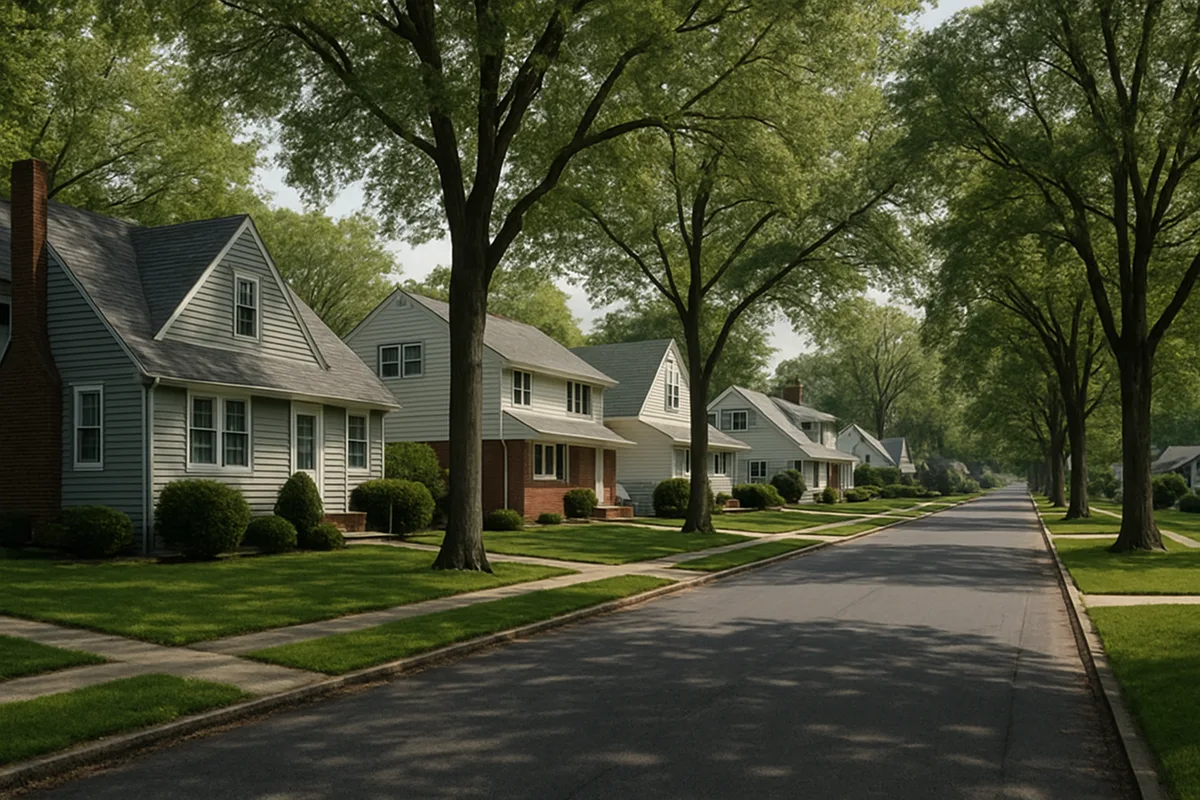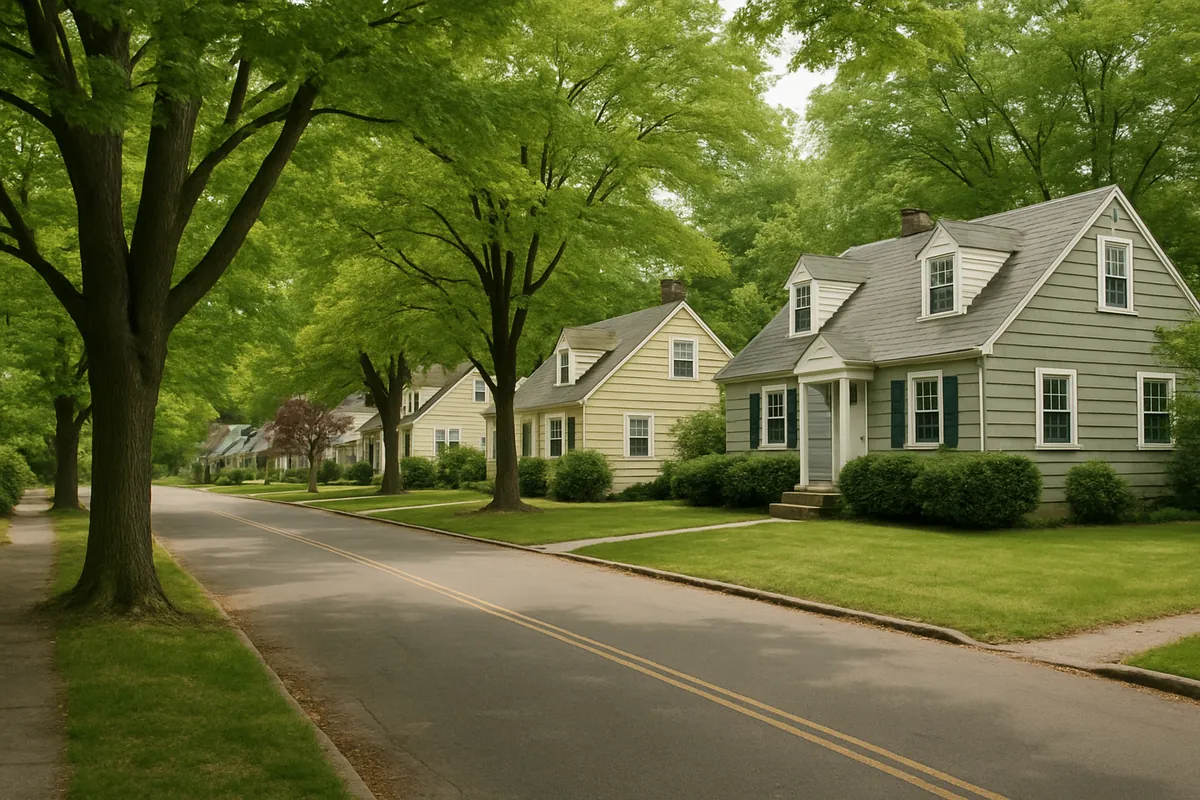
New City Trenchless covers lining and bursting options for the original clay and Orangeburg laterals under Nanuet’s postwar tract streets. Nanuet is a hamlet of the Town of Clarkstown, and for most of its history it was a small depot settlement surrounded by farmland. That ended in 1955, when the Tappan Zee Bridge and the New York State Thruway opened and put Nanuet inside commuting distance of the city. Many capes, split-levels and ranches from the following fifteen years still drain through their original laterals.
Two Nanuets, Two Generations of Buried Pipe
There are really two housing stocks here, and they fail in completely different ways.
The older one sits close to the railroad, around the depot on the line now run as NJ Transit’s Pascack Valley Line. Those houses predate the suburbs and are plumbed like prewar homes anywhere in the county: cast iron under the basement floor and through the foundation, vitrified clay from there to the street, and frequently a house trap at the wall that blocks camera and liner access until it is dealt with.
The larger stock is the tract build-out. Streets laid between Middletown Road, Route 59 and the Thruway went in fast from the late 1950s through the 1960s, a run of construction that only tailed off around the time the Nanuet Mall opened in 1969. Those laterals are short, shallow, and made of whatever the supply yard was moving that week.
Why the Tract Boom Buried So Much Orangeburg
The timing was unlucky. Bituminized fiber pipe, sold as Orangeburg, was in wide use from 1945 to 1972, which is almost exactly the window in which Nanuet was built out. The factory that made it stood about ten miles away in the hamlet of Orangeburg, so supply was local, cheap and fast to cut, and that is the combination a tract builder wants.
The pipe is wood fiber bound with coal tar pitch. Under sixty years of soil load the wall loses its round shape, goes oval, then delaminates and swells inward until an auger cable will not pass. A deformed run cannot host a liner, because a liner cures to the shape of the pipe it is pressed against and simply inherits the oval. Those laterals go to Orangeburg pipe replacement by bursting instead, where a head fractures the old wall outward through the soil while towing fused HDPE in behind it.
Clay from the same era behaves differently. The barrel usually survives. The joints do not, because they were laid in short sections with mortar or bituminous packing and six decades of trench settlement has pulled them open.
Flat Ground, Shallow Groundwater and Sixty Year Old Joints
Nanuet sits on low, level ground that drains south toward the Hackensack. There is none of the steep fall the river villages have, so a Nanuet lateral is built close to design minimum grade and has little margin to spare. Lose a half inch of fall to a settled joint and solids start dropping out at that point.
The water table sits close to the surface here in wet months, and that matters in two directions. Groundwater pushes into open joints, which is the infiltration that the EPA’s wastewater permitting program treats as a system-wide load and not just a homeowner nuisance, and it carries fine soil in with it, which is how a belly forms in ground that was originally compacted properly. Saturated soil is also where fiber pipe gives up fastest.
Freeze-thaw cycling works on shallow bury depths every winter, and frost depth is the reason an open-cut trench in a Nanuet front yard in February costs what it does. Not opening one is most of the argument for trenchless here.
Where Sewer District No. 1 Stops and Your Pipe Starts
Nanuet drains to Rockland County Sewer District No. 1, which owns and maintains the main under the street. Everything on the house side of the tap connection is private pipe, which is why a failed lateral is the homeowner’s repair and not the county’s, and why it is worth knowing what you own before it fails. The county government site is the place to confirm district boundaries and any permit requirement for work in the right of way.
The geography carries a certain irony. The district’s treatment works sit in Orangeburg, the hamlet that gave the failing fiber pipe its name.
What the Camera Finds on a Nanuet Run
A sound repair plan starts with a sewer camera inspection through a cleanout, with defects graded to the PACP codes published by NASSCO and depth and position fixed from the surface with a locating sonde. That is what turns a guess into a scope of work.
On Nanuet laterals the same short list repeats: root intrusion at open clay joints, offset joints where 1960s backfill settled, fiber pipe somewhere on the way from round to oval, and the occasional early PVC run with a belly in it. One failed joint in an otherwise sound line needs only a sewer spot repair rather than a full-length job.
| Nanuet build era | Likely lateral material | What the camera usually shows |
|---|---|---|
| Pre-1930, depot area | Cast iron under slab, vitrified clay to street | Scale and invert channeling in the iron, open clay joints, house trap at the wall |
| 1945 to 1972 tract streets | Orangeburg fiber, or short clay sections | Oval deformation and delamination, roots at clay joints |
| 1970s onward | Early PVC or ABS | Settlement bellies, poor bedding, crushed sections near the tap |
What Trenchless Work Costs on a Nanuet Lot
Trenchless sewer repair in Nanuet starts with the camera at $250 to $500, often credited toward the work. A sectional point repair falls between $1,500 and $4,000, lining a full lateral between $4,000 and $12,000, and bursting a deformed or collapsed line between $6,000 and $15,000. Length, depth and access decide where a job lands in the range. Open-cut replacement on the same run often comes in at 1.5x to 2x the trenchless price once excavation, backfill, driveway and landscape repair are added up.
Many Nanuet repairs can finish in a day. A full bursting pull commonly takes one to two days including the pits, although timing depends on site conditions and approvals. Neighbouring Bardonia and West Nyack were built during the same era and often show similar materials underground.
Frequently Asked Questions
How do I know if my Nanuet home has Orangeburg pipe?
Build date is the first clue. Anything built from 1945 to 1972, which covers most of Nanuet's tract housing, sits in the install window. A $250 to $500 camera inspection settles it, and deformed fiber pipe is unmistakable on video.
Can Orangeburg be lined instead of replaced?
Only while it still holds a round profile, which late-stage Orangeburg rarely does. Once the wall has deformed, pipe bursting at $6,000 to $15,000 is the honest fix, because a liner cured inside an oval pipe inherits the oval.
Who is responsible for my sewer line, me or Sewer District No. 1?
The district maintains the main in the street. The lateral from your foundation to the tap connection is yours, including everything under the lawn and driveway.
My lateral runs under the driveway. Does it have to come up?
Almost never with trenchless methods. Nanuet's tract lots are compact and the driveway often sits square over the run, which is exactly the case trenchless was built for. Lining works through an existing cleanout, and bursting needs a small pit at each end rather than a trench along the whole line.
Are older homes near the Nanuet depot different from the tract streets?
Yes, and it changes the method. Pre-1930 houses near the railroad usually have cast iron under the slab and clay out to the street, often with a house trap at the foundation wall. Tract houses from the late 1950s and 1960s tend to be short runs of clay or Orangeburg with no trap at all.