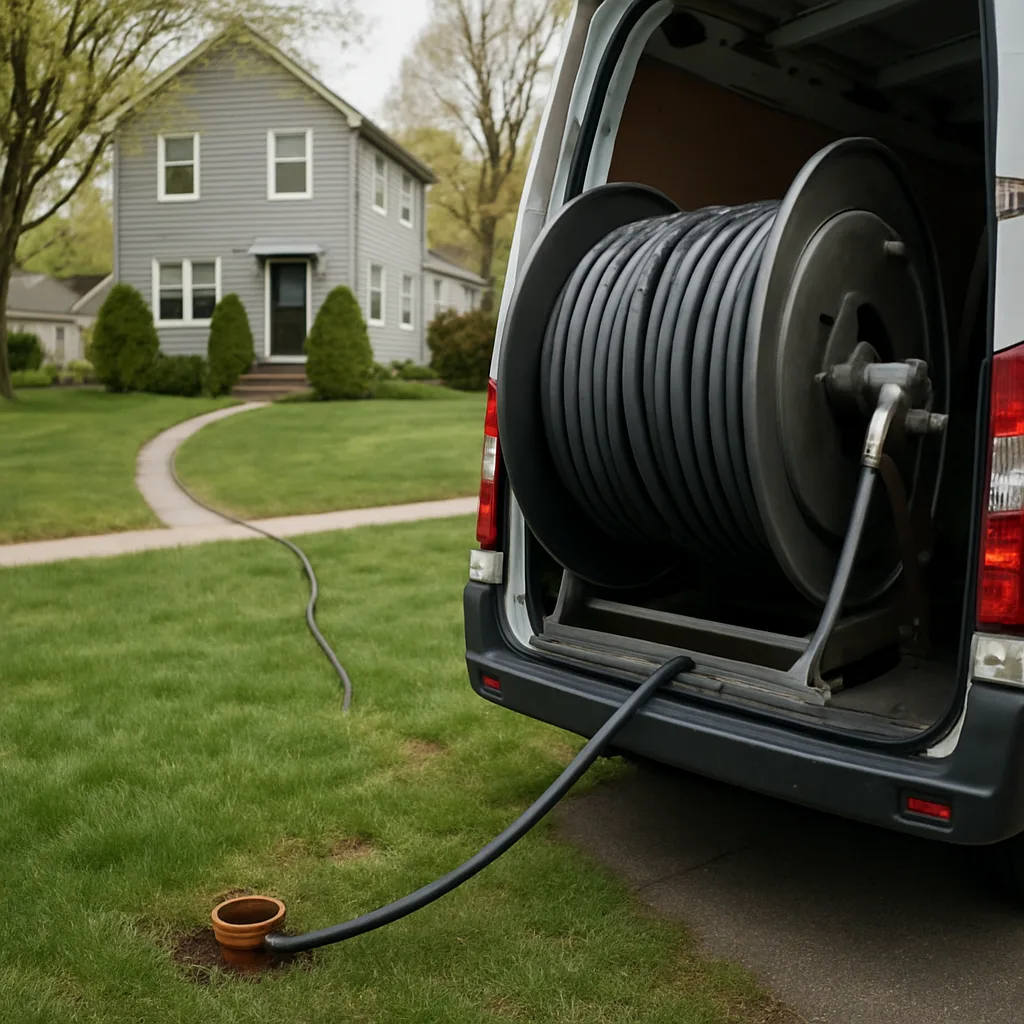
New City Trenchless covers three uses for hydro jetting on Rockland County laterals: cutting root mats out of vitrified clay joints, descaling cast iron, and cleaning host pipe back to its original wall before a cured-in-place liner goes in. The machine may be the same, but the setup is what separates professional jetting from simply pointing pressure at a clog.
Pressure Cuts, Flow Carries
Two numbers describe every jetting rig. PSI is the cutting force at the nozzle. GPM is the flow that carries what was cut out of the line. Residential sewer jetting typically runs between about 1,500 and 4,000 PSI, but pressure alone is half a tool: without enough flow, sheared roots and stripped grease settle in the first low spot they reach and rebuild the blockage a few feet downstream.
The hose goes in at a cleanout and the nozzle is pulled up the line by its own rear-facing jets, so the working direction is upstream and the debris travels back down with the flow toward the sewer main. Hose length costs pressure through friction loss, which is why the reading at the pump is never the pressure at the nozzle, and why a long run needs either a larger hose or a machine with headroom above the target pressure.
Sizing the Rig to the Line
| Line | Typical flow | Typical pressure | Hose |
|---|---|---|---|
| Kitchen and branch lines, 2 to 3 inch | 4 to 8 GPM | 1,500 to 3,000 PSI | 3/8 inch |
| Residential lateral, 4 to 6 inch | 9 to 18 GPM | 2,000 to 4,000 PSI | 1/2 inch |
| Commercial and municipal, 6 inch and up | 18 GPM and above | 2,000 to 4,000 PSI | 1/2 inch and larger |
Undersized flow in a 6 inch line is the common mistake. The nozzle cuts, the water cannot carry, and the line blocks again within weeks a short distance downstream of where the work was done. Oversized pressure in a fragile line is the opposite mistake and it is worse, because you find out about it on the camera pass afterward.
Nozzles: One Machine, Four Jobs
A nozzle is a machined head with a set number of orifices at fixed angles. Orifice count and size divide the pump’s flow, so the same machine behaves completely differently depending on which head is on the hose.
Penetrator
A forward-jet nozzle that punches a pilot opening through a full blockage so water can move and the real cleaning can start. Fewer, tighter forward orifices concentrate the pressure into the plug.
Rotary root cutter
A spinning head that shears root intrusion flush with the pipe wall instead of just tearing a hole through the mat. The rotation is what turns a set of fixed jets into a continuous cutting circle at the pipe wall.
Descaling nozzle
Controlled rotary action that breaks hardened scale off cast iron without resting the full pressure on one spot of the wall. Speed control matters more here than raw PSI, because a head that stalls in one place cuts into the pipe rather than the deposit.
Flusher
Rear-facing jets and high flow, the finishing pass that rinses the cut material out of the line and down to the main. This is the pass that decides whether the work holds, and it is the one that gets skipped when a jetting visit is priced to the minute.
Descaling Cast Iron Without Punching Through It
Sixty-year-old cast iron in Rockland’s postwar houses narrows from the inside as tuberculation and scale build inward, and it thins from the bottom as channeling wears a trough along the pipe floor. The two happen at once, which is the trap: the pipe looks blocked and is treated as if it were solid, when the invert may be the thinnest part of the wall.
Descaling restores the bore, but the camera comes first, because a pressure that is right for a sound pipe is wrong for a wall that channeling has worn thin. Jet settings are chosen off what the CCTV inspection shows, worked in short passes, and checked on the monitor as the deposit comes off. A line too far gone for safe descaling becomes a candidate for cast iron pipe lining or a sectional point repair instead. Descaling a pipe that is then lined is the sequence that works: clean wall, new pipe inside the old one, no more scale to catch paper.
Root Cutting in Clay Joints
Vitrified clay pipe fails at its joints, and every offset joint is a doorway for the street trees this county planted seventy years ago. A root-cutting pass clears the mat and restores full flow the same day. It does not close the doorway: roots come back through the same joints within a season or two.
Cutting is the treatment. Sealing the joints is the cure, and jetting first is what makes that sealing possible. The full method, including what foaming herbicides do and do not accomplish, is on our tree root removal page.
Jetting Before Lining: The Liner Is Only as Good as the Wall Behind It
A CIPP liner is an epoxy resin-saturated felt tube cured against the host pipe. If the host pipe still carries grease film, scale or root stubs, the liner cures against debris instead of pipe, and the result is voids behind the liner and, in the worst case, delamination of the new pipe from the old.
Cleaning and inspecting the host pipe before installation is not an optional courtesy step. It is written into the practice for cured-in-place rehabilitation published by ASTM as ASTM F1216, and the inspection that verifies it is coded to the defect standard maintained by NASSCO. So every trenchless pipe lining job includes a jetting stage and a post-jet camera pass to confirm the wall is clean before the resin arrives, and the jetting is priced inside the lining job rather than added as an extra.
Water, Winter and the Practical Side of a Jetting Visit
A jetter is a water-hungry machine. At 12 to 18 GPM, a working pass moves real volume, drawn from a hose bib into the rig’s tank, and it has to be replaced as fast as it is used or the pump starves. On a well-supplied house that is a non-issue. On an older village property with a slow outside spigot it changes how the day is scheduled.
The season matters too in a county that cycles through freeze and thaw all winter. Water left in a pump, hose reel or nozzle after a cold-weather job freezes and splits things, so cold-weather work ends with the system purged. Frost also stiffens the hose and makes a long push harder. None of that stops winter jetting, but a jetting quote given in January and a jetting quote given in June are not describing quite the same afternoon.
Everything the jetter cuts loose ends up in the sewer system, which is why what gets flushed downstream, and what has to be contained instead, sits inside the wastewater rules administered by New York State DEC. Grease-heavy commercial work in particular is a containment question, not just a cleaning one.
When the Jetter Should Stay on the Truck
Some Rockland lines should not be jetted. Orangeburg fiber pipe that has begun to soften can delaminate under high pressure water, turning a cleaning into a collapse, and that pipe is everywhere in subdivisions built between the late 1940s and the early 1970s. A line the camera shows as already deformed or partially collapsed gets repaired, not cleaned.
Long bellied runs are jetted with tempered expectations, since the low spot that collected the grease will still be there collecting it next year. Pre-1940 laterals in the river villages need a lighter approach because age changes what the wall can take. Where cabling is the better tool for a single soft clog, it should be used instead. The camera decision comes before the jetting decision.
Frequently Asked Questions
How much does hydro jetting cost in New City?
It depends on line length, access and what is in the pipe, so a quote should follow a camera look. When jetting is the cleaning stage of a lining job it is commonly included in the full-lateral price rather than billed separately.
Can hydro jetting damage my pipes?
Sound clay, cast iron and PVC handle jetting well. The exceptions are Orangeburg fiber pipe, which can delaminate under pressure, and pipe already close to collapse. That is why a camera should go in before the jetter, not after.
Will jetting remove tree roots permanently?
A root-cutting pass clears the mat back to the pipe wall, but roots return through the same clay joints. Permanent means sealing the entry points, usually by lining that section of the line.
Is hydro jetting better than snaking?
Different jobs. A cable opens a hole through a blockage; jetting cleans the full circumference of the pipe wall. For grease, sludge and scale, jetting is the only one of the two that actually removes the material.
How long does a jetting visit take?
A straightforward residential lateral is usually a few hours including setup, the cleaning passes and a camera check afterward. Heavy cast iron descaling takes longer because the head has to be worked back and forth over the same footage until the wall reads clean on the monitor.