New City Trenchless explains full sewer lateral renewal from the foundation wall to the tap connection at the sewer main, using cleanouts and one or two small pits rather than a trench across the property. Trenchless sewer replacement is the umbrella over two distinct methods, and choosing correctly between them is most of the engineering.
When the Whole Lateral Goes, Not Just a Section
Full replacement earns its cost in four situations. Defects spread along the entire run on camera, where sewer line repair would only chase failures one joint at a time. Orangeburg pipe anywhere in the line, because the bituminized fiber material is past its service life as a class, not just at the visible defect. Cast iron with channeling along most of its invert. And laterals that have already absorbed two or three spot repairs, where the repair history itself is the argument.
The counter-case is worth stating plainly, because it saves money. One root-invaded joint in an otherwise sound clay run is a spot repair at $1,500 to $4,000, and replacing the whole line to fix it is waste. The decision turns on defect density and pipe material, not on how alarming a single frame of video looks.
Why Rockland County Laterals Reach End of Life Together
The housing stock explains the pattern. Rockland built out hard after the Tappan Zee Bridge opened in 1955, and whole streets went in within a couple of years of each other on the same specifications, with the same clay tile and the same Orangeburg. Laterals installed in the same season, in the same soil, under the same species of street tree, fail in the same decade. A neighbor’s sewer problem is genuinely predictive here in a way it would not be on a street built out over fifty years.
The older river villages are a separate case. Nyack, Piermont, Haverstraw and Tappan carry pre-1940 and 19th century housing, so those laterals are older, often deeper, and frequently run under additions and hardscape added long after the pipe went in. Freeze-thaw cycling works the joints looser every winter, and mature trees do the rest.
Lining or Bursting: The Method Decision
Structural cured-in-place liner
Where the host pipe still holds a round, passable shape, trenchless pipe lining builds the replacement inside it: an epoxy-saturated liner cured into a jointless structural pipe under ASTM F1216, published by ASTM International, usually in one day with no pits at all.
Pipe bursting with fused HDPE
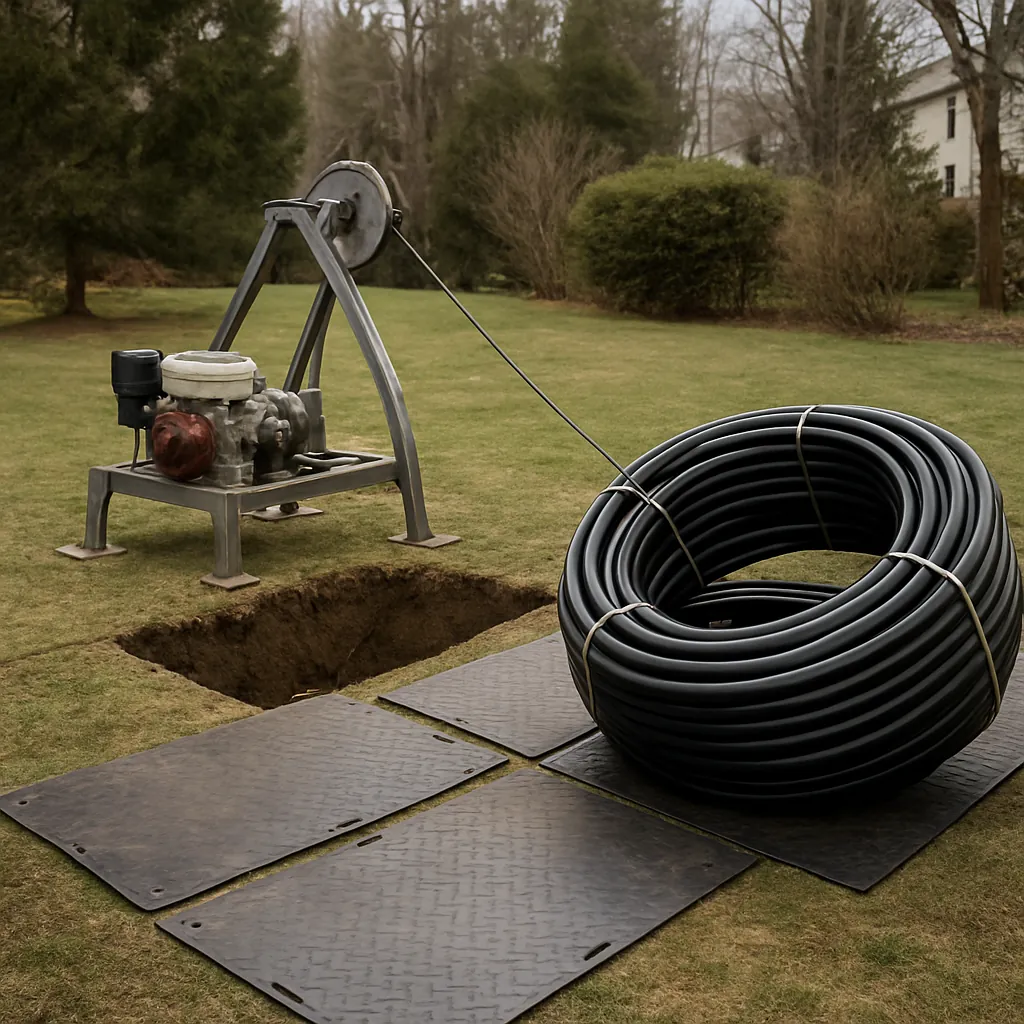
Where the line is collapsed, ovaled or undersized, pipe bursting fractures the old pipe outward and tows in a fused HDPE line of equal or larger diameter through two small pits.
| Cured-in-place lining | Pipe bursting | |
|---|---|---|
| Host pipe required | Round and passable | Only a threadable path |
| Excavation | Often none, works from cleanouts | Two small pits |
| Diameter result | Slightly smaller bore, much smoother wall | Same size or upsized |
| Resets fall | No, copies host grade | No, follows host alignment |
| Typical duration | One working day | One to two days |
| Typical cost | $4,000 to $12,000 | $6,000 to $15,000 |
The split is never preference. Shape and passability route a job to the liner. Collapse, deformation or the need to upsize route it to the bursting rig, and the camera footage is the routing document.
The Survey That Makes the Call
A replacement quote that arrives without video is a guess. The pre-work survey has to produce four things: material, defect list, alignment and depth, and fall.
Material is read off the pipe wall on camera, and it is often mixed, with clay from the street and a different material at the house from a later repair. Defects are coded to the PACP standard from NASSCO so that a crack, an offset joint, a root mass and an active infiltration point are recorded distinctly, each with a distance and a clock position, instead of being described loosely as damage. Alignment and depth come from the sonde trace, which is what decides where pits can go and whether the line crosses a driveway or a neighbor’s ground. Fall is judged from where water stands in the run, and it is the measurement that determines whether a trenchless method is appropriate at all.
Every one of those findings has a direct consequence for the price, which is why a sewer camera inspection at $250 to $500 comes first and is usually credited against the work.
Access, the Easement and the Tap at the Main
A lateral does not end at the property line. It runs to the tap, sometimes crossing a neighbor’s ground or a right of way under a sewer lateral easement, so the responsibility boundary gets confirmed before any work near the street. Rockland County Sewer District No. 1 maintains the mains, while the lateral from the house out to the tap belongs to the property owner, and the exact boundary is worth confirming with the county through Rockland County government before a scope is fixed.
Replacement then remakes both ends properly. A two-way cleanout goes in at the house if the line never had one, which makes every future inspection and cleaning cheaper for as long as the house stands. The connection at the main is remade as a proper tap rather than an unsealed break-in, because an unsealed connection is a permanent infiltration path, and infiltration is what turns a rainstorm into a sewer surcharge.
The finished pipe is then surveyed end to end on camera and its fall checked, because a new line laid on the old alignment inherits the old slope, good or bad, and you should know which before the pits close.
What a Replacement Day Actually Involves
| Stage | What happens |
|---|---|
| Locate and mark | Sonde trace, public utility mark-outs, pit positions painted out |
| Access | Cleanout opened, or launch and receiving pits excavated and shored |
| Clean | Root cutting, descaling and jetting the host pipe |
| Install | Liner inverted and cured, or bursting head pulled and HDPE towed in |
| Reconnect | Foundation entry and tap remade, branch connections reinstated |
| Prove | Closing camera pass, flow test, pits backfilled and compacted |
The line is out of service during the install and cure, or during the pull, not for the entire visit.
Trenchless Against Open-Cut on a Rockland Yard
A lined full lateral runs $4,000 to $12,000 and a burst replacement $6,000 to $15,000, while open-cut on the same line often reaches 1.5 to 2x once excavation, dewatering and landscape repair are counted. The gap is widest where digging is worst. In the low river towns, Piermont above all, a high water table turns an open trench into a pumping exercise, and on any postwar street the trench line would run under sixty years of driveways, retaining walls and mature plantings. Keeping that surface intact is not a comfort feature. It is where the cost advantage comes from.
Frost depth matters as well. A trench opened and backfilled in a Rockland winter is slower work, and compaction over a deep winter trench is harder to get right, which is how settled trench scars show up across lawns and driveways a year after an open-cut job.
Where Trenchless Is the Wrong Answer
Three honest exceptions. A run with genuine back-pitch needs its grade reset, and neither method resets grade, so that low section gets opened. A lateral crushed under a footing or a slab edge has no clearance for a bursting expander and no shape for a liner to press against. And a line whose tap at the main cannot be located or proven has to be exposed before anything is committed to.
Saying so before the rig arrives is cheaper than discovering it with the pits already open, and it is the difference between a fixed price and a change order.
Frequently Asked Questions
Is trenchless sewer replacement always better than repair?
No. One or two isolated defects in sound pipe are a $1,500 to $4,000 spot repair, not a replacement. Replacement wins when defects span the run, the material is Orangeburg, or repairs keep recurring.
Will my replacement be lining or bursting?
The camera decides. A host pipe that holds its shape and can be passed gets a cured-in-place liner. A collapsed, deformed or undersized line gets burst and replaced with fused HDPE.
What does full trenchless replacement cost in New City?
$4,000 to $12,000 for a full-lateral liner, $6,000 to $15,000 for pipe bursting. Open-cut on the same line often lands 1.5 to 2 times higher once excavation and restoration are counted.
Who is responsible for the lateral, me or the town?
In most sewer districts the property owner owns the lateral from the house out to the tap at the main. Confirm the exact boundary with your district, and the work gets scoped to it.
Can trenchless replacement correct a sagging or back-pitched line?
Not by itself. A liner copies the host pipe's shape and a burst pull follows the host pipe's alignment, so neither method resets grade. Where the survey shows real back-pitch, that low section is opened and reset while the rest of the run is still done trenchlessly.