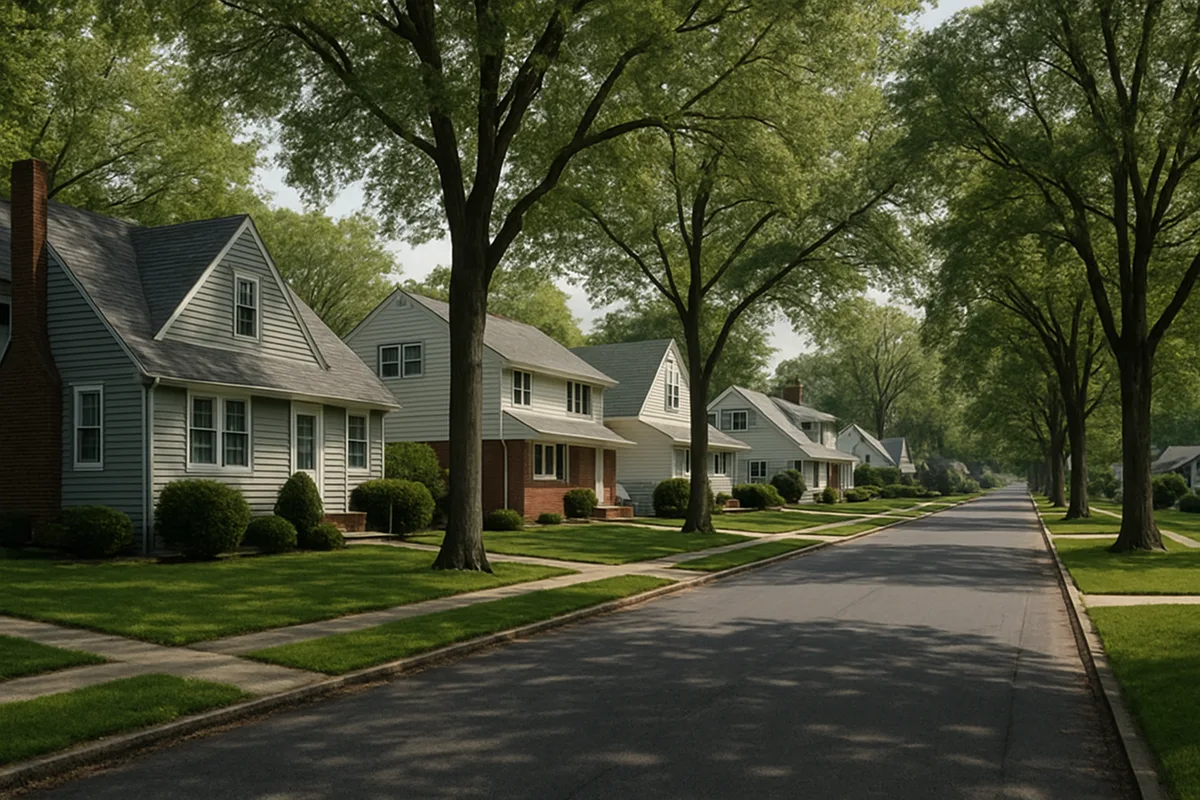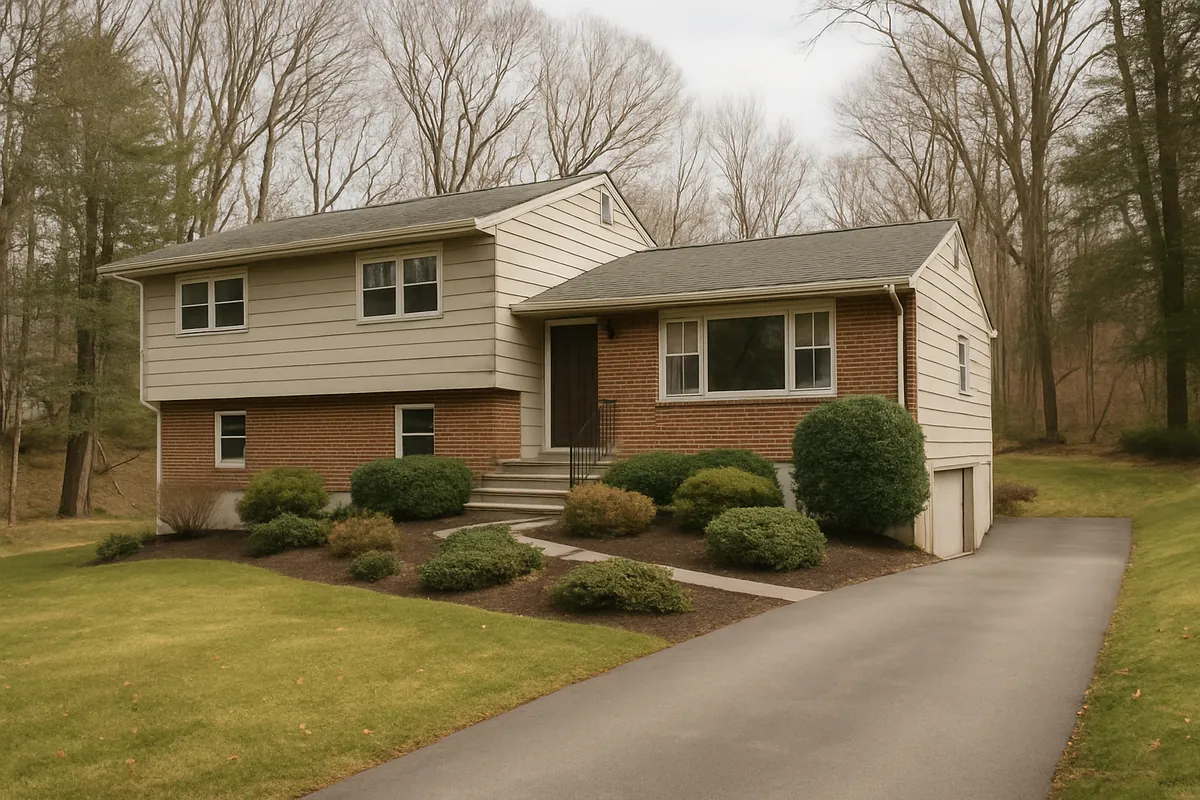
New City Trenchless covers repair and replacement options for the sewer laterals under Blauvelt’s split-levels, many framed in the 1950s and 60s near the factory that made Orangeburg pipe. When these streets were plumbed, the local fiber product and vitrified clay tile were common choices, and both are now more than sixty years into service.
Subdivisions Platted at the Height of the Fiber Pipe Era
Blauvelt was a rail stop and a scatter of farms until the Tappan Zee Bridge opened in 1955 and Orangetown filled in behind it. The tracts off Greenbush Road, Western Highway and Erie Street went up in the years that followed, while the plant that gave bituminized fiber pipe its name was still in production a short drive south in Orangeburg.
Two things follow from that timing. The laterals under these lawns were installed when fiber pipe was at its commercial peak, cheap and light and quick for a developer to lay. And the house type of those same years was the split level, which buries its drainage differently from the full-basement colonials that came a decade later.
| Blauvelt street built | Usual lateral material | How it fails now |
|---|---|---|
| Late 1940s to early 1950s | Vitrified clay tile | Root intrusion and offsets at mortared joints |
| Mid 1950s to late 1960s | Bituminized fiber (Orangeburg) | Delamination, ovalling, interior blisters |
| 1970s onward | Cast iron indoors, early plastic outdoors | Corrosion at the transition, settled bellies |
The Traprock Ridge Along Blauvelt’s Eastern Edge
The hamlet runs up against Clausland Mountain, the wooded diabase ridge that carries Blauvelt State Park and the concrete walls of the old Camp Bluefields rifle range still standing in the trees. It is the same Palisades sill that makes the cliffs above the river, and on the eastern streets it means rock is not far under the topsoil.
Where bedrock sits shallow, the original sewer trench was cut shallow, so the lateral takes more of the winter freeze-thaw movement in the surface soil than a deeper line would. It also means reopening that trench today is breaker work rather than an afternoon with a mini excavator. That single fact widens the gap between trenchless and open-cut on this side of Blauvelt, and it is why pipe bursting so often wins here on price as well as on disruption.
Wet Flats on the Western Side
Cross Route 303 and the ground changes completely. The low land toward Pearl River drains into the headwaters of the Hackensack River, and those flats hold water, with wetland soils and a seasonal water table close to the surface.
A lateral bedded in ground that saturates every spring settles unevenly. The result is a bellied run holding standing water between two high spots, so solids drop out in the sag and the line blocks at the same footage every year no matter how often it is snaked.
Groundwater getting into a cracked joint is not only a household problem. That infiltration travels the public mains to the treatment works and is treated at public cost, which is why the EPA’s wastewater permitting program treats infiltration and inflow as a system-level defect rather than a private nuisance. In Rockland the mains themselves belong to the county sewer district, while the lateral from your house out to the tap is yours to maintain and yours to repair.
Two Ways a Blauvelt Lateral Dies
Fiber pipe that lost its shape
Fiber laterals here fail by deformation. Moisture softens the laminated walls, delamination follows, soil load ovals the pipe, and interior blisters squeeze the channel until snaking stops helping. Once a fiber run has lost its round shape there is nothing left to line against, and the correct answer is replacement rather than repair. That is the whole subject of Orangeburg pipe replacement, and in this hamlet it comes up more than anywhere else in the county.
Clay joints that grew roots
Clay runs fail at the joints instead. The maples and oaks planted with these subdivisions are mature now, and the yards on the eastern streets back straight onto the state park woods, so there is no shortage of root mass hunting for water. Cornell Cooperative Extension publishes the underlying point plainly enough: roots follow moisture and nutrients, which is precisely what a leaking sewer joint offers. They enter at every weeping joint and rebuild after every cleaning, which puts homeowners on an annual auger routine until the entry points themselves are sealed by a cured-in-place liner.
Why the Split Level Changes the Access Plan
A split level puts its lowest finished floor close to grade, so the lateral often leaves the house under a family room or garage slab rather than through a full-height basement wall. Open-cut on that geometry means breaking finished concrete inside the house, which is most of the reason an open-cut quote lands so much higher here.
Lining runs through an existing cleanout. Bursting needs a compact pit at each end, both placed outside the foundation line. Neither opens the slab. Where the failed stretch sits directly beneath the house, sewer repair under a slab requires its own plan. Adding a two-way cleanout while access is open can give future cameras and jetters a straight shot in both directions.
Reading the Line Before Choosing the Method
A proper evaluation starts with a camera survey. A locating sonde traces the run under slab and lawn and marks its depth from the surface, defects get standard condition codes with footage marks, and hydro jetting cleans the host pipe so the lens reads pipe wall instead of grease. The choice between lining, bursting, and a sectional point repair then follows the evidence.
That evidence matters more in Blauvelt than in towns with one dominant pipe material, because two adjacent streets here can carry two different products depending on which yard delivered cheaper the month they were built. Neighbors in West Nyack and Nyack sit on the same postwar timeline, but the mix is never identical street to street, and neither is the ground it sits in.
What the Work Costs Here
A camera inspection is $250 to $500 and is often credited against the repair. A sectional spot fix runs $1,500 to $4,000. Full lateral lining runs $4,000 to $12,000, and pipe bursting replacement runs $6,000 to $15,000. Open-cut on the same lateral commonly lands at 1.5 to 2x the trenchless figure once excavation, rock, and putting the lawn and driveway back are counted.
A line that still passes water today may still be worth filming. Fiber deformation and root mats can appear on camera long before the first backup, making inspection a useful first step.
Frequently Asked Questions
What does trenchless sewer repair cost in Blauvelt?
Full lateral CIPP lining runs $4,000 to $12,000, pipe bursting replacement runs $6,000 to $15,000, and a sectional spot repair runs $1,500 to $4,000. The camera inspection that picks between them is $250 to $500.
The sewer line runs under my lower level slab. Do you have to break the floor?
Usually not. Lining and bursting both work from a cleanout or a single access pit outside the foundation, so the finished floor above the pipe stays finished. Breaking interior concrete is the open-cut price, and avoiding it is most of the reason trenchless wins in a split level.
Is the pipe under my Blauvelt house fiber or clay?
In this hamlet either material may appear depending on when and how the street was built. A camera inspection identifies it, and the answer drives the method: root-sealed lining for sound clay, or bursting once fiber has lost its shape.
Do you hit rock on the Clausland Mountain side of the hamlet?
The eastern streets sit close to the Palisades diabase, so yes, an open trench there can turn into breaker work partway down. That is exactly the cost trenchless avoids, because a bursting pull follows the existing pipe path through ground nobody has to re-excavate.
My yard backs onto the state park woods. Are the trees the cause?
If your lateral is clay, very likely. Roots do not drill through sound pipe. They find a joint that is already leaking and colonize it, then rebuild after every cleaning. Sealing the joints with a liner removes the entry points rather than the roots.