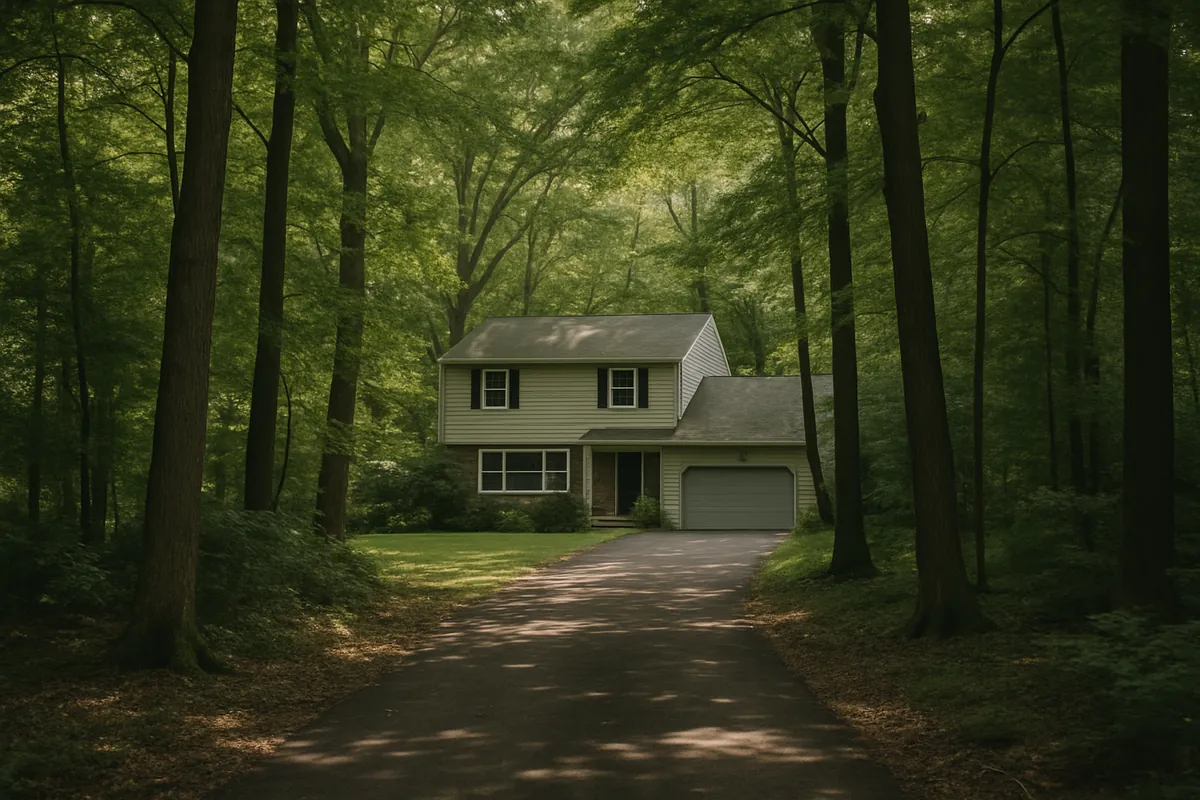
New City Trenchless covers trenchless sewer repair for Montebello, a wooded village of roughly 4,500 residents tucked into the hills along the Route 17 corridor in the Town of Ramapo. Lots here tend to be larger and steeper than the flatter tracts closer to the county’s center, and the laterals running under them split mainly between vitrified clay tile and cast iron, with little of the Orangeburg fiber pipe that turns up in more modest construction nearby. That material mix, and the hillside grading above it, shapes nearly every repair decision we make here.
A Hillside Village Built Along the Route 17 Corridor
Montebello sits where the Town of Ramapo rises into forested, uneven ground close to the Route 17 and Thruway interchange area, bordering Suffern to the southwest and Airmont to the north. Unlike the open, graded tracts that cover much of eastern Rockland, a large share of Montebello’s housing was built into existing hillside terrain rather than on land that was leveled first. Driveways here commonly drop or climb between the street and the house, mature oak and hemlock canopy shades much of the property, and a sewer lateral frequently has to cross that same elevation change on its way to the main.
That terrain is not just scenery. A lateral running downhill from a house perched above the street grade covers more vertical distance, and often more horizontal distance, than the short, flat run typical of a postwar ranch tract. Longer, deeper runs give a defect more places to hide and make an open trench a much larger undertaking, since digging through a slope means retaining the excavation, not just filling it back in.
Clay Joints and Cast-Iron Hubs, Not Orangeburg
Montebello’s housing stock trends toward larger, later-built homes than the dense, budget tract construction found in parts of nearby Monsey or Spring Valley, and that build pattern is reflected underground. A camera inspection on a Montebello lateral most often turns up one of two materials: vitrified clay tile laid in short sections with a mortared joint every few feet, or cast iron, used widely through the 1960s and into the 1970s on homes built with a heavier plumbing standard than the cheapest tract product of the same era.
The two fail in different ways. Clay cracks and separates at its joints, giving roots and groundwater a point of entry while the pipe body itself usually keeps its round shape. Cast iron corrodes from the inside along three fronts at once: tuberculation, scale nodules that narrow the bore and snag debris; channeling, which erodes the bottom of the pipe where water actually flows until a groove forms in the floor; and graphitic corrosion, which leaches iron out of the wall and leaves a soft shell that can look sound on camera but gives way under hand pressure. Both materials usually still hold a shape a liner can bond to, which is why lining, not automatic replacement, is the first option a camera inspection tends to support in this village.
Why Elevation Change Hides the Real Depth
On a flat tract lot, a camera crew can estimate depth reasonably well before ever breaking ground. On a Montebello hillside lot, that assumption falls apart. A lateral that sits four feet down at the foundation can be running six or seven feet down by the time it reaches a street set well below the house, and the opposite pattern shows up just as often on lots where the road sits above the building pad.
A locating sonde run alongside the camera head solves this by marking the pipe’s actual path and depth on the surface rather than assuming a straight line at a uniform grade. That matters directly for trenchless work, since the access pits at each end of a lining or bursting job have to be dug to the pipe’s real depth, not an estimate, and a hillside lot is exactly where an estimate is most likely to be wrong.
Root Intrusion Under Mature Hillside Canopy
Mature trees close to the house are common on Montebello’s wooded lots, and roots follow the moisture and nutrient plume that leaks out of a cracked clay joint or a loosened cast-iron hub the same way they do anywhere else in Rockland County. What differs here is proximity. A hillside lot with limited buildable area often has large trees planted closer to the lateral’s path than a flat, open tract lot would allow, so a root intrusion problem can establish faster and recur more aggressively once it starts.
Cutting the roots out with a jetter’s rotary head clears the immediate blockage, but it does not close the joint or reseat the hub the root grew into, so the growth returns within a season or two unless that opening is actually sealed. Trenchless pipe lining seals every joint and hub along the run at once, which is the difference between buying another year of cleanings and actually ending the cycle.
Access Pits on a Slope Versus a Trench Down the Hill
Open-cut replacement on a graded tract lot is disruptive but straightforward. On a Montebello hillside lot, it is a different order of problem. A continuous trench running down a slope has to be shored or stepped to keep the walls from sliding, the spoil has to be hauled rather than piled on the downhill side, and anything in its path, retaining walls, mature trees, a paved driveway apron, generally does not come back the way it was.
Trenchless methods avoid nearly all of that by working from two small pits, one near the foundation and one near the tap, with the pipe itself replaced or relined through that narrow corridor rather than along the whole run. On a lot where the hardest part of any job is simply getting equipment safely onto a slope, limiting the footprint to two pits instead of a hillside trench is usually the deciding factor.
Montebello Lot Position and What It Tends to Mean
| Lot position relative to the street | Typical depth pattern | What that means for access |
|---|---|---|
| House set above street grade | Lateral deepens toward the tap | Access pit near the main may need to go noticeably deeper than expected |
| House set below street grade | Lateral deepens toward the foundation | House-side pit often needs the greater depth instead |
| Relatively level lot along the corridor | Depth stays fairly consistent | Closer to a standard flat-tract access plan |
This is why a Montebello quote should always follow the camera and locate, not precede it. Two houses on the same block can need very different access plans depending on which direction the land actually slopes.
From Camera to Finished Repair
Every job starts with a sewer camera inspection, which reads the material, the depth and slope of the run, and the exact location of any defect before anyone proposes a method. On a hillside lot that single step replaces what would otherwise be guesswork about where to dig and how deep to go.
From there the path follows sewer line repair and replacement. A single failed clay joint or a corroded cast-iron hub on an otherwise sound run is usually a sectional spot repair. A lateral with distributed joint failure or interior corrosion but a still-round cross-section is a strong candidate for trenchless pipe lining, which seals the entire run in one pass. A line that has lost its structural wall or collapsed outright moves to pipe bursting, which replaces the pipe through the same two small pits rather than a trench down the slope. Hydro jetting ahead of the camera pass is common on Montebello’s wooded lots specifically because root growth and scale tend to accumulate faster here than on open tract lots between inspections.
Montebello Among Its Ramapo Neighbors
Montebello sits inside Rockland County Sewer District No. 1 along with the rest of the Town of Ramapo, which maintains the mains under its streets while the lateral from the foundation to the tap stays the homeowner’s responsibility. The wooded, graded terrain here is closer to what we see across the line in Suffern than to the flatter tracts further east, though Suffern’s low position along the Ramapo River brings a groundwater infiltration problem that Montebello’s higher ground mostly avoids.
Just north, Airmont shares Montebello’s mix of shallow Ramapo-foothill bedrock and wooded lots, while Wesley Hills a short drive east sits on flatter, more uniform postwar tracts with a different pipe story of its own. A camera inspection is still the fastest way to find out which of those patterns actually applies to a specific Montebello lot.
Frequently Asked Questions
Does Montebello have Orangeburg pipe like some neighboring villages?
It shows up far less than in nearby budget-built tracts. Montebello's housing stock along the Route 17 corridor leans toward larger, later-built homes, and the two materials a camera inspection usually finds here are vitrified clay tile and cast iron, not the bituminized fiber pipe common in more modest postwar construction a few miles east.
My lot slopes sharply from the house down toward the street. Does that change the job?
It changes how the pipe is read before it changes how the pipe is fixed. A sloped Montebello lot can bury the lateral noticeably deeper near the road than at the foundation, so a locating sonde run with the camera, not an assumed straight grade, is what tells an installer where to place access pits and how deep they will need to go.
Can a cast-iron lateral under a Montebello home still be lined?
In most cases, yes, as long as the pipe still holds a round cross-section. Cast iron fails by losing material from the inside, tuberculation narrowing the bore and channeling eating away the invert, rather than by crushing flat, so a liner curing against that corroded wall usually has a sound shape to bond to. A section that has lost its structural wall entirely is the exception and goes to pipe bursting instead.
Is my sewer lateral my responsibility or Ramapo's?
The main under the street belongs to Rockland County Sewer District No. 1, which covers the Town of Ramapo including Montebello. Everything from the foundation wall out to the tap connection on that main, tap included, is the homeowner's private lateral, and that private section is what almost every repair call in the village actually involves.
How does trenchless work avoid tearing up a wooded, sloped yard?
It needs only two small access pits, one near the foundation and one near the tap at the street main, rather than a continuous trench the length of the run. On a Montebello lot with mature trees, a retaining wall, or a steep drop to the road, that difference is usually the reason trenchless gets chosen over open-cut digging in the first place.