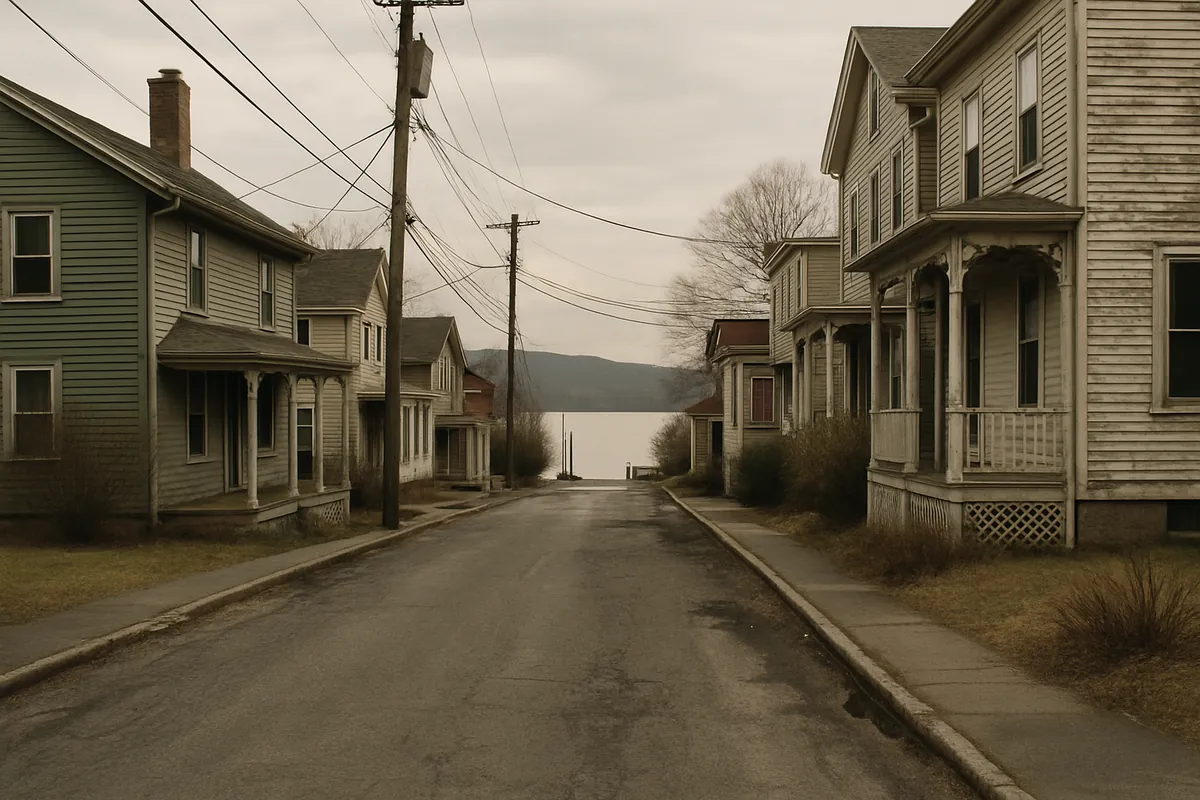
New City Trenchless covers trenchless sewer lateral repair in Sparkill, a small hamlet in the Town of Orangetown that sits in the Sparkill Creek valley. Some homes here occupy low, creek-adjacent lots while others stand on higher ground above them, and that difference, more than anything else, shapes what a lateral is likely to be doing underground. A repair plan should start by establishing where a given house sits in that valley, then follow with a supported choice between lining, pipe bursting and focused excavation.
A Hamlet Built in the Creek Valley
Sparkill takes its name and its shape from the creek. Sparkill Creek runs down through the hamlet on its way toward the river, passing through the Sparkill Gap, the one notch in the Palisades ridge low enough for a watercourse to cut through at anything near valley level. The creek continues east and empties toward the marsh edge at Piermont, but the ground here in Sparkill is a creek corridor rather than a tidal flat.
That distinction matters for sewers. Piermont’s low blocks answer to the Hudson tide; Sparkill’s low lots answer to the creek and to the weather. Ground near the valley floor tends to hold water through wet seasons and dry out between them, so the water a lateral has to contend with rises and falls on a seasonal rhythm, not a daily one. A house set back on the higher ground above the creek sits in a different situation entirely, often a drier one.
Two Kinds of Lot in One Small Hamlet
A Sparkill lateral behaves differently depending on where the house sits relative to the creek. The camera, not the street address, is what sorts one from the other.
| Where the house sits | Ground under the lateral | What tends to go wrong |
|---|---|---|
| Low lots near the creek valley | Damp valley soil, seasonal high water | Infiltration at cracked joints, standing water in a settled run |
| Mid-slope, older hamlet core | Mixed fill over a long build-out | Offset joints, root intrusion at material transitions |
| Higher ground above the creek | Firmer, better-drained soil | Root intrusion and ordinary joint wear rather than water |
The low-lot runs are partly a water problem; the higher runs are a pipe-and-root problem. Neither is a guess once a camera is in the line, and neither should inherit a diagnosis from the other simply because both carry a Sparkill address.
What Seasonal Groundwater Does to a Low Lateral
On the creek-adjacent lots, a lateral that dips below the wet-season water line takes in groundwater through every cracked or offset joint. That infiltration runs down the public mains at the system’s expense, and the same defects can let wastewater seep out into ground that drains toward the creek corridor. Unlike a tidal setting, the effect here tracks rainfall and the season rather than a twice-daily cycle, so it can be strong one month and quiet the next.
Soft valley soil also settles unevenly over decades. A run that sags between two higher points holds standing water, solids drop out in the low spot, and the sag deepens until the line barely clears. Standing water seen on camera is a reason to investigate further, not a finished grade survey. Cleaning, locating and additional measurements may be needed to tell an obstruction from an offset from a genuinely settled section.
Mid-Century Homes and a Mixed Parts List
Much of Sparkill’s housing dates to the middle of the last century, and the laterals under those homes reflect it. A single run can pass through vitrified clay toward the street, a cast iron section where an indoor stack was carried outside, and in some cases a bituminized fiber splice from the window when that pipe was being made a few miles up the road in Orangeburg. Each change of material is a coupling, and couplings are where many of these lines give out first.
A sewer camera inspection records each material change and locates every transition from the surface, with defects coded to standard grades so the report stays useful to the owner, a contractor or a future home inspector. On a mixed line the survey is the whole foundation of the decision, because no two older Sparkill laterals share a parts list.
Laterals That Cross Older Yards
The other recurring Sparkill constraint is the route itself. On older hamlet lots a lateral does not always run straight to the street. Some angle across a side yard, pass near a shared boundary, or bend toward the creek valley behind the house, through ground that has carried mature trees and landscaping for generations. Roots treat the joints along that path as a way in, which is why tree root removal buys a season while sealing the joints is what ends the recurrence.
Where the located route runs near a boundary or appears to cross neighboring land, the paperwork comes before the digging. A camera location establishes where the pipe is; it does not establish a right to enter a neighbor’s yard. Access permission and any easement questions get settled first, so the physical repair route and the legal one agree before the ground is opened.
Choosing Lining or Bursting on a Valley Lot
Trenchless pipe lining can suit a lateral with repairable wall defects or leaking joints once the host pipe is cleaned and prepared, and it works from a cleanout or a compact pit rather than a trench across a yard full of mature plantings. A liner forms a new continuous interior along the existing route, which is why it reads well on the low lots: a jointless surface gives seasonal groundwater nothing to enter. What a liner does not do is raise a settled belly or change an alignment, so where the grade itself is the problem, sewer line repair and replacement may call for a targeted opening at that one spot even when the rest of the run can be repaired without a continuous trench.
Pipe bursting replaces an unsuitable lateral by splitting the old host pipe outward while pulling fused HDPE through its path, leaving a continuous jointless run with nothing for roots or groundwater to find. It needs room at both access pits plus a staging area for the replacement pipe, so on a tight valley lot the plan has to confirm where that setup will fit. A collapsed section gets a specific evaluation rather than an automatic promise that a pull will pass through it.
Confirm Requirements and Restoration First
Before any excavation, owners should confirm the permit, utility-marking and inspection requirements with the Town of Orangetown, and ask directly about work near the creek corridor, a road, a sidewalk or a connection outside the lot. Those requirements belong with the written scope of work, not assumed from how a neighboring village handles things. Restoration deserves the same attention as the pipe: identify the proposed openings, the affected paving and plantings, and how backfill will be handled on soft valley ground.
Sparkill’s neighbors each face a different version of the same work. Piermont answers to a tidal marsh and a high water table under its pier village streets. Tappan carries generations of patched, mixed-material laterals around its historic core. Orangeburg sits up the hill along its commercial and industrial corridor, with the hometown fiber pipe under many of its homes. Sparkill is the creek-valley case between them, where the first question is always how close a given lateral runs to the water in the ground.
Frequently Asked Questions
My house sits down near Sparkill Creek. Does the creek change how my lateral behaves?
It can, on the low lots. Ground close to a creek valley tends to hold more water through wet seasons, and a cracked joint below that level will take in groundwater that comes and goes with the weather. A camera run shows whether a given lateral sits in that band or on drier ground above it, which is the thing worth settling before choosing a method.
The lateral seems to run across an older yard toward the creek. Does that complicate the repair?
It can, so it is worth locating first. Older hamlet lots sometimes carry a run that angles across a side yard or near a shared boundary before it reaches the street or the valley. A camera with a locating sonde marks the actual route and depth from the surface, and if any part of the work would touch neighboring land, permission and easement questions get resolved before a crew opens the ground.
A pipe heading toward the creek must drain into it, right?
Direction alone does not establish the connection. A lateral pointed at the valley may still tie into a street main rather than the creek. Have the accessible pipe inspected and its route located, then confirm the connection against available property records before planning anything beyond the lot.
What pipe is likely under a mid-century Sparkill house?
Homes from that era around here commonly carry clay tile toward the street, cast iron where an indoor stack was carried outside, and in some cases a fiber section spliced in from the factory window up the road. The camera confirms which, and where one material meets another, because those transitions are where many of these laterals actually fail.
Do I need to check with anyone before digging near the creek?
Yes. Confirm permit, utility-marking and inspection requirements with the Town of Orangetown before any excavation, and ask specifically about work near the creek corridor or outside your lot line. Do not borrow an assumption from a neighboring village. Keep the confirmed requirements with the written scope of work.