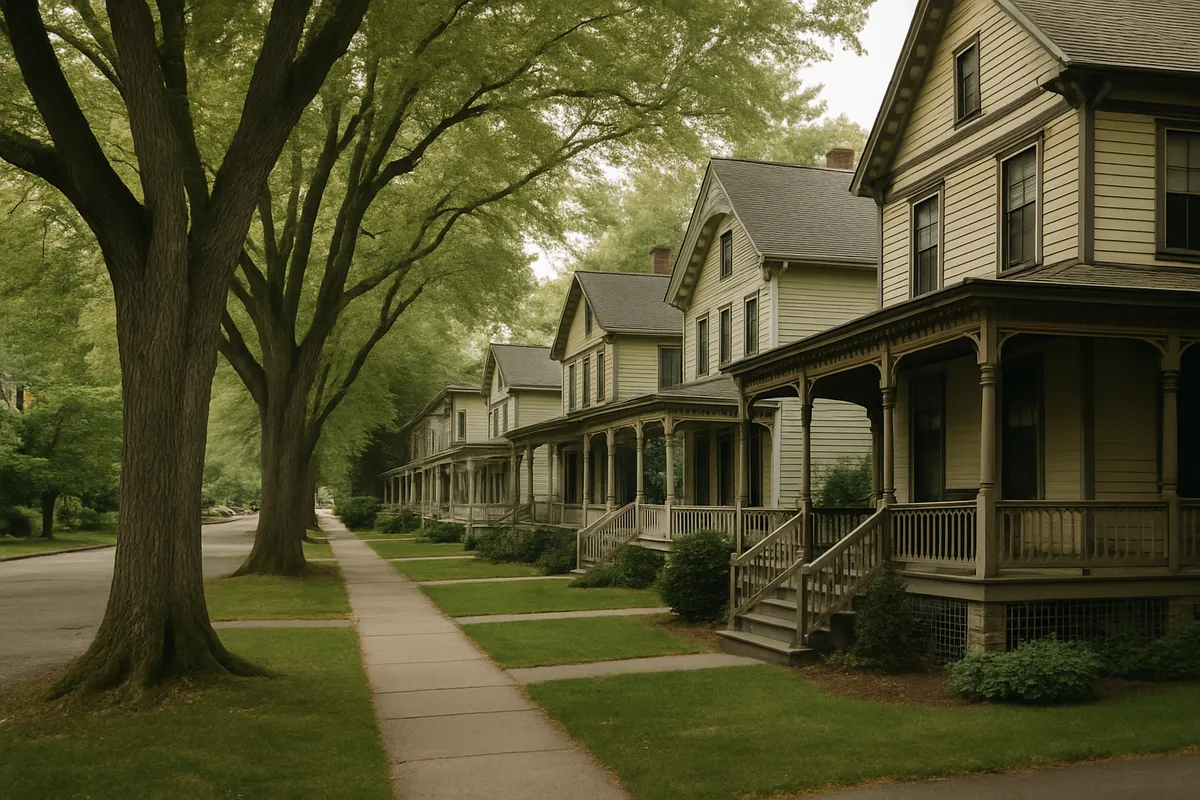
New City Trenchless covers repair options for the mixed-material sewer laterals found under Tappan, a hamlet settled in 1686 where a single run can pass through vitrified clay, cast iron, fiber pipe and PVC before it reaches the street.
Three Centuries of Housing, One Buried Patchwork
The 1700 DeWint House and the ’76 House still stand near the old four corners, the Reformed congregation dates to the 1690s, and homes have been added around them in every generation since. The sewers arrived long after the houses did, and the repairs arrived piecemeal after that: clay tile at the first hookups, cast iron sections dropped in at mid-century, a fiber splice from the factory era a few miles up the road in Orangeburg, and plastic point fixes from the last thirty years.
Every material change means a coupling. On the oldest lines here there can be four or five couplings between the house trap and the main, each one installed by a different crew, to a different standard, in a different decade.
| What the camera finds | Where it usually came from | Typical failure at that point |
|---|---|---|
| Vitrified clay tile | Original hookup, first half of the century | Root intrusion, offset mortared joints |
| Cast iron | Mid-century repair, or the indoor stack carried outside | Corrosion channeling along the invert, scale |
| Bituminized fiber | Postwar splice from the factory era | Ovalling and delamination, cannot be lined |
| Plastic (SDR-35) | Recent point repair | Sound pipe, failed coupling to whatever it met |
Dutch Sandstone Houses and the Plumbing Added Later
Tappan’s old core is built of local red sandstone, laid up as low, thick-walled Dutch colonials on shallow foundations. Those houses were not designed around indoor plumbing. Drainage was cut into them afterward, sometimes more than once, and the exit point through a stone wall is frequently the tightest and most awkward part of the whole run.
That drives method selection more than most homeowners expect. A stone wall penetration is not something anyone should be widening, and it rules out approaches that assume a clean sleeve through poured concrete. Working from an outside cleanout, or setting one in a compact pit, leaves the original wall untouched.
Why the Splices Fail Before the Pipe
Mixed materials settle at different rates. A heavy cast iron section bears down while the light plastic beside it floats in its bedding, and an offset joint opens at the transition. Mismatched inside diameters leave a lip that snags paper until a grease blockage forms at the same footage every winter.
Roots treat every splice as a door. Root intrusion on a patched line clusters at the couplings, not along the barrel of the pipe, which is why tree root removal buys a season and sealing the joints buys a generation. The trees here are older than the plumbing by a wide margin; the ones shading Old Tappan Road and Kings Highway were mature before the first laterals went in.
A lateral that needs snaking every year is nearly always failing at its transitions rather than along its length. That is the single most useful thing to know before spending money on this kind of line.
The Postwar Streets Between the Old Core and the State Line
Most of Tappan is not colonial at all. The hamlet filled out south and west toward the New Jersey line through the 1950s, 60s and 70s as commuters came over the new bridge, and those subdivisions carry single-era laterals, mostly clay and fiber, without the patchwork.
Those runs fail differently and far more predictably. A street built out in one season tends to reach the end of its service life in the same few years, which is why one backup on a block is often followed by two or three more within a couple of winters. On streets like that, filming a lateral that still drains is straightforward preventive work rather than a reaction to a flooded basement.
Mapping a Mixed Material Line Foot by Foot
On a patched line the survey is especially valuable because no two Tappan laterals share a parts list. A camera inspection records each material change while a locating sonde marks the position and depth of every transition from the surface. Defects get standard condition codes and footages using the grading system maintained by NASSCO, so the report remains useful to the owner, contractor, and a future home inspector.
The output is a map of which couplings hold and which do not. The method decision falls straight out of it, and so does the price.
One Bad Splice Does Not Need a Whole New Lateral
Where the map shows a single failed transition, a sectional point repair is the right-sized fix. A short fiberglass sleeve is wetted out with epoxy resin, positioned over the bad coupling from the cleanout, and left to cure against the host pipe. Sewer spot repair exists for exactly this kind of line, and on Tappan patchwork it is often the difference between a four-figure job and a five-figure one, $1,500 to $4,000 against $4,000 to $12,000.
Where several transitions have failed at once, a full-length cured-in-place liner turns the whole patchwork into one continuous jointless pipe and is the better spend. Where a fiber section has already lost its shape, no liner will cross it and the run is burst instead, $6,000 to $15,000. Note which way the arithmetic runs: on a five-coupling line, three separate spot repairs cost more than lining the lot.
Working Ground Inside the Historic District
The historic district is the other reason trenchless fits this hamlet. Lots around Main Street and Old Tappan Road are tight, walkways are old stone, and several of these properties sit in a district recognized under the National Register program. Putting an excavator on that ground is a conversation with the town before it is a plumbing job.
Working through cleanouts and one compact pit avoids most of that conversation and leaves the stone, the trees and the grade where they are. The same argument carries downhill to Piermont, where the obstacle is groundwater instead of history, and north to Blauvelt, where it is shallow rock. Different ground, same conclusion about trenching.
One last piece of Tappan housekeeping: the mains in the street are the county sewer district’s responsibility, and the lateral from the house to the tap is yours. On a line with five couplings in it, knowing exactly where your responsibility ends is the first thing the camera settles.
Frequently Asked Questions
Why does my Tappan sewer line clog at the same spot every year?
Almost certainly a splice. A lip at a material transition or an offset joint snags paper and grease at the same footage every time. Snaking clears the symptom for a season; fixing that one coupling ends it.
What does a spot repair cost in Tappan?
A sectional spot repair runs $1,500 to $4,000. If the camera shows failures at several transitions, lining the full lateral at $4,000 to $12,000 is the better spend. The camera inspection itself is $250 to $500.
Can one liner run through clay, cast iron and PVC in the same line?
Yes. A cured-in-place liner bridges every material and coupling in the run and comes out as one continuous pipe. Diameter steps between old and new sections are handled in the liner sizing, which is one reason the camera survey comes first.
My house is in the historic district. Does that limit what can be done?
Check with the Town of Orangetown before anyone breaks ground, because that is the office that decides. The practical point is that trenchless work barely breaks ground at all: a cleanout and one compact pit, no trench across a stone walk, no excavator beside a two-hundred-year-old foundation.
The old part of my house is sandstone. Does that change the job?
It changes the preferred access point. A drain cut through a thick stone foundation wall long after the house was built is usually the tightest point in the run, and a repair should not require widening it. An outside cleanout can provide access instead.