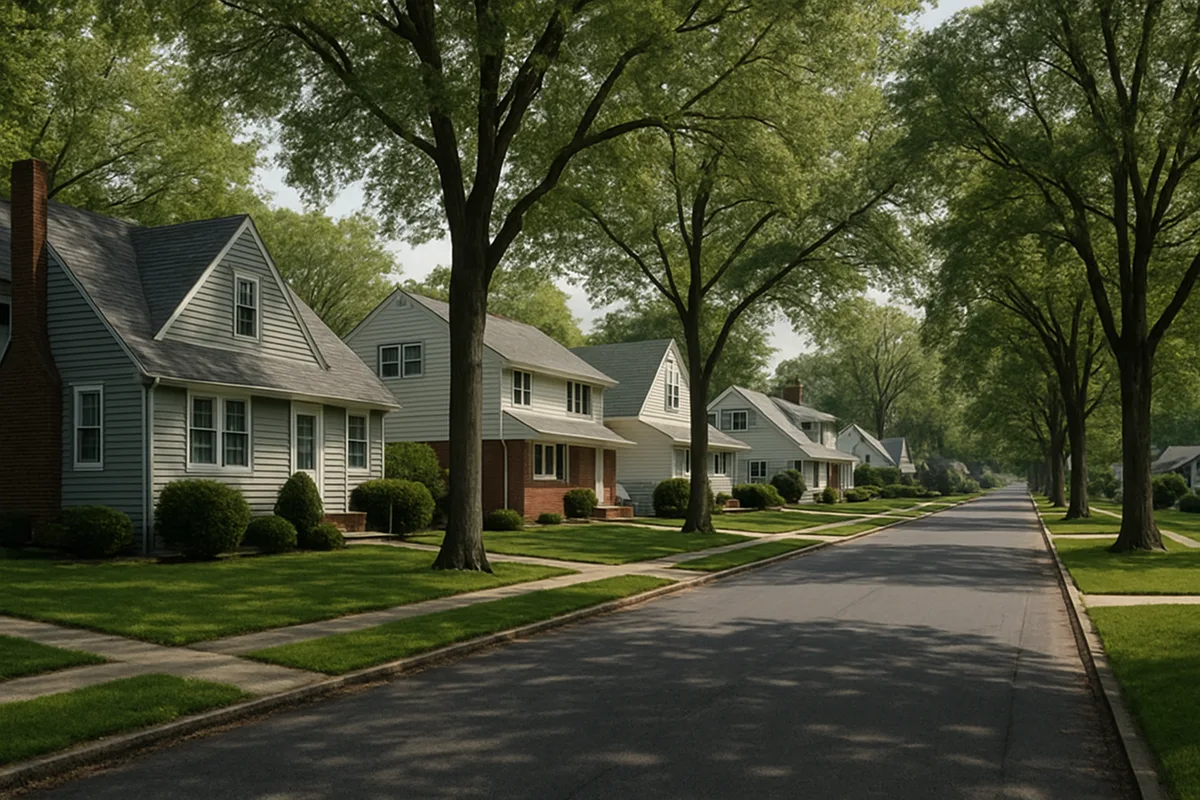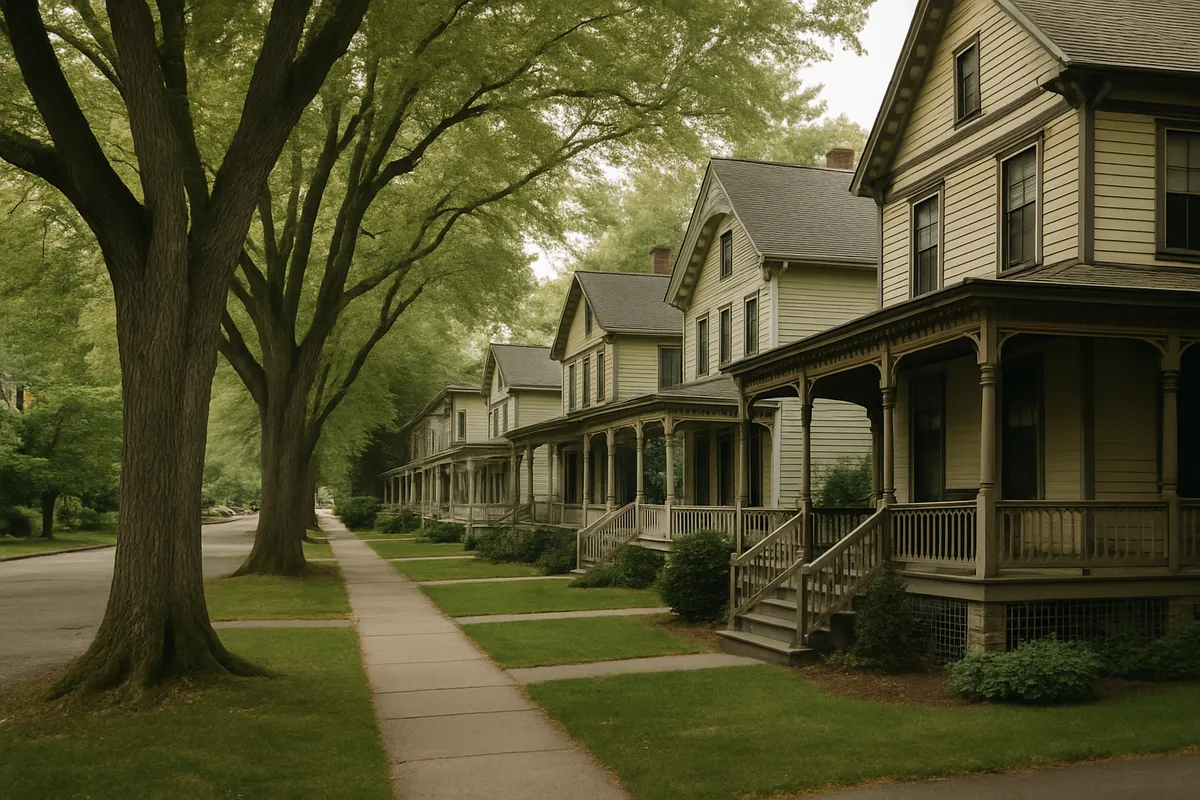
New City Trenchless covers repair options for some of Rockland County’s oldest sewer laterals in Nyack, a Victorian river village whose mature street trees have had decades to find clay joints under the sidewalks.
Laterals Older Than Most of the County’s Houses
Nyack was a working river town long before Rockland had suburbs. Steamboats landed here, shoe factories employed the village, and the housing on the slope between Broadway and the Hudson dates to the same stretch of the 1800s as the Edward Hopper House on North Broadway, which was built in 1858. The village was incorporated in the 1870s, and much of the vitrified clay pipe serving these homes went into the ground when the streets themselves were laid out.
Clay of that vintage was made in short sections, a couple of feet at a time. A sixty foot lateral can therefore hold twenty or more joints, every one of them generations old and every one a candidate for root intrusion, groundwater infiltration or an offset. Nothing about that pipe is defective. It has simply outlived the jointing material that held it together.
Treatment for the Nyacks is handled locally rather than by the county district that takes the Clarkstown hamlets, but the ownership line is the same everywhere in Rockland. The main under the street is public. The lateral from your foundation wall out to the tap is yours, including the section under the sidewalk and the tree belt.
A Century of Street Trees Over Open Joints
Nyack’s canopy causes most of its sewer calls, and the mechanism is worth understanding because it explains why snaking never ends the problem.
Roots do not break into sound pipe. They follow moisture and nutrient gradients, and a joint weeping warm wastewater into cool soil is the strongest signal a tree gets. Fine hair roots enter through the gap, then thicken over seasons into a mat that catches wipes, grease and paper. Clearing that mat with an auger buys a season, because cutting changes nothing about the opening the roots used to get in.
The lasting fix pairs tree root removal by mechanical cutting and hydro jetting with lining of the affected section, which seals the entry joints and takes the roots out of the equation without harming the tree. Guidance from Cornell Cooperative Extension on mature tree care runs in the same direction: the damage to an established tree comes from cutting through its root plate, which is exactly what an open trench through a Nyack tree belt does.
Steep Fall, Shallow Rock and a Tidal River Below
Three pieces of Nyack geography change how a lateral behaves here.
The grade is the first. Streets terrace down toward the Hudson and laterals follow, so pipe fall in the village often exceeds design minimums instead of falling short of them. Steep fall keeps solids moving, which is a genuine advantage, but it magnifies what a single offset joint does to flow and it dictates how a liner is installed and cured.
The rock is the second. On the slope, bedrock and glacial till sit close to the surface, with the diabase ridge of Hook Mountain rising just north of the village and quarried there historically. Shallow rock is why so many old laterals here are set at awkward depths and why open-cut excavation gets expensive fast.
The river is the third. The Hudson at Nyack is tidal, part of the estuary tracked by New York State’s Hudson River program and gauged by the U.S. Geological Survey, and it is close to three miles wide between here and Tarrytown. At the bottom of the slope, on Piermont Avenue and the streets near the water, groundwater sits high and moves. Every open clay joint down there is an infiltration point.
Retaining Walls, Terraces and the Real Cost of a Trench
What makes open-cut expensive in Nyack is rarely the trench itself. It is what stands above the pipe: terraced gardens, dry-laid stone retaining walls, brick walks, slate steps and the trees. None of that gets put back the way it was, and on the slope the wall above a lateral is often holding the yard up.
Trenchless sewer repair sidesteps all of it. Access is an existing cleanout or one or two small pits, and the ground between them stays closed.
| What the camera shows | Method | Typical range |
|---|---|---|
| One failed joint, rest of the run sound | Sectional point repair | $1,500 to $4,000 |
| Open joints and roots the length of the run, walls intact | Clean, cut roots, then full lateral lining | $4,000 to $12,000 |
| Collapsed or crushed section, walls gone | Pipe bursting with fused HDPE | $6,000 to $15,000 |
| Unknown, or a sale under contract | Camera inspection first | $250 to $500, often credited |
Open-cut on the same run commonly runs 1.5x to 2x the trenchless figure here once the stonework and planting restoration are counted honestly, which is the gap most Nyack quotes turn on.
Lining Century-Old Clay Without Opening the Street
The process itself is exact. The felt liner tube is saturated with epoxy resin, inverted into the run, pressed against the host pipe with a calibration tube and cured, ambient cure on shorter runs and steam cure when the schedule calls for speed. The result of trenchless pipe lining is one continuous jointless bore from cleanout to sewer main, inside a pipe that may have been serving the same house since the village’s steamboat days.
Where the clay has already deformed or a section has dropped out, no liner will hold the shape and the run is burst and replaced instead. That call is made on video, never on the phone.
Scope It Before You Buy Above Broadway
Nyack turns over a lot of century-old houses, and the lateral is the one system a standard home inspection does not look inside. A pre-purchase sewer inspection costs $250 to $500 and tells you whether you are buying sound clay with tired joints or a run that is already gone.
The same housing age and the same tree-lined streets run south through Piermont and north through Valley Cottage, while West Nyack just over the hill is postwar tract housing with an entirely different set of problems underground.
Frequently Asked Questions
Roots come back into my sewer line every year. Can that actually stop?
Yes. Cutting alone reopens the pipe but leaves the joints open, so regrowth is guaranteed. Lining the affected section after cutting seals the entry points, and the cycle ends.
Is hundred-year-old clay pipe still linable?
Usually. Clay walls outlast clay joints, and a liner needs sound walls, not sound joints. The camera makes the call: lining for intact but leaky runs at $4,000 to $12,000, pipe bursting for collapsed sections at $6,000 to $15,000.
Will the work damage the street trees?
No. Trenchless access is one or two small pits or an existing cleanout, so the root systems above the lateral are left alone. Open-cut trenching through a mature root zone is what harms trees, and avoiding it is much of the point.
We are buying an old house in Nyack. Should we scope the sewer first?
Always, in housing this age. A pre-purchase camera inspection costs $250 to $500, and a failed lateral is a $4,000 to $15,000 negotiation point you want before closing, not after.
My house is on the slope and the lateral runs under a stone retaining wall. Now what?
That is a standard Nyack job and it is the strongest case for going trenchless. A liner is installed through a cleanout at the top of the run, and bursting needs a pit at each end rather than a trench, so the wall, the terrace and the steps above the pipe are never touched. Rebuilding dry-laid stone after an open cut usually costs more than the pipe work did.