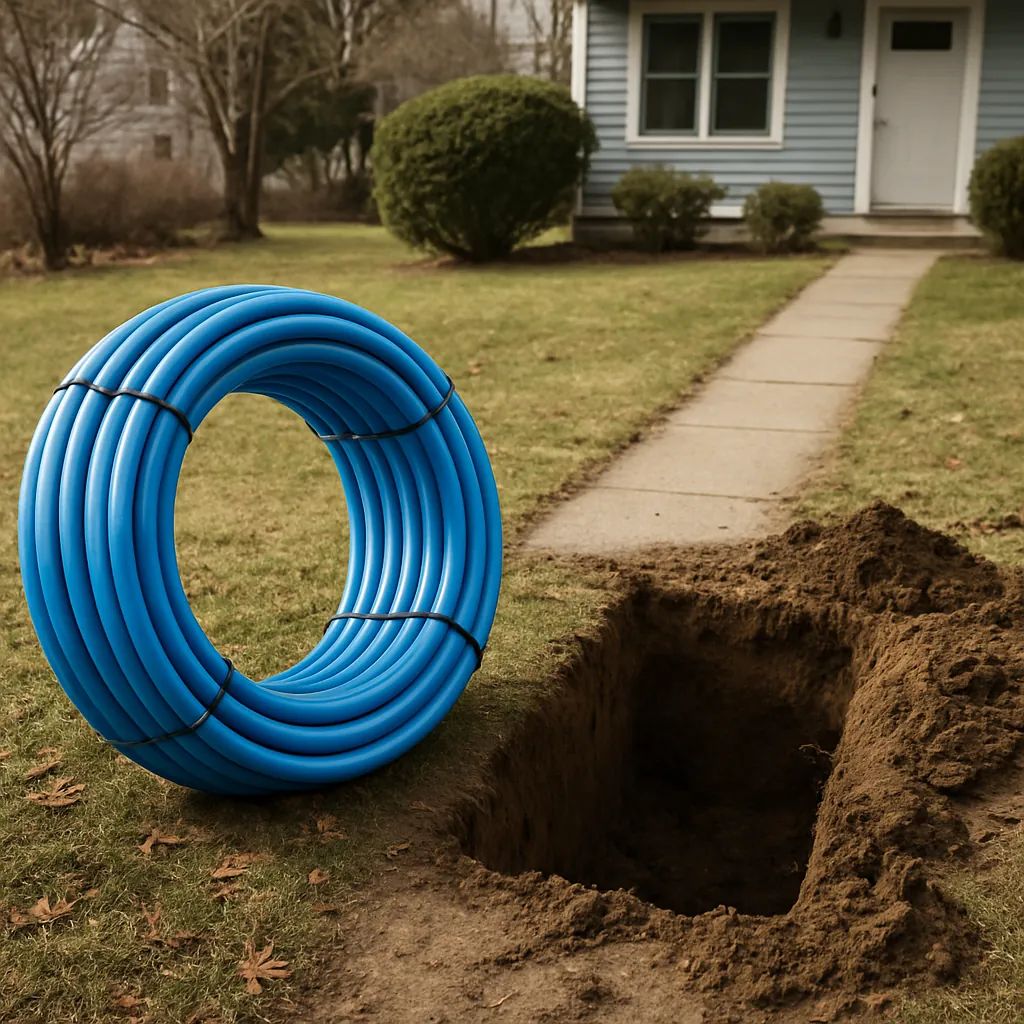
New City Trenchless explains how failing water service lines can be replaced by pulling new Type K copper or HDPE through the path of the old pipe, with one small pit at the curb stop and one at the foundation instead of a trench across the front yard. It is the pressurized-side cousin of trenchless sewer replacement, and it is a different job in almost every detail that matters.
A Water Service Line Is Not a Sewer Lateral
A sewer lateral is gravity pipe: 4 to 6 inches in diameter, laid to a slope so waste falls toward the sewer main, and it fails inward, by root intrusion and infiltration through open joints. A water service is the opposite animal. It is 3/4 inch or 1 inch, runs under constant street pressure, needs no fall at all, and fails outward, pushing treated water into the soil day and night.
That difference drives the diagnosis. There is no cleanout to open and no CCTV crawler small enough to drive through a 3/4 inch bore, so nothing here resembles a sewer camera inspection. A water service is diagnosed from the outside: the meter dial with every fixture closed, a static and flowing pressure reading at a hose bib, the drop between the two, and acoustic listening along the pipe path when the leak has not surfaced. The pipe route itself is traced with a line locator before anything is opened.
What Gets Pulled In: Type K Copper and HDPE
| Material | Typical size | Joints under the yard | Notes |
|---|---|---|---|
| Type K copper | 3/4 in or 1 in | None between the pits | Heaviest wall of the three copper types, 0.065 in wall at 3/4 in, the traditional direct burial standard |
| HDPE, copper tube size | 3/4 in or 1 in | None, one continuous coil | PE 4710 resin, SDR 9, rated 200 psi for water at 73 F, flexible enough to pull around a bend |
| Galvanized steel | 3/4 in | Threaded couplings every length | What is usually coming out, not going in. Corrodes from the bore outward |
| Lead | 1/2 in to 1 in | Wiped joints | Soft, non magnetic, scratches shiny. Replace the full run, never half of it |
Both new materials are pressure tested and disinfected before the service goes back in use, and both go in below the frost line, which in this part of the lower Hudson Valley means several feet of cover. Standards for small diameter polyethylene water service pipe are published by AWWA, and both material choices are ordinary utility practice rather than anything exotic.
How the Pull Actually Runs
The old service is traced and marked with a locating sonde, then two pits are opened, one at the curb stop and one where the line enters the foundation. Utility marks go in first, because a water service commonly shares the front yard with gas, electric and communications runs, and the pull path has to clear all of them.
A cable or rod goes through the old pipe from one pit to the other. A splitting head, the small-diameter cousin of the head used in pipe bursting, is then towed back through under hydraulic pull. It opens the old line along its length and draws the new pipe in behind it in a single continuous pull. The new line is connected at the curb stop and at the meter, pressure tested, flushed until clear, and put back in service. What the yard sees is two patches, not a scar the length of the property.
What Fails Under Rockland’s Postwar Yards
The same subdivisions that got vitrified clay and Orangeburg on the sewer side of the trench got galvanized steel or early copper on the water side. Galvanized steel corrodes from the inside out: the bore closes up over decades, pressure at the far fixtures drops, and the first draw of the morning runs rusty. Early thin-wall copper fails by pinhole leaks instead, often several within a few feet of each other once the wall has thinned, which is why patching one pinhole rarely ends the story.
One local footnote: Orangeburg fiber pipe was never a water material, so whatever is carrying your drinking water, it is not the hometown pipe. If the house sits on Orangeburg for the sewer, though, that dates the build, and a lateral of that era usually means a water service of that era in the same trench line.
Ground Conditions That Decide the Method
Freeze-thaw cycling works on any shallow buried pipe, which is why cover depth matters as much as material. Frost heave lifts and settles the soil column, and a rigid threaded joint takes that movement badly while a continuous coil of HDPE simply moves with it.
The low-lying river villages add a second factor. Ground near the Hudson and near the Hackensack headwaters wetlands carries a high water table, so a leaking service in Piermont or the flats below Nyack may never surface as a wet patch at all, because the water joins groundwater that is already close to the surface. In those neighborhoods the meter test carries more weight than what the lawn looks like. Wet, acidic soil is also hard on buried metal, which is a fair argument for the jointless plastic option.
The Lead Question Without the Scare Tactics
If your home predates roughly 1950 and the service has never been replaced, lead is possible, not certain, and it is worth twenty minutes to find out. The scratch test at the meter in the FAQ below settles most cases. Water systems are now required to compile service line material inventories under federal drinking water rules administered by the EPA and enforced in this state through the New York State Department of Health, so your supplier may already have your answer on file before you touch a coin.
If the line is lead, replace the full run in one pull. A partial swap that leaves half the lead in the ground disturbs the pipe without removing the problem. What the situation does not call for is a scare quote signed on the spot: a lead service that has sat undisturbed for 70 years does not become more dangerous during the week you take to get a second bid.
Signs the Service Is Already Leaking
The classic test costs nothing: shut every fixture off and watch the meter. Movement with no water in use means the line is losing water somewhere between the curb and the house. Softer evidence includes a permanently soggy strip or an oddly lush green line in the lawn along the pipe path, a hiss at the meter, pressure that has faded year over year, or a water bill that stepped up and never stepped back down.
A pressurized leak runs around the clock and never heals, which is why trenchless water line replacement is usually scheduled within days of the meter test, before the water bill does the scheduling for you.
When Trenchless Is the Wrong Call
Pulling in a new service assumes the old pipe can be followed and split. Several conditions break that assumption, and it is better to know before the pits are open than after.
A line that has collapsed flat, been cut by later work, or been rerouted around an addition may not accept a rod end to end. Shallow bury, rock close to the surface, or a service that runs under a slab or through a finished basement wall can force a partial dig. A path crowded with other utilities at the same depth is another stop sign, because a splitting head displaces soil sideways and needs clearance. In those cases the honest answer is a partial open cut, or a new line on a fresh path, and the cost comparison shifts accordingly. Trenchless work is a method, not a religion, and the same logic that decides what a sewer repair should cost applies here: the right method is the one the ground allows.
Frequently Asked Questions
Can you line a water pipe the way you line a sewer?
Not with the same system. The felt liner tube and epoxy resin used in CIPP sewer lining is built for gravity pipe in the 4 inch and up range, not for a pressurized 3/4 inch potable line. For residential water services the reliable trenchless answer is pulling in a new pipe, not lining the old one.
How do I check whether my service line is lead?
Find the pipe entering your water meter and scratch it gently with a coin. Lead is soft gray metal that scratches shiny and does not attract a magnet. Galvanized steel holds a magnet, and copper is copper colored. Your water supplier may also already list your line in its service line material inventory.
How long does a water line pull take?
Typically a single day. The pits are opened in the morning, the new line is pulled, pressure tested and flushed, and water is back on the same evening. Yard restoration is two small patches rather than a trench.
Who owns which part of the water service?
In most Rockland systems the utility owns from the main in the street to the curb stop, and the homeowner owns from the curb stop to the house. Confirm with your own water supplier before any work, because district rules differ.
Copper or HDPE, which should I pick?
Both are long service materials. Type K copper is the heaviest wall copper made and the traditional direct burial choice. HDPE arrives as one continuous coil, so there is no joint anywhere under the yard and nothing for aggressive soil to attack. Where the ground is wet or acidic, the jointless plastic run is usually the easier argument.