New City Trenchless covers the full range of sewer line repair options in Rockland County, from a sectional fix over one leaking joint to full replacement of a lateral. Vitrified clay, cast iron and Orangeburg each fail differently. Which repair fits should be read from camera footage, defect by defect.
Repair or Replace: The Camera Makes the Call
A proper evaluation starts with a CCTV sewer inspection, with each root mat, offset joint, fracture and sag recorded by position and severity. The pattern decides the work. One or two defects in an otherwise sound line may justify a repair, while defects distributed along the run can support replacement.
Grading to a published standard matters because it takes opinion out of the estimate. A crack graded as a longitudinal fracture and a crack graded as a broken pipe with soil visible behind it are two different jobs at two different prices, and the NASSCO coding says which one is on your screen. Ask for the footage and the log, not a verbal summary, on any quote including ours.
Where Your Line Ends and the District’s Begins
The pipe from your fixtures to the connection at the street is yours. The main it connects into is maintained by the sewer district, which in most of this county is Rockland County Sewer District No. 1. That boundary decides who pays, and it also decides how the work is scheduled, because anything reaching the tap or the right of way is coordinated with the town or village and with Rockland County rather than simply dug.
Practically, the boundary is why a two-way cleanout near the property line is worth the small extra cost during any repair. It gives every future camera and jetter a launch point on your side of the line, and it produces footage that clearly shows whether a problem is upstream or downstream of your responsibility.
Repairs That Stop Short of Replacement
Sectional point repair
A short cured-in-place sleeve is set over a single failed spot, an offset joint, a root entry, a fracture, and cured there. One defect, one fix, detailed on the sewer spot repair page.
Clearing without repairing anything
Grease blockage and scale buildup are service problems, not always structural ones. A drain auger clears the stoppage, and a hydro jetter strips grease, scale and cut roots back to the pipe wall. The honest caveat: clearing roots without sealing the joint they entered through buys a year or two, not a fix.
Finding to Method: The Decision Table
| What the camera grades | Usual method | Yard impact |
|---|---|---|
| One offset joint or root entry, sound pipe either side | Sectional point repair | None, works through a cleanout |
| Root intrusion at most clay bells, pipe still round | Full-lateral cured-in-place lining | None to minimal |
| Cast iron channeled along the invert, shape intact | Descale and line | None to minimal |
| Any confirmed Orangeburg | Pipe bursting in new HDPE | Two small pits |
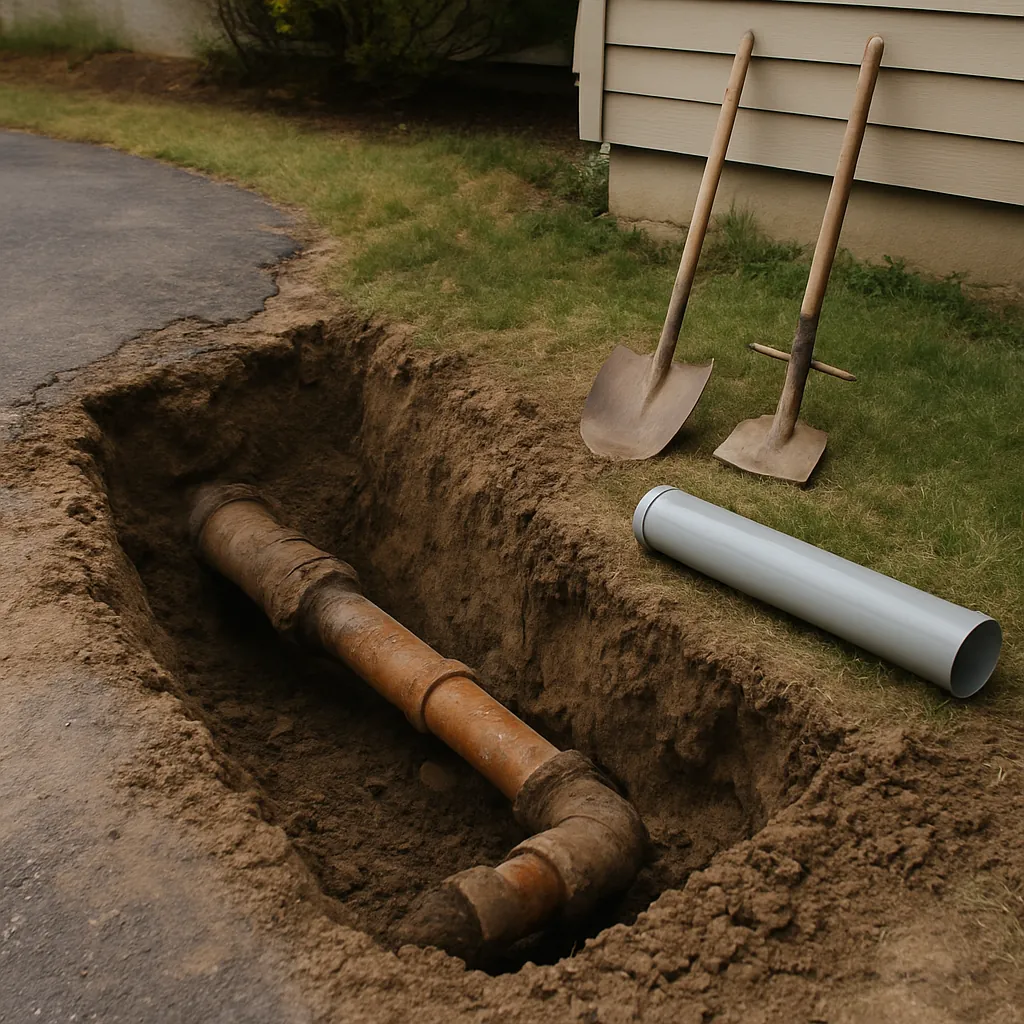
| Collapse, or a belly that has to be corrected | Open-cut at the affected length | Trench over that section |
The Cost Ladder
The camera inspection runs $250 to $500 and is often credited against the work. A sectional point repair runs $1,500 to $4,000. Full-lateral lining runs $4,000 to $12,000, and bursting replacement $6,000 to $15,000. Open-cut of the same run typically lands at 1.5 to 2 times the trenchless number once excavation, spoil hauling and landscape repair are counted. The ladder is why the footage matters: a $2,500 spot repair on a line with nine graded defects is the most expensive kind of cheap.
Grade and Fall: The One Thing Trenchless Cannot Fix
A house drain works on gravity and needs consistent fall, commonly a quarter inch per foot on smaller drains and an eighth of an inch per foot on four inch and larger building drains. Too little fall and solids stall. A belly, where settled trench backfill has let a length of pipe sag below the run line, breaks that fall and collects standing water and solids in the low spot every day.
Here is the limit no brochure mentions. A liner follows the host pipe exactly, so lining a bellied run produces a smooth, watertight, still-bellied pipe. Bursting follows the same bore and can improve alignment only incidentally. Correcting grade means exposing that length, re-bedding it on compacted stone and setting it to fall, which is open-cut work by definition. Bellies are common in this county wherever the trench was cut through soft ground, including the wetland-adjacent soils around Congers and the Hackensack headwaters, and the New York State Department of Environmental Conservation maps of those wetland areas explain the ground conditions better than any soil guess at the curb.
When Repair Stops Making Sense
Some findings move a line off the repair ladder entirely. Stoppages returning within months of cleaning. Root intrusion at every clay bell, so sealing one joint just redirects the roots to the next. Cast iron channeled along its invert for most of the run. Any Orangeburg at all, whatever its current condition, because the material is at end of life as a class. And bellied runs where settled trench backfill has let the pipe sag out of its fall. Those cases go to trenchless sewer replacement, which weighs a structural liner against bursting for that specific line.
Clay, Cast Iron and Orangeburg: How Each One Fails
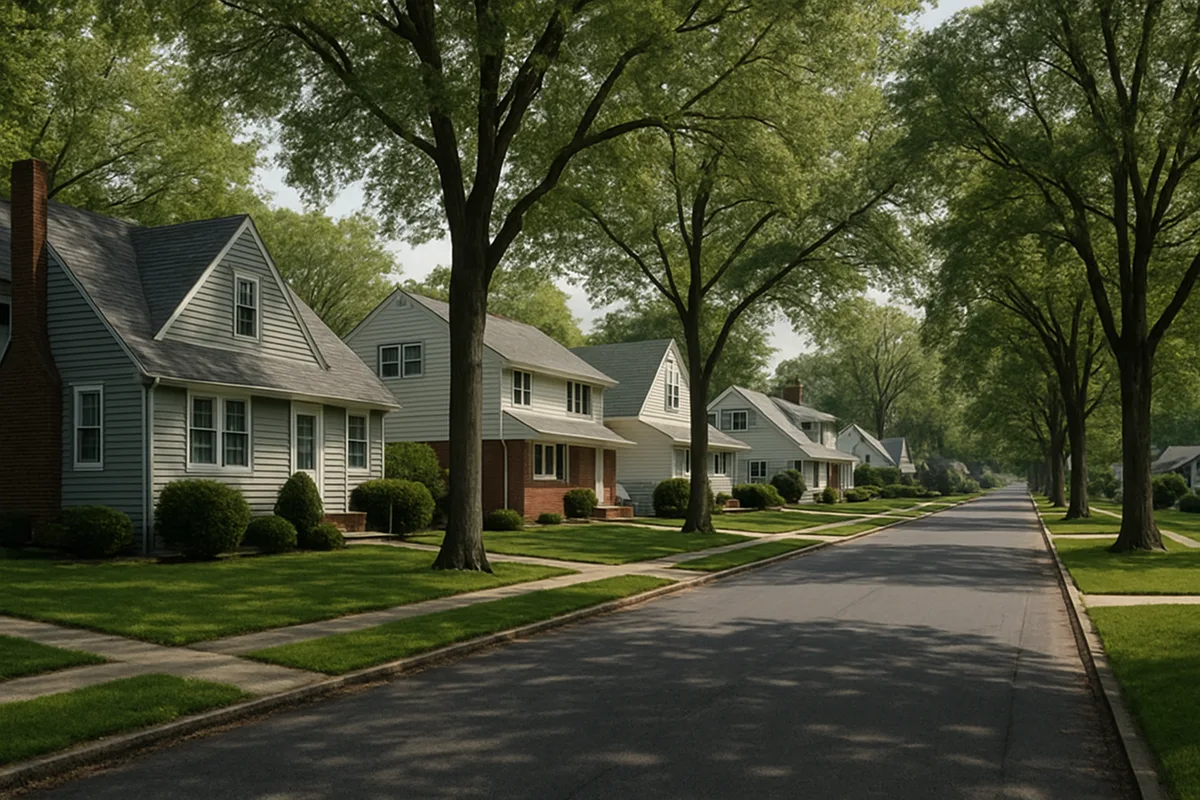
Clay was laid in short sections with a joint every few feet, and every bell becomes an entry point once its seal gives. Mature street trees exploit each one, which is why root intrusion is the classic clay failure and a lush wet stripe over the lateral, exfiltration feeding the lawn, is its tell. Clay itself does not corrode, so a clay line with sound barrels and bad joints is the best lining candidate on the list.
Cast iron fails from the inside. Scale narrows the bore while corrosion channels along the invert where water always runs, so a pipe can look sound at the crown and be gone at the bottom. Older river-village homes add a complication: a house trap at the foundation that blocks rodding access, which is a good argument for adding a two-way cleanout during any repair. In Haverstraw and the other pre-1940 river villages, that trap is often the oldest fitting on the property and the first thing the camera has to get past.
Orangeburg is bituminized wood fiber, produced at the plant in Orangeburg NY ten miles from New City and installed county-wide from the war years into the 1960s. It absorbs water, blisters inward and flattens under load. Any Rockland house from the 1945 to 1972 window may be running on it, and one camera pass settles the question in under an hour.
Related Infrastructure Services
Larger shared lines may call for commercial sewer repair. Separate site problems can require storm drain pipe repair or trenchless water line replacement, each diagnosed and priced independently from the sanitary lateral.
Frequently Asked Questions
Should I repair or replace my sewer line?
If the camera shows one or two isolated defects in otherwise sound pipe, repair. If defects run the length of the line, or the material is Orangeburg, full replacement by lining or bursting costs less than a string of repairs.
What does sewer line repair cost in New City?
$1,500 to $4,000 for a sectional point repair over one defect. Full-lateral work runs $4,000 to $12,000 lined or $6,000 to $15,000 burst. The $250 to $500 camera inspection that sets the number is often credited against the job.
Do I have to dig up my yard?
Rarely. Spot repairs and lining work through existing cleanouts, and bursting needs two small pits. Open-cut is reserved for grade resets and total collapses, and it typically costs 1.5 to 2 times more.
My drain keeps backing up after snaking. Why?
Recurring stoppages mean the auger is clearing symptoms of a structural problem: a root mat regrowing through an open joint, a belly holding solids, or a section starting to collapse. The camera finds which, and the fix is matched to it.
How much of the sewer line is mine to fix?
In most Rockland municipalities the lateral from the house to the connection at the main is private property and the main itself belongs to the sewer district. Work that reaches the street or the tap is generally coordinated with the town or village first, so confirm the local permit requirement before anyone breaks ground.