New City Trenchless covers repair and replacement options for West Nyack sewer laterals, where the Hackensack River and nearby wetlands keep groundwater close to the surface under parts of the hamlet. Wet ground can accelerate bedding movement and make open-trench work more expensive, which strengthens the case for a camera-led trenchless evaluation.
The Hackensack Valley Runs Under Half the Hamlet
The Hackensack River rises in Rockland County and drains south through West Nyack on its way to New Jersey. The flats either side of it are soft, silty and wet within a few feet of the surface for much of the year. Streets on that valley floor, including the low ground off Strawtown Road, Germonds Road and the land behind the Route 59 commercial strip, behave nothing like the streets climbing east toward the Clarkstown ridge or north toward Bardonia, where the soil is firmer glacial till over rock.
You can predict a lot about a lateral just from which side of that line the house sits on. Owners can check where their own parcel falls on the FEMA flood map service center, which is a fair proxy for how wet the ground under the front lawn stays through a normal year.
Two Layers of Housing, Two Kinds of Lateral
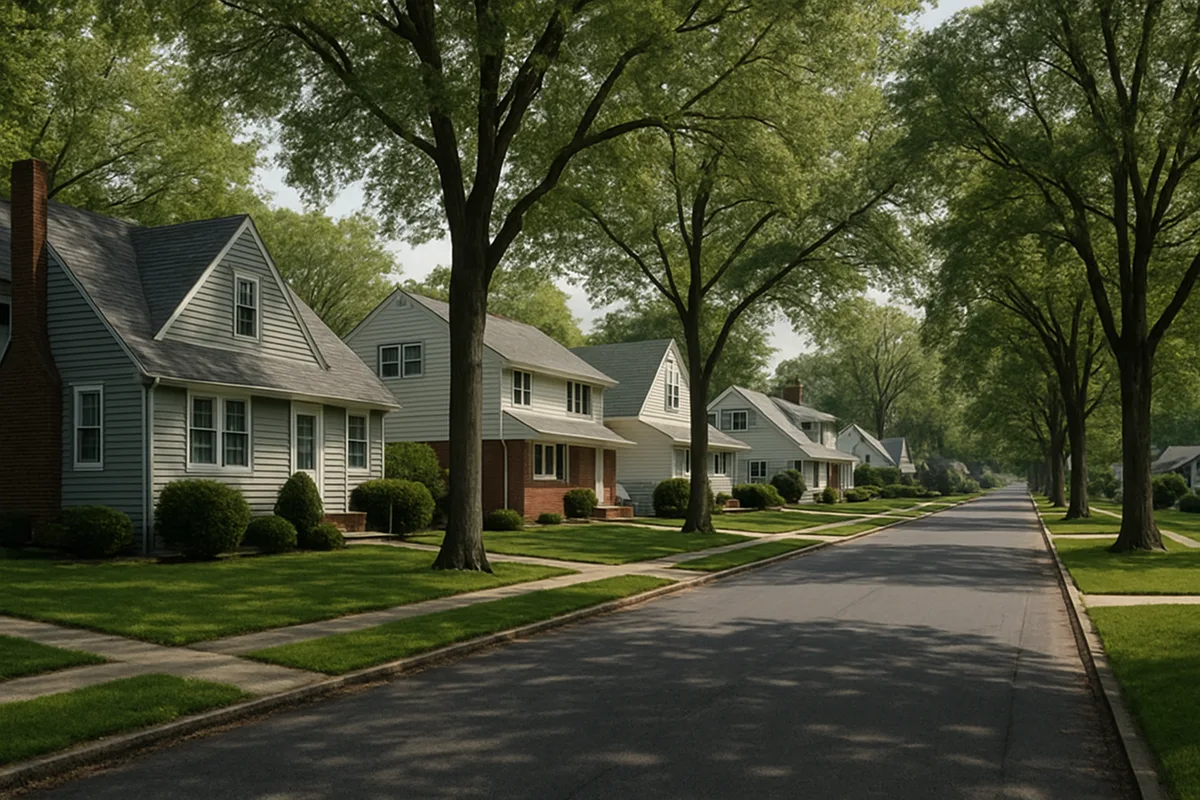
West Nyack has an old core and a young majority. The hamlet was known as Clarksville before it took its railroad-era name in the 1880s, and pre-1900 houses still stand on the older lanes near the original crossroads. Those laterals are rarely one continuous pipe. They are usually a stack of eras: cast iron under the slab, clay tile out in the yard, and a patched length from an emergency repair nobody wrote down.
The rest of the hamlet is postwar. Clarkstown filled in quickly after the Tappan Zee Bridge opened in 1955, which puts most West Nyack laterals squarely in the vitrified clay and Orangeburg installation window. Commercial build-out along Route 59 and the arrival of the Palisades Center in 1998 then loaded the same low ground with much larger service lines.
| Where the house sits | What the camera usually shows | Method that usually fits |
|---|---|---|
| Valley floor, wet most of the year | Bellies, offset joints, running infiltration | Bursting, plus a short dig at any deep belly |
| Mid slope, seasonal water table | Open joints, early root intrusion | Full lateral lining |
| Upland toward Bardonia, drier till | Root mats, deformed Orangeburg | Lining, or bursting once the fiber pipe has gone oval |
A Water Table That Moves All Year
Groundwater in the valley is not a fixed line. It climbs through late winter and spring snowmelt and drops through a dry summer, and that annual swing does more damage than any single high-water event. Groundwater levels rise and fall seasonally in exactly this pattern, and a buried clay lateral sits through every cycle of it.
When the table stands above the pipe, groundwater pushes in through every open joint and crack. That clear-water infiltration keeps the lateral running wet even when the house is empty, and across a whole neighborhood it is a documented contributor to sanitary sewer overflows. When the table drops below the pipe, the flow reverses and wastewater exfiltrates into the soil, washing fines out from around the pipe and worsening the settlement that opened the joints in the first place. Each process feeds the other, which is the short explanation for why a West Nyack lateral wears out faster than the same pipe half a mile uphill.
Why Wet Ground Makes Bellies the Likeliest Defect Here
Trench backfill in wet, organic-rich soil keeps consolidating for decades. As it sinks unevenly, pipe sections tilt and part, and the run loses its fall in one or two places. On video that shows as standing water that never drains between flushes.
A belly is not a blockage, but it manufactures them. Solids drop out in the slow water, grease congeals on the crown, and the homeowner ends up on a snaking schedule that never resolves anything. Depth is what matters: an inch of standing water in a long run is tolerable and can be lined over, while a sag deep enough to hold solids between flushes has to be re-graded. That distinction is the whole point of running a sewer camera inspection with a locating sonde before anyone quotes a price, because the sonde marks the depth and position of the low spot so a short dig can be aimed precisely instead of exploratively.
Why Bursting Beats a Dewatered Trench
Open-cut replacement below the water table is genuinely miserable work. It means well-point dewatering, shored trench walls, mud across the property for days, and a fresh cut of disturbed backfill that starts settling the day it is closed. In other words, the repair recreates the conditions that caused the failure.
Pipe bursting avoids all of it. The bursting head travels the existing bore, fracturing the old clay or Orangeburg outward into the surrounding soil while towing continuous HDPE pipe in behind it. The HDPE joints are heat fused rather than gasketed, so there is nothing for future soil movement to pull apart and nothing for groundwater to seep through. Two small pits replace the trench, which on a wet lot is the difference between a one to two day job and a week of pumping. For a full picture of how the method is planned and sized, see trenchless sewer replacement.
Where Your Pipe Ends and the County’s Begins
West Nyack drains to Rockland County Sewer District No. 1, which owns the mains and carries flow south to the district’s treatment works. The lateral from the house to the tap at that main is the property owner’s, which is why almost every failure described on this page is a private repair decision rather than a county work order.
Two practical consequences follow. First, many postwar houses here were built without an outside cleanout, so part of most repairs is adding a two-way cleanout near the foundation. Second, on the lowest streets a backwater valve is cheap insurance while the line is already open, and it is the one device that stops a surcharged main sending flow the wrong way. If that has already happened to you, sewer backup repair covers the cleanup and prevention sequence.
What It Costs on a Wet West Nyack Lot
Inspection runs $250 to $500 and is often credited against the work. A sectional point repair is $1,500 to $4,000, full lateral lining $4,000 to $12,000 where the camera shows the grade is sound, and pipe bursting $6,000 to $15,000. Open-cut on the same line often lands at 1.5 to 2 times the trenchless figure once excavation and landscape restoration are counted, and a site that needs dewatering is precisely where that gap widens.
The pattern holds across the valley floor, so if you are comparing notes with family in Nanuet on drier ground, expect your West Nyack quote to lean harder toward bursting. The video picks the method and the water table picks how much trenchless saves you.
Frequently Asked Questions
Why does my sewer camera video show water sitting in the pipe?
Standing water marks a belly, a low spot from settled backfill, and in West Nyack's wet soil a belly is the defect this ground is most likely to produce. Shallow ones are manageable; deep ones hold solids and need the section re-graded or replaced.
Is pipe bursting safe with a high water table?
Yes, it is the preferred method here. The work happens inside the existing bore, so only the small entry and exit pits contact groundwater, which is far easier to manage than a full dewatered trench.
What does trenchless sewer replacement cost in West Nyack?
Pipe bursting runs $6,000 to $15,000 and full lateral lining $4,000 to $12,000, with a $250 to $500 camera inspection first to confirm which one the pipe actually needs.
Is the pipe in my front yard mine or the county's?
Yours. Rockland County Sewer District No. 1 owns and maintains the main in the street, and the lateral running from the house out to the tap at that main is the property owner's responsibility, front lawn included.
My West Nyack basement backs up only after heavy rain. What causes that?
Two things do it here. Groundwater infiltrating your own lateral through open joints raises the flow the pipe carries, and a surcharged main on the valley floor can push flow back toward the house. A camera inspection separates the two, and on low-lying streets a backwater valve is worth fitting while the line is open.