New City Trenchless explains the boundary between the public sewer main and the private lateral, which is where confusion often starts when a basement backs up. The rule is simple in principle and expensive to get wrong, so it is worth knowing before you need it.
The line splits at the tap. Everything on your side is yours.
Where the Line Changes Hands
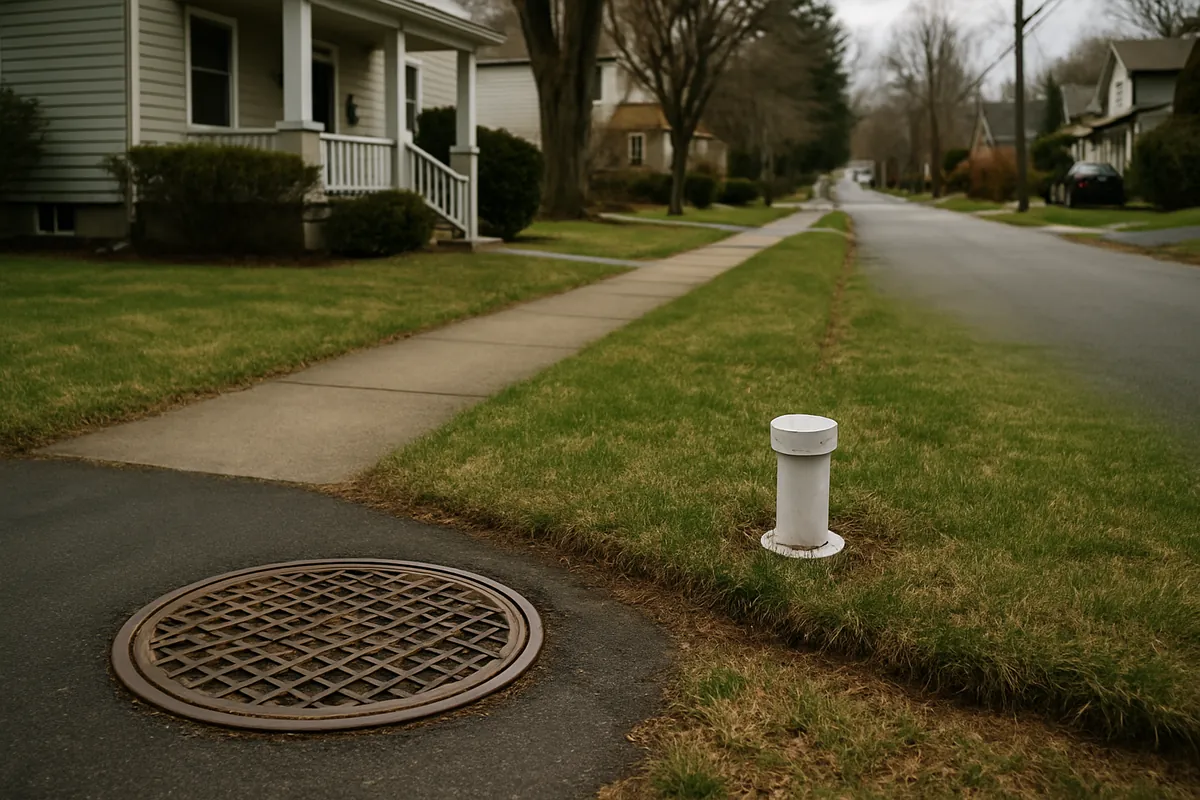
Your sewer lateral runs from the plumbing in the house, out under the yard, and connects to the public main under the street at a fitting called the tap. That entire lateral is private property in the same sense the roof is. Rockland County Sewer District No. 1 maintains the mains and the treatment side, not your service line.
The part homeowners find surprising is that responsibility does not stop at the curb. In most arrangements the lateral remains the owner’s obligation right up to the connection, which means the stretch under the sidewalk and the street is still yours even though you cannot dig there without a permit and traffic control.
That is why a defect at 60 feet costs differently from a defect at 20 feet. Same pipe, same owner, very different job.
Not every property is on the district
Rockland is not uniformly sewered. Some properties are on septic systems, some sit within village owned collection systems with their own rules, and connection standards differ between municipalities. Before assuming anything about your address, confirm with your town or village and with the district. It takes one phone call and it settles which set of rules applies to you.
What the Sewer District Does and Does Not Do
The district’s job is the collection and treatment system: the mains in the street, the interceptors, the pumping and the plants. When a main surcharges or blocks, that is theirs to clear, and a surcharging main can push sewage backward into the lowest fixture in nearby houses even though nothing is wrong with those houses.
Your job is everything from the tap inward: the pipe, the joints, the roots that entered them, the bellies, the material it was built from. Maintenance of the system as a whole is why groundwater and stormwater getting into cracked private laterals matters to the utility at all, which is the infiltration and inflow problem that EPA wastewater programs address at the system level.
Why Rockland Laterals Fail Where They Do
Ownership is only half the story. The other half is that this county’s laterals are old and were built in bursts.
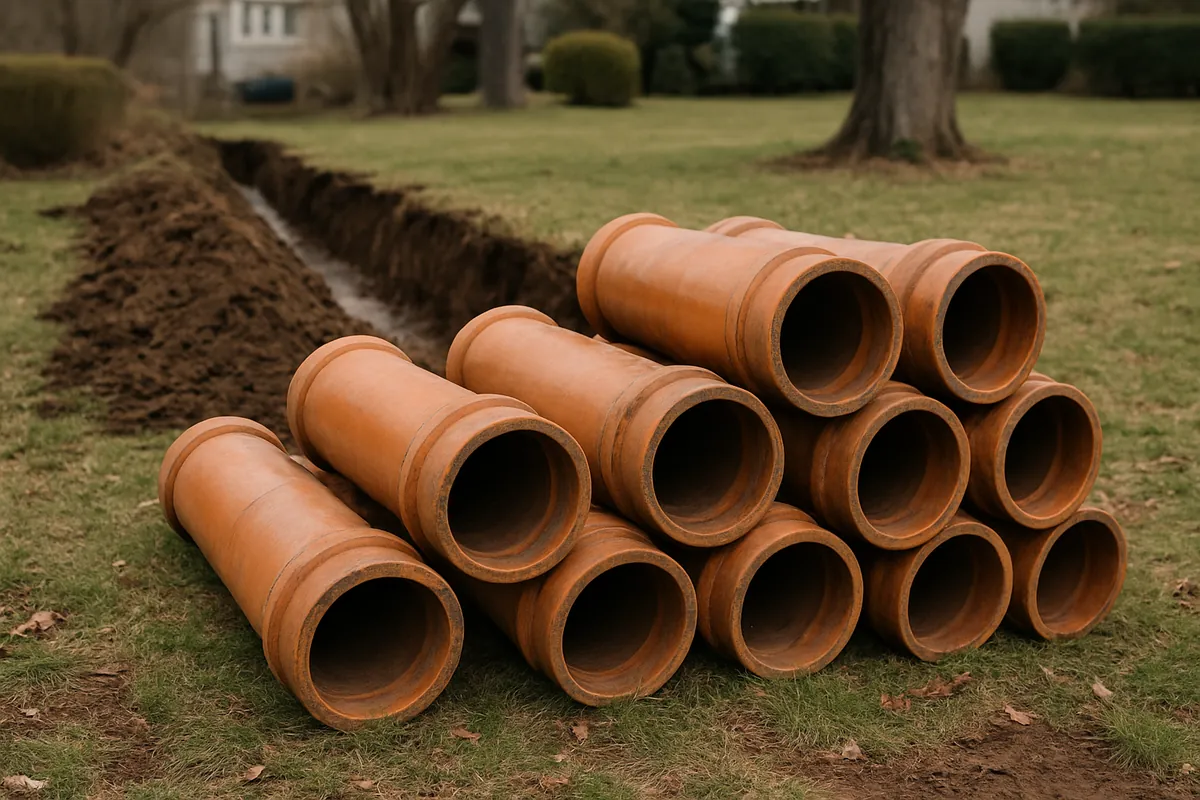
The Tappan Zee Bridge opened in 1955 and set off a decade of tract building through Nanuet, Bardonia, West Nyack, Congers and Valley Cottage. Those houses were plumbed with clay tile or with Orangeburg, the bituminized fiber pipe manufactured in Orangeburg NY about ten miles from New City and installed nationally from 1945 to 1972. Both materials are now well past their design life.
The older river villages, Nyack, Piermont, Haverstraw and Tappan, carry pre-1940 and nineteenth century housing on laterals older still, in low lying ground with a high water table. Add mature street trees hunting for the moisture at every joint, and freeze thaw cycling working on the ground every winter, and the failure pattern across the county is not mysterious. It is age plus roots plus soil.
None of that changes who owns the pipe. It just explains why so many owners here meet the question at all.
What Homeowners Insurance Typically Does
This is where the surprises happen, so read your own policy rather than trusting a summary. In general terms, though, standard homeowners coverage in New York is written around sudden and accidental losses, and buried lateral failure is usually neither.
| Situation | How standard policies usually treat it |
|---|---|
| Pipe failed from age, corrosion or deterioration | Excluded as wear and tear |
| Tree roots entered and broke the joint | Commonly excluded |
| Line settled, sagged or shifted with the soil | Commonly excluded as earth movement |
| Sewage backed up into the basement | Generally excluded unless a backup endorsement was added |
| Cost of excavating to reach the buried line | Typically the owner’s cost |
| Water damage inside the house from a sudden burst supply line | More often covered, subject to policy terms |
The pattern is consistent. Policies tend to respond to damage inside the house from a sudden event, not to the cost of replacing a deteriorated pipe in the ground. The New York State Department of Financial Services publishes consumer guidance on homeowners coverage and is the right place to start if you want to understand what your carrier is actually obliged to do.
Sewer backup endorsements and service line riders
Two optional add ons are worth asking your agent about before you need them.
A water or sewer backup endorsement generally covers cleanup and damage inside the home when waste backs up through a drain, which is the loss that ruins a finished basement. It does not usually pay to fix the pipe.
A service line endorsement is the one that addresses the pipe itself, covering repair of buried utility lines on the property. Read the limit, the deductible and the boundary carefully. The question to ask directly is whether coverage extends from the house all the way to the main, or stops at the property line, because the section under the street is the expensive stretch to reach.
Both are cheap relative to a lateral replacement, and both have to be in place before the loss. Nobody adds them mid backup.
What to Do First When It Backs Up
Order matters here, both for your health and for your bill.
- Stop using water. Every flush, load of laundry and dishwasher cycle adds to what is coming up the floor drain.
- Work out whether it is yours or the system’s. If neighbors are backing up at the same time, or sewage is surfacing in the street or at a manhole, call the sewer district or your municipality before you call anyone else.
- Keep people and pets out of standing sewage. It carries pathogens, and New York State Department of Health guidance on cleaning up after sewage exposure is worth reading before anyone starts mopping.
- Kill power to affected circuits if water is near outlets, and do not stand in it to reach a panel.
- Photograph everything before cleanup, with timestamps. If a claim happens later, this is the evidence.
- Get the line cleared, then get it inspected. Clearing restores service. It does not tell you why it happened.
That last distinction is the one that costs people money twice. A cleared line and an unexplained backup means it is coming back.
Proving Which Side of the Tap the Problem Is On
A sewer camera inspection is what converts an argument into a record. It gives you a defect with a footage number, a located line path and a depth, and it identifies the pipe material. If the camera runs the whole lateral and reaches the tap with nothing wrong on your side, that is documented, and you take it to the district. If it stops at a collapsed section at 40 feet, that is documented too, and it is yours.
The inspection runs $250 to $500 and is often credited against the work. Ask for a copy of the footage regardless of what it shows.
From there the repair path follows the defect. A single bad joint may only need a sectional repair. Roots through otherwise sound clay usually means cleaning then lining. A deformed fiber lateral cannot be lined at all and gets burst, which is the sewer line repair and replacement decision in a sentence. When sewage is already in the house, sewer backup repair and emergency sewer repair run on a different clock, but the diagnostic step does not change.
Homeowners in Spring Valley with a 1960s lateral and homeowners in Piermont with a pre war one both end up at the same place: footage first, decision second.
Your Next Step
Know two things before you have a problem. First, that the lateral is yours all the way to the tap, including under the street. Second, whether your policy has a service line endorsement on it, which is a five minute call to your agent.
Then, if a drain is slowing or a backup already happened, get a camera down the line. It costs $250 to $500, it is usually credited against the repair, and it is the only way to prove which side of the tap you are on before anyone starts digging.
Related Rockland County Sewer Guides
Review the permit process for sewer work, compare local sewer replacement cost ranges, and document the problem with a sewer camera inspection.
Common Questions
Where does my responsibility for the sewer line end?
At the tap, where your lateral connects to the public main. Everything from the fixtures in the house out to that connection is the homeowner's, and in most cases that includes the portion buried under the sidewalk and street. The main itself is maintained by the sewer district, not by you.
Does homeowners insurance cover a collapsed sewer lateral?
Usually not. Standard policies are built around sudden accidental events, and they generally exclude wear, deterioration, tree root damage and earth movement, which covers most of how buried laterals actually fail. The excavation and the pipe itself are typically the homeowner's cost. Read your own policy language rather than assuming.
What is a service line endorsement?
An optional add on some insurers offer that covers repair of buried utility lines on your property, including the sewer lateral. Limits are commonly modest and deductibles apply, and the terms vary a lot between carriers. Ask specifically whether the portion under the street is included, since that stretch is often the most expensive to reach.
Who do I call first when sewage backs up into the basement?
Stop using water in the house immediately, then find out whether the problem is yours or the main's. If neighbors are backing up too, or sewage is surfacing in the street, call the sewer district or your municipality first. If it is only your house, it is almost certainly your lateral and you need a camera in it.
Can I be billed for a blockage in the public main?
You should not be billed for work inside the public main. The risk is paying a contractor to clear or dig your lateral when the actual obstruction is downstream of the tap. That is why the camera pass matters. Footage showing the defect location tells you which side of the line you are on before money is spent.