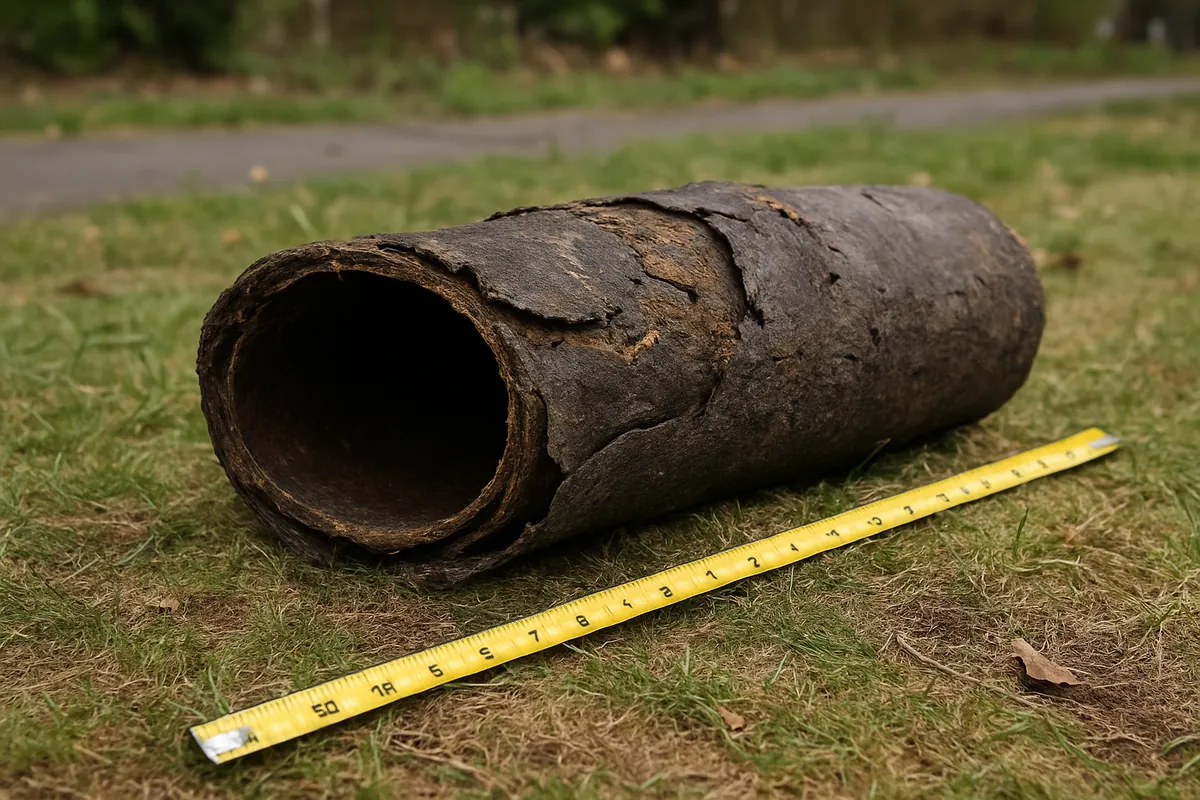
New City Trenchless explains the vitrified clay laterals common under postwar tract housing in Clarkstown and Orangetown. Homes built during the wave after the Tappan Zee Bridge opened in 1955 often drain through clay or Orangeburg, two materials that age and fail very differently.
Clay is the good news case. Here is what it is, why it still fails, and how to read it on a camera.
Vitrified Clay Is Not the Weak Part
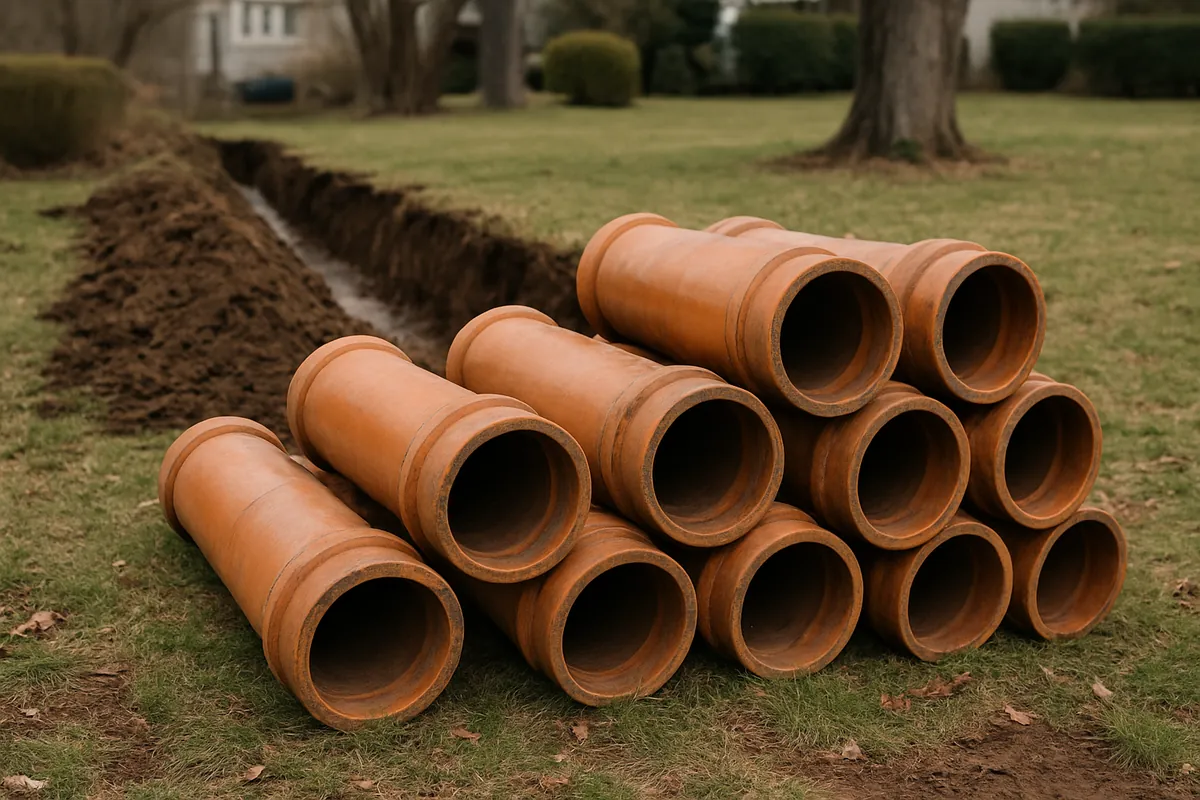
Clay sewer pipe is shale and clay fired at extreme temperature until the body vitrifies, meaning the particles fuse into a glass-hard, non-porous ceramic. That single manufacturing step is why the material behaves the way it does underground.
Vitrified clay does not rust like cast iron. It does not soften with moisture like bituminized fiber. It is chemically inert, so the sulfuric acid produced by bacteria in the sewer atmosphere, which hollows out the crown of an iron pipe over decades, does nothing to it. Roots cannot chew it. Detergents, drain chemicals and groundwater do not touch it.
The tradeoff is that vitrified clay is brittle and rigid. It will not flex or deform, so under a point load or a shifting trench it either holds perfectly or it cracks. There is no middle state where it bends and survives, and there is no gradual wall thinning to watch on camera.
The Joint Every Few Feet
Clay laterals are built from short sections, commonly four inches in diameter on a residential run, in lengths of only a few feet each. One end of every section is flared into a bell, and the plain spigot end of the next section seats inside it.
Do the arithmetic on that. A sixty foot lateral from the house to the tap, assembled from three foot sections, carries roughly twenty joints. Every one is a seam that has to stay closed for the pipe to work.
How the joints were sealed
Older Rockland installations used cement mortar packed into the bell by hand. Mortar is rigid, it shrinks slightly as it cures, and it degrades under long groundwater contact. From the 1960s onward, factory-applied polyurethane or rubber compression gaskets replaced mortar and made a far better seal, but even a gasketed joint depends on the two sections staying in alignment.
What pulls them open
Trench backfill from a 1950s or 1960s subdivision consolidates for decades after the crew leaves. As it settles unevenly along the run, sections rotate a few degrees against each other and the bell lifts off the spigot. Add freeze and thaw cycling near the shallow end of the run, hydrostatic pressure in wet ground, and roots wedging into any gap, and the joints do not stay tight.
An open joint is a small thing. It is also, functionally, the whole problem.
Rockland Ground Works Against Clay Joints
Three local conditions accelerate joint failure here.
Graded fill. The postwar build-out cut and filled hillsides fast to get houses up. Laterals in Bardonia, Nanuet, Congers and West Nyack often sit in engineered fill that has been consolidating ever since, which is exactly the loading pattern that opens bell joints.
Water table. In the low river villages the water table sits high, and groundwater is at the pipe for much of the year. Open joints in a saturated trench let groundwater into the sewer, which the EPA classes as infiltration and treats as a real load on collection systems, covered in its sanitary sewer overflow material. Groundwater coming in also means sewage going out through the same gap.
Trees. The street trees planted with those subdivisions are now sixty and seventy years old, with root plates that reach well past the sidewalk. Freeze-thaw cycling then loosens the surrounding soil each spring and gives roots an easier path toward the leaking joint.
Reading Clay, Orangeburg and Cast Iron on Camera
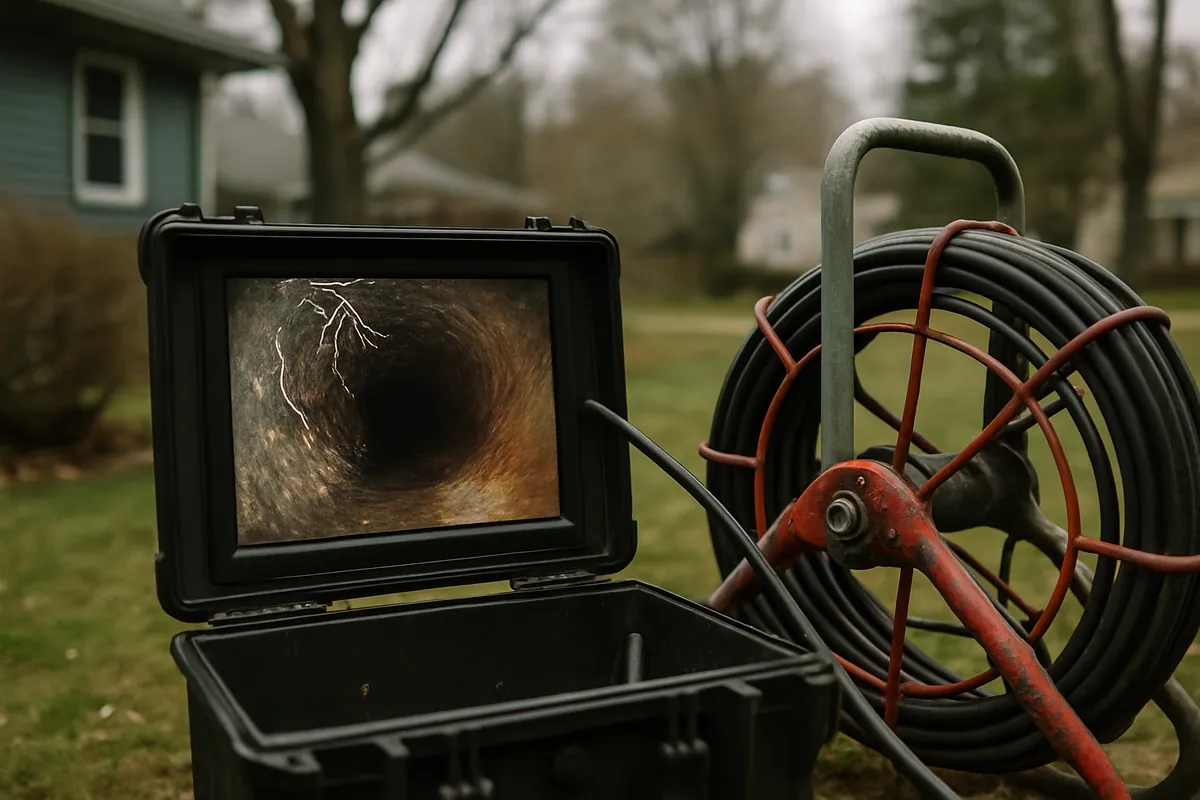
The material determines the repair, so identifying it correctly is the entire point of the first inspection. A sewer camera inspection tells you in minutes what a title search never will.
| Material | Wall on camera | Joint pattern | Typical failure | Lining candidate |
|---|---|---|---|---|
| Vitrified clay | Buff, tan or grey, glazed and hard, holds a round bore | Visible bell hub every few feet | Offset joints, cracked barrel, roots at hubs | Usually yes when walls are sound |
| Orangeburg | Matte black, fibrous, blistered flaps | Long runs with tapered fiber couplings | Ovalling, delamination, collapse | No once the bore is deformed |
| Cast iron | Dark grey under orange-brown scale and tuberculation | Hub joints packed with oakum and lead | Crown corrosion, heavy scale, channeling | Often yes after full descaling |
| PVC or ABS | White, green or black, smooth and uniform | Solvent welded bell roughly every ten feet | Bellies, backpitch, crushing | Rarely needed |
The giveaway for clay is the rhythm. You see a hub, then a clean smooth run, then another hub at the same spacing. Orangeburg gives you the opposite: a long dark tube with no regular hub and a bore that is visibly taller than it is wide. That distinction decides everything, because a deformed Orangeburg lateral cannot hold a liner and has to be burst, while sound clay is close to an ideal host.
Roots Do Not Break Clay, They Exploit It
There is a persistent belief that tree roots crack sewer pipe. On vitrified clay they almost never do. Roots find the warm, humid vapor escaping from an already open joint, thread hair-fine tips through the gap, and only then thicken into the woody mass that blocks flow and levers the joint wider.
That sequence matters for what you do about it. Cutting or jetting the roots out restores flow, and on a stable line a scheduled cleaning interval is a legitimate way to manage a lateral. But the entry point is still open, the same tree is still there, and the roots come back. If the interval keeps shortening, the pipe is telling you the joints have moved past maintenance.
Why Sound Clay Is the Best Lining Host There Is
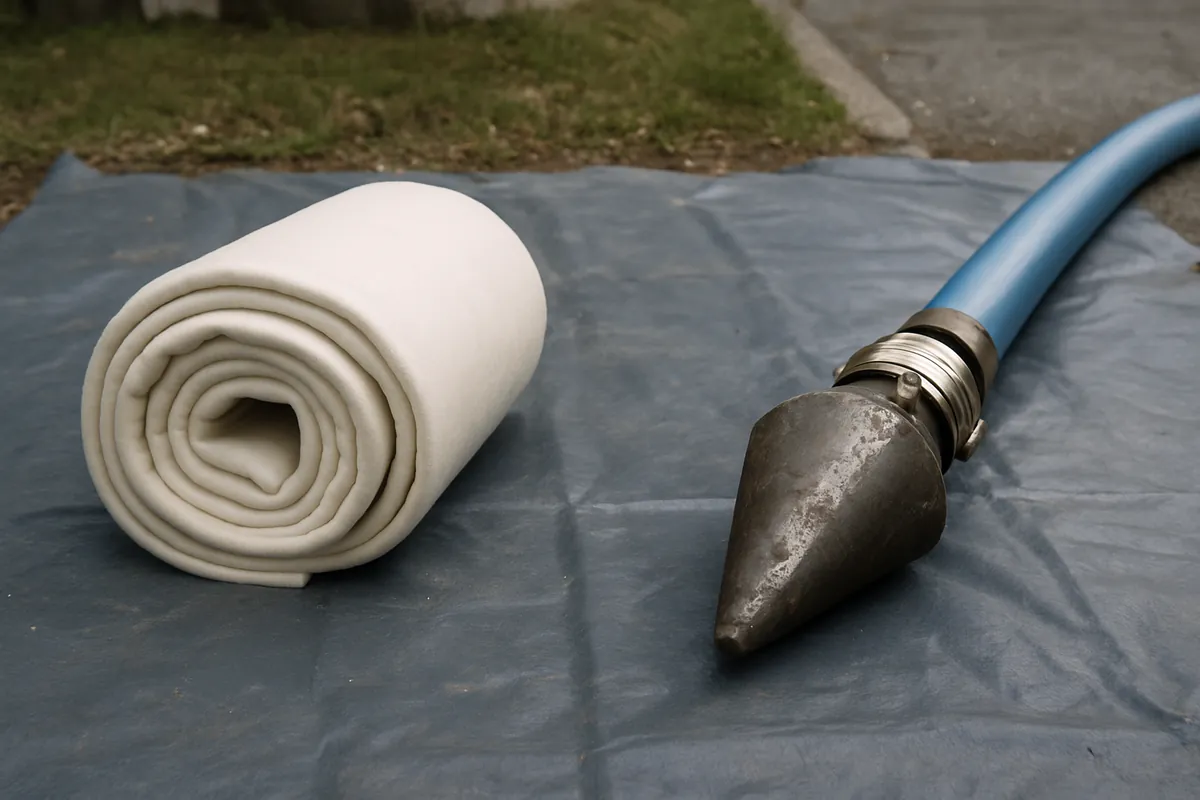
Cured in place lining works by inflating a resin saturated tube inside the existing pipe and curing it hard against the wall. The old pipe acts as the mold. That means the process rewards a host that is rigid and round, and punishes one that has deformed.
Clay is rigid and round by nature. It also tolerates aggressive cleaning, so a jetter and a mechanical cutter can strip roots, scale and hardened debris back to a clean wall without damaging the host, which is exactly what resin needs to bond against. Industry practice for pipe assessment and rehabilitation is set out by bodies like NASSCO and the material and installation standards by ASTM.
The result is that trenchless pipe lining turns twenty separate joints into one continuous jointless pipe. There is no hub left for a root to enter and no gap left for groundwater to push through. On a clay lateral running under a mature yard, a driveway or a stone walk in a village like Piermont, that outcome without a trench is usually the whole reason to choose trenchless.
When Clay Has Gone Past Lining
Not every clay line qualifies. The camera is looking for disqualifiers:
- Collapse or a missing invert. If the bottom of the barrel has sheared out and soil is visible, there is nothing to line against.
- Severe joint offset. A section dropped far enough that the bore steps sideways will not accept a liner cleanly.
- A belly. A sag holds standing water. Lining a sag preserves the sag, because the liner follows the existing grade.
- Voids around the pipe. Long term leakage washes soil out from around the run, and that ground has to be dealt with, not covered over.
Where one joint has failed and the rest of the run grades out sound, a sectional spot repair at that joint is the proportionate fix. Where the line has lost grade or structure across its length, pipe bursting pulls new fused HDPE through the old path and resets the run. Homes across Congers and the rest of the postwar ring split fairly evenly between those three outcomes.
What Each Outcome Costs
| Work | Range | When it applies |
|---|---|---|
| Camera inspection | $250 to $500 | Always first, often credited against the work |
| Sectional spot repair | $1,500 to $4,000 | One failed joint or a short cracked run |
| Full lateral CIPP lining | $4,000 to $12,000 | Sound clay walls, multiple leaking joints, root entry |
| Pipe bursting replacement | $6,000 to $15,000 | Collapse, lost grade, bellies, no usable host |
| Open cut for the same work | Often 1.5x to 2x the trenchless price | Once excavation, hauling and landscape repair are counted |
Your Next Step
Nothing above can be decided from the ground. Material, joint condition, grade and root entry are all camera findings, and on a clay lateral the camera usually delivers good news, since a sound barrel with tired joints is the cheapest serious problem a sewer line can have.
Book a camera inspection, get the recorded run and the located depth, and make the call from evidence instead of from the age of the house.
Related Rockland County Sewer Guides
Learn how clay differs from Orangeburg pipe in Rockland County, compare CIPP lining with pipe bursting, and read why tree roots enter sewer lines.
Common Questions
How long does clay sewer pipe last?
The clay barrel itself can outlast the house. Vitrified clay does not rust, rot or soften, and sections pulled out of the ground after seventy years often still have a hard, smooth wall. What fails is the joint between sections, so the practical lifespan of a clay lateral is set by ground movement and root pressure, not by the material.
How do I know if my sewer line is clay or Orangeburg?
Build year narrows it and a camera settles it. Clay shows a buff or grey glazed wall with a bell hub every few feet. Orangeburg shows a matte black fibrous wall with long jointless runs and an out of round bore. A $250 to $500 camera inspection identifies the material in minutes and is often credited against the work.
Can clay sewer pipe be lined instead of dug up?
Usually yes, and clay is the best host material there is. Cured in place lining needs a pipe that still holds a round shape to act as a mold, and rigid clay does exactly that. Once the line is cleaned and the camera confirms sound walls with no collapse or belly, a liner spans every joint in one continuous pass.
Why do roots keep coming back after I have the line cut?
Cutting removes the root mass but leaves the opening it grew through. The joint is still separated, still leaking vapor and moisture, and the same tree sends new hair roots back into it. Root cutting is maintenance. Sealing or replacing the joints is the repair.
Does lining fix a sagging or bellied clay line?
No. A belly is a grade problem, not a pipe problem, and a liner cured inside a sag keeps the sag. Bellied sections need the pipe reset to grade, which means bursting or a targeted excavation of that run. The camera and a locating sonde tell you the depth and length of the sag before anyone quotes.