New City Trenchless inspects cast iron sewer laterals across Rockland County on a near-daily basis, and the pattern is almost always the same: the house has had no obvious problem for years, and then a backup arrives that looks sudden from inside the kitchen but was decades in the making underground. Cast iron does not fail the way a cracked clay joint fails. It corrodes from the inside, quietly, along more than one front at once, until the bore it left behind cannot keep up with ordinary household flow.
Why Cast Iron Corrodes the Way It Does
Cast iron is an alloy of iron and carbon, and buried sewer and drain pipe made from it has no interior coating protecting the metal from the waste and gases passing through it every day. Over decades, that constant exposure to moisture, hydrogen sulfide gas and the acids produced by decomposing waste attacks the iron itself. The attack does not happen evenly across the pipe. It concentrates wherever flow, moisture and gas exposure are heaviest, which in a sloped lateral is almost always along the bottom of the pipe and at the joints.
Three distinct failure patterns grow out of that same corrosion process, and a single pipe commonly shows all three at once by the time anyone calls for an inspection.
Tuberculation: Scale That Grows Inward
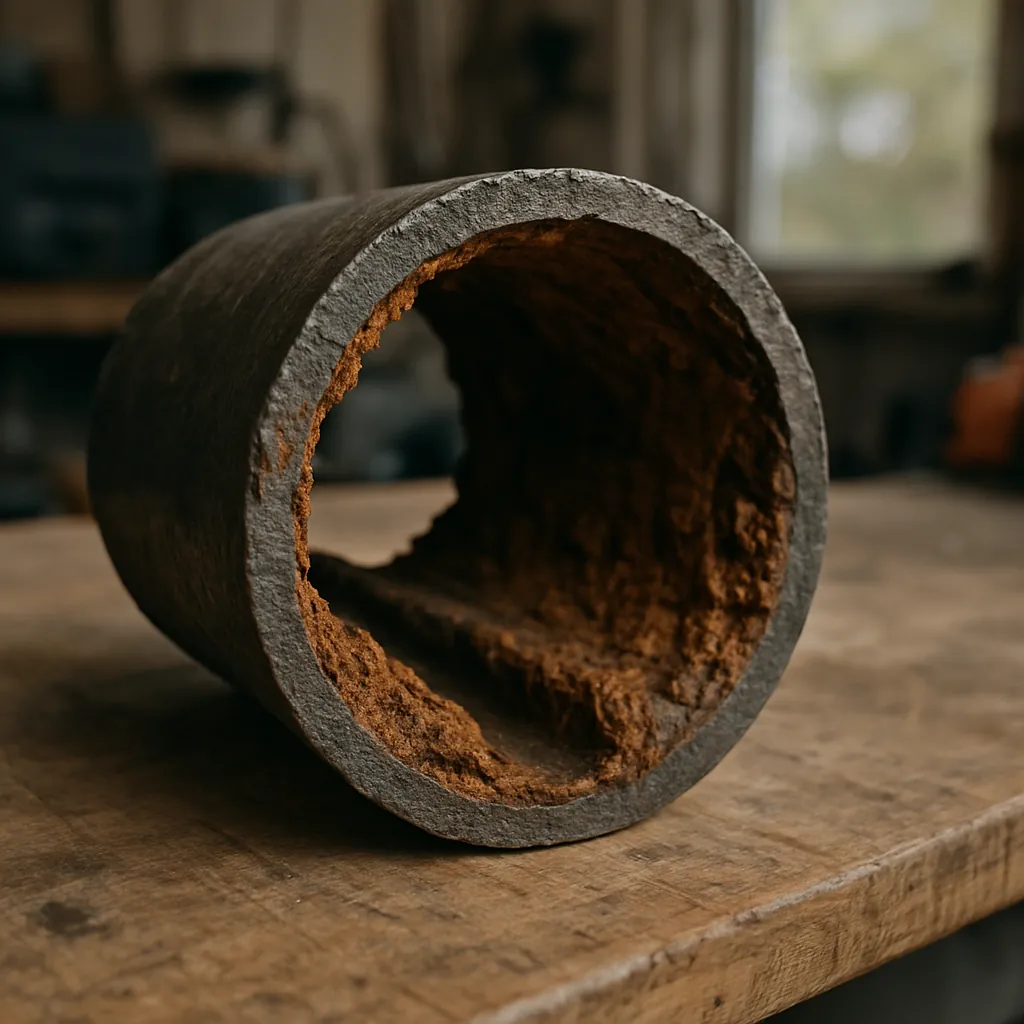
Tuberculation is the buildup of rust nodules and mineral scale on the interior pipe wall. As the iron corrodes, the byproducts do not simply wash away. They accumulate as hard, uneven bumps that narrow the open bore and roughen what should be a smooth interior surface. A newly installed four-inch cast iron pipe has a clean, round opening. Decades of tuberculation can leave that same pipe with an effective opening closer to two or three inches, and the rough surface left behind snags paper, wipes and grease far more readily than smooth pipe does.
This is why a line that has run fine for years can suddenly start backing up without any single dramatic event triggering it. The bore has been narrowing by fractions of an inch for a long time, and a clog finally catches on a surface that has grown rough enough to hold it.
Channeling: A Groove Cut Along the Invert
Channeling is a different, more structural problem. The invert, the lowest point inside the pipe where standing and flowing water sits, takes the most sustained corrosive exposure of any point in the cross-section. Over time that constant contact wears a visible groove into the pipe floor, and in advanced cases the groove deepens into an open trench where the bottom of the pipe has essentially worn through.
A channeled invert changes how the pipe behaves hydraulically even before it fails outright. Water that should move in a controlled flow instead pools and meanders along an uneven floor, which slows drainage and gives solids more opportunity to settle rather than being carried along to the main.
Graphitic Corrosion: The Failure a Camera Can Miss
The most deceptive of the three is graphitic corrosion. As the iron component of the metal leaches out, what remains is a soft graphite shell that keeps roughly the same shape and can appear intact on a camera pass. The pipe looks like pipe. It is not structurally pipe anymore. A section with advanced graphitic corrosion can be pushed through with hand pressure, and jetting or lining preparation that applies too much force to a weakened section risks breaching it rather than cleaning it.
This is the main reason an experienced technician reads pressure and resistance during descaling, not just the picture on the monitor, and dials back tooling wherever the footage shows a thin, chalky-looking wall rather than solid metal.
What a Camera Inspection Actually Shows
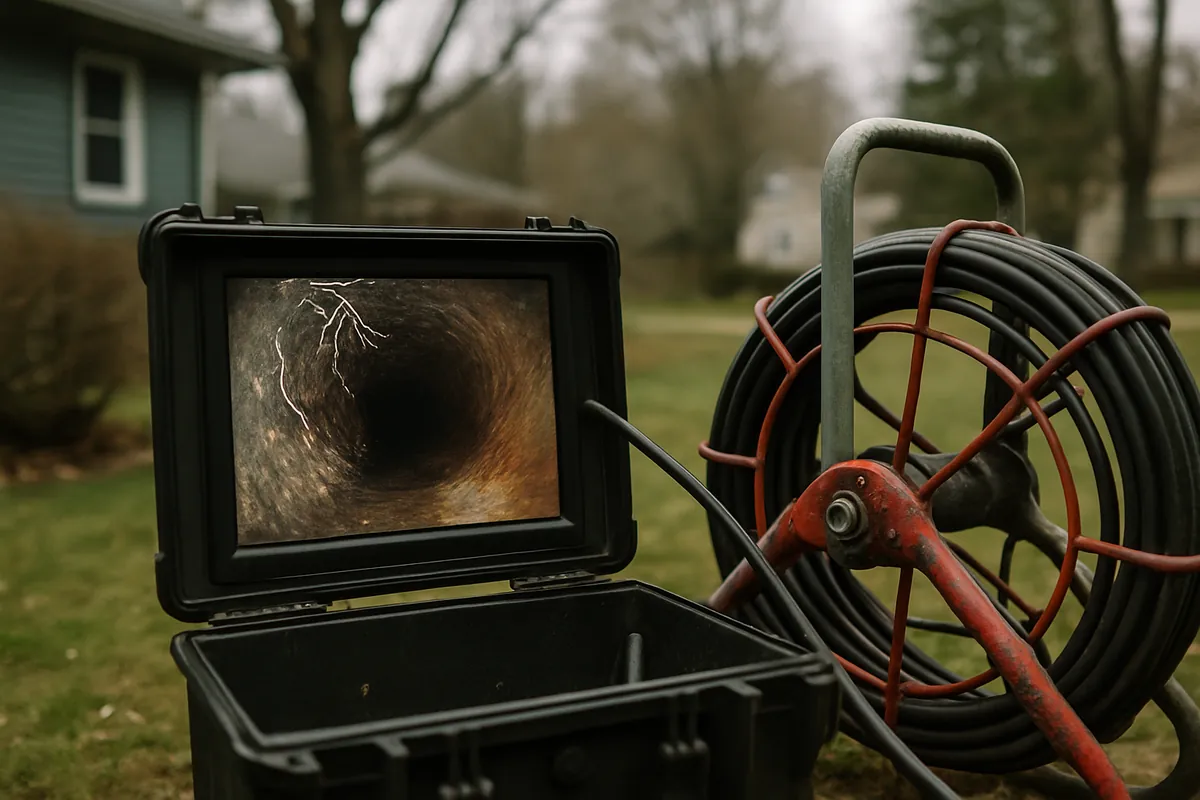
A sewer camera inspection run with a locating sonde documents all three failure patterns in one pass: the degree of tuberculation narrowing the bore, the depth of any channel worn into the invert, and whether a section’s wall looks thin or compromised rather than simply discolored. It also records where the bell-and-spigot joints, sealed with lead and oakum when the house was built, have loosened enough to let roots or groundwater into the line.
That documentation is what turns a vague “it’s old cast iron” conversation into an actual plan. Two houses built in the same year on the same street can have very different cast iron conditions depending on soil chemistry, slope and how the line has been maintained, and a camera pass is the only way to tell which situation a given house is actually in.
Reading the Camera Footage: Severity in Practice
| What the camera shows | What it usually means | Typical next step |
|---|---|---|
| Light rust coating, bore still mostly open | Early-stage tuberculation | Monitor, or clean ahead of a planned lining job |
| Heavy nodules narrowing the bore significantly | Advanced tuberculation | Mechanical descaling, then lining if the shape holds |
| Visible groove or standing water along the invert | Channeling | Lining to bridge the lost invert, if the wall is sound |
| Chalky, thin-looking wall or loss of definition | Graphitic corrosion | Careful evaluation; replacement if the wall cannot be trusted |
| Loosened joints with root or water intrusion | Failing bell-and-spigot connections | Lining to seal every joint along the run |
When Lining Is Still the Right Call
Lining works on cast iron as long as the pipe, however corroded on the inside, still holds its round shape and has enough sound wall left to bond a new structural liner against. Heavy tuberculation and a channeled invert are not disqualifying on their own; they describe exactly the kind of damage trenchless pipe lining is built to repair, since the cured liner becomes a new standalone pipe rather than a coating that depends on the old iron for strength. Mechanical descaling has to bring the wall back to bare metal first, because a liner bonded over scale is a liner that will eventually delaminate.
When Replacement Is the Only Real Option
Two conditions move a cast iron lateral past lining and into sewer line repair and replacement territory. A section that has collapsed or lost its round shape leaves no host pipe for a liner to cure against. A section with advanced graphitic corrosion, where the camera cannot confirm a trustworthy structural wall behind the graphite shell, is not a safe candidate for a liner that depends on that wall to hold pressure. Both situations typically call for pipe bursting, which replaces the pipe outright while still working through two small access pits rather than a trench the length of the yard.
Why This Matters So Much in Rockland County
Rockland County’s housing boom ran heavily through the 1950s and 60s, and cast iron was the standard drain and sewer material for a large share of that construction, particularly homes plumbed to a higher standard than the cheapest tract product of the same decade. That means a substantial share of the county’s original laterals are now sitting at or beyond the 50 to 75 year service range cast iron is typically rated for, whether the house sits in New City, Nanuet, Suffern or any of the other towns under Rockland County Sewer District No. 1.
Clearing a slow-draining line with hydro jetting is often the first practical step, both to restore flow and to expose the true condition of the wall for an accurate camera reading. A line that has been cleared and still shows heavy corrosion on camera is telling you something cleaning alone cannot fix.
Getting a Straight Read on Your Own Line
Cast iron corrosion is progressive, not random, which means the same camera inspection that explains today’s symptom also gives a reasonable read on how much service life the rest of the line has left. If a slow drain, a gurgling toilet, or a musty basement smell has you wondering whether it is time to look at the pipe itself, call 845-507-6985 and we will walk through what a camera pass would need to confirm before recommending lining, a spot repair, or replacement.
For the material-specific inspection and preparation questions, see cast iron pipe lining.
Common Questions
How long does a cast iron sewer lateral actually last?
Most cast iron drain and sewer pipe is rated for roughly 50 to 75 years of service. The bulk of Rockland County's cast iron went into the ground during the 1950s and 60s building boom, which means a large share of the original lines in this county are now sitting at or past the far end of that range.
Can corroded cast iron pipe still be lined instead of replaced?
Usually, yes. As long as the pipe has not lost its structural wall or collapsed, a cured liner bridges a missing invert and becomes a new standalone pipe inside the old one. The pipe does not need to look good on camera to be a lining candidate; it needs to still hold its round shape.
What does tuberculation actually look like on a sewer camera?
It looks like rust-colored nodules and ridges growing inward from the pipe wall, narrowing the open bore and giving grease and paper something to snag on. In advanced cases the nodules nearly close off the pipe, and the camera has to pass through a channel that looks far smaller than the pipe's actual diameter.
Is a backup always the first sign something is wrong with cast iron?
Not necessarily. Slower drainage across several fixtures, a gurgling sound after a toilet flushes, or a musty basement smell near a floor drain can all show up well before a full backup, because they reflect a bore that has been narrowing gradually rather than a pipe that just failed.
Does lining make a cast iron drain smaller?
Only by a few millimeters of wall thickness, and in practice flow usually improves rather than worsens. A smooth cured liner replaces a rough, tuberculated surface, so water and waste move through it more easily than they did through the corroded iron it covers.