New City Trenchless explains which sewer backups may be preventable and which are not. A clay joint that finally drops out of alignment may fail regardless of maintenance, but periodic attention can reveal changes before they become a flooded basement or a larger repair.
This is the short list of what actually helps. Most of it costs nothing.
Find Your Cleanout Before You Need It
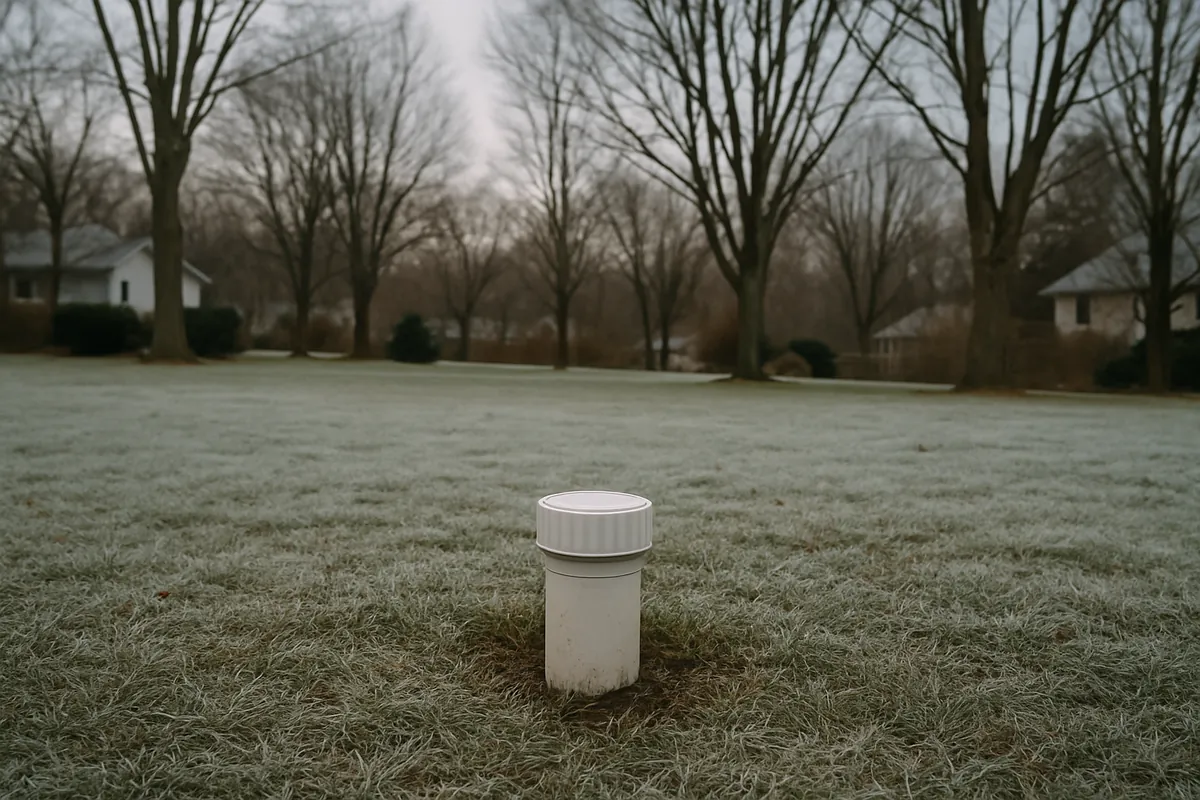
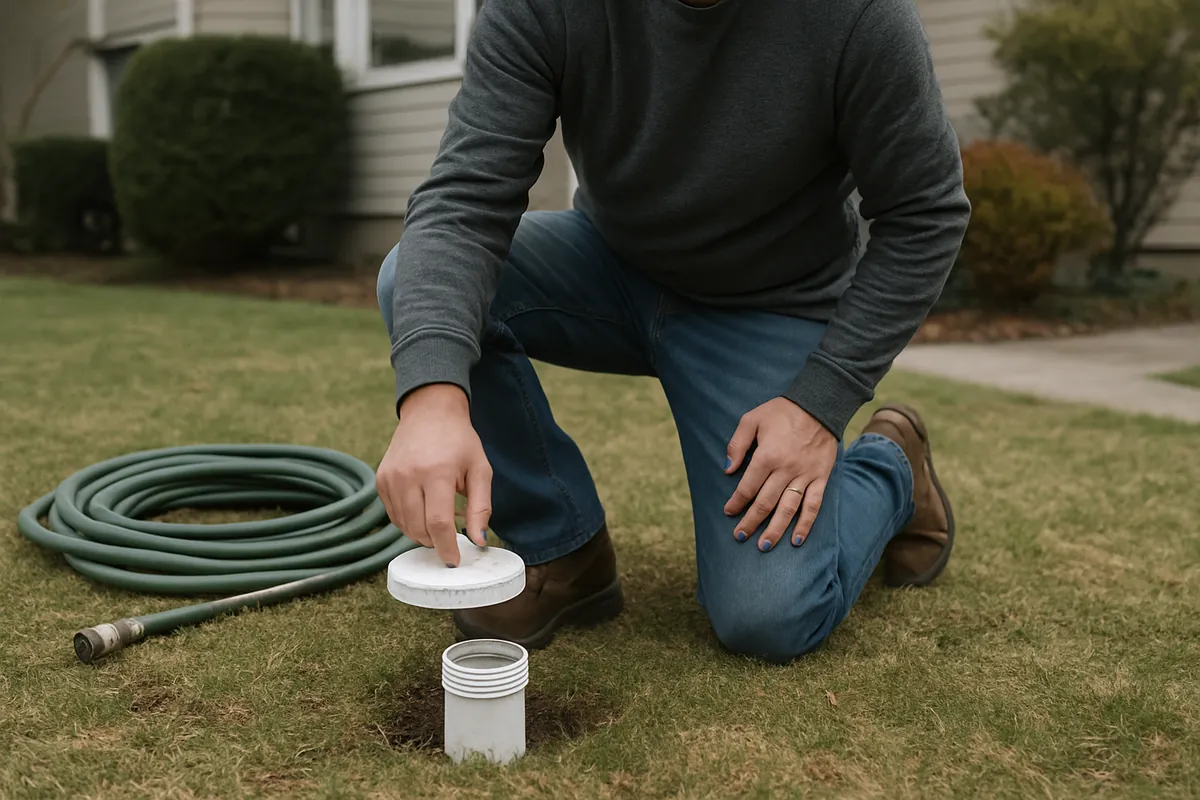
The cleanout is a capped access point that opens directly into your lateral. It is how a camera goes in, how a jetter goes in, and how a backup gets relieved outside the house instead of through the lowest fixture inside it.
Knowing where it is on a Tuesday afternoon is worth a great deal at eleven at night with water rising in a basement floor drain.
Where to look
Start on the side of the house the sewer leaves from. Most often the cleanout is a capped pipe at or just below grade within a few feet of the foundation, sometimes hidden under mulch, a shrub or a decade of leaf litter. Inside, check the basement floor near the base of the main stack, or a plugged fitting in the wall where the line exits.
Postwar Rockland tract homes usually have one. Older housing in the river villages frequently does not, because the requirement was not universal when those lines went in. If yours has none, adding one during any planned work is inexpensive and changes what every future service call costs.
Once you find it, mark it. A paver, a stake, a photo with a measurement off the corner of the house. Crews spend billable time hunting for buried cleanouts that the homeowner walks past every day.
What Never Goes Down the Drain
Almost every avoidable blockage traces back to a small number of items.
| Item | What it does in the line |
|---|---|
| Wipes of any kind, including ones labeled flushable | Do not break apart in water, snag on any joint or root, form the core of most rag blockages |
| Cooking grease, fats, oil, bacon drippings | Pour warm, cool fast against a pipe sitting at ground temperature, build a hardened layer on the wall |
| Coffee grounds | Do not dissolve, settle in low spots and pack down |
| Paper towels and tissues | Made to hold together when wet, unlike toilet paper |
| Cat litter | Absorbs water and sets |
| Dental floss and hair | Thread through root masses and bind loose debris into a mat |
| Solvents, paint, and thinners | A water quality problem for the treatment plant, not just a pipe problem |
Grease deserves the emphasis. Your lateral is buried below frost depth, which means it stays cold year round, and it gets colder through a Rockland winter. Warm grease poured at the sink is a solid film by the time it is thirty feet out. Fats, oils and grease are a documented driver of collection system blockages, which the EPA treats as a system wide issue rather than a private inconvenience.
None of this requires a device or a product. It requires a coffee can under the sink.
Enzyme Products Versus Caustic Openers
These are not two versions of the same thing. They do different jobs and one of them can do damage.
Enzyme and bacterial treatments feed cultures that digest organic material: grease film, soap scum, food residue, paper. They act slowly, over repeated doses, and they are safe against clay, cast iron, PVC and fiber pipe alike. Used monthly, they are legitimate maintenance for a household that cooks heavily. Used on an actively blocked line, they do nothing useful, because they need time and flow.
Caustic openers are sodium hydroxide or sulfuric acid formulations that generate heat as they react. In a sink trap holding hair and soap, they work. Past the trap they have two problems. First, they are heavier than water and tend to settle at the first low point, which means a blockage forty feet out in the yard never sees them. Second, the heat is hard on aged cast iron and dangerous against softened bituminized fiber.
The bigger point applies to both. Roots, a separated bell joint, an out of round pipe and a bellied section are mechanical failures. No chemical restores grade or closes a gap. If a drain is slowing again a week after a bottle, the bottle was never the answer.
Roots Set the Cleaning Interval
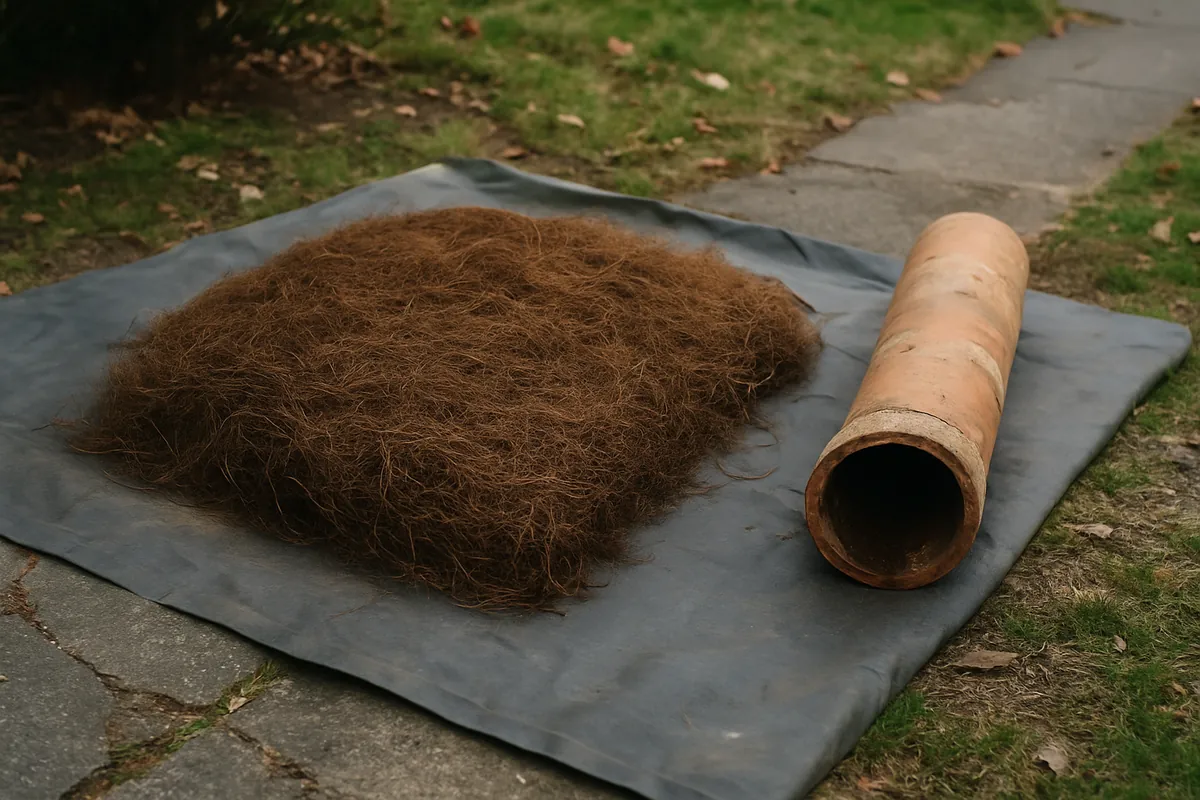
Roots do not attack sound pipe. They follow warm, humid vapor leaking from a joint that has already opened, thread hair fine tips through the gap, and thicken into the mass that stops flow. Root systems chasing moisture and reaching well past the visible canopy is standard tree biology, described in the extension literature published by Cornell Cooperative Extension.
Rockland gives them every advantage. The street trees planted alongside the subdivisions that filled in after the Tappan Zee Bridge opened in 1955 are now sixty and seventy years old, and freeze thaw cycling loosens the soil around the line every spring.
| What the camera shows | Sensible approach |
|---|---|
| PVC or modern pipe, no root findings | No routine cleaning, recheck every several years |
| Sound clay, hubs tight, no root entry | Camera every three to five years, no scheduled jetting |
| Root entry at one or two joints, line flowing | Cleaning on a twelve to twenty four month cycle while you plan a repair |
| Interval getting shorter each cycle | Stop buying cleanings, the joints have moved past maintenance |
Hydro jetting scours the wall with water rather than dragging a blade through it, and with a cutter head it clears tree root intrusion properly. But method has to match material. Jetting pressure that strips scale out of cast iron will cut straight through delaminated Orangeburg, and Orangeburg was manufactured ten miles from New City and buried across this county from 1945 to 1972. The pipe has to be identified before the nozzle goes in, which is the whole argument for looking first.
The Baseline Inspection Is the Record Worth Having
A sewer camera inspection on a line that is behaving normally feels like money spent on nothing. It is the opposite. It produces the reference footage that makes every later inspection meaningful, and it answers the questions that decide every future repair: what the pipe is made of, where the joints sit, whether the grade holds, how deep the run is and where it crosses the property line.
Inspection findings recorded to the assessment coding practice maintained by bodies like NASSCO give you defects described consistently rather than as one technician’s adjective. Ask for the recording either way.
The best moment for this is at purchase. A pre-purchase sewer inspection costs $250 to $500 and is frequently credited against work, and it is the cheapest hour in the entire transaction. It matters more the older the housing gets, so a pre-1940 house in Nyack or one of the other river villages sitting on a much older lateral in a high water table is exactly the case for it.
When a Schedule Beats Waiting for a Backup
Maintenance does not prevent every failure. What it does is change which repair you are buying, because the proportionate fix shrinks the earlier you find the defect.
| Where it gets caught | Proportionate response | Cost range |
|---|---|---|
| Root entry at a single joint, line still flowing | Cleaning plus a sectional spot repair | $1,500 to $4,000 |
| Multiple leaking joints, barrel walls still sound | Full lateral CIPP lining | $4,000 to $12,000 |
| Lost grade, deformation or collapse after years of ignored warnings | Pipe bursting replacement | $6,000 to $15,000 |
| Any of the above done open cut instead | Trench, spoil hauling, landscape and driveway rebuild | Often 1.5x to 2x the trenchless price |
Backup cleanup sits on top of all of those and is not part of the pipe price at all. Neither is the disruption of losing every drain in the house on the day it happens.
What Maintenance Cannot Fix
Be honest about the limits. Cleaning restores flow through a defect. It does not close a separated joint, it does not lift a sagging run back to grade, and it does not put an ovalized fiber pipe back into round.
The lateral from the house to the tap is yours, including the section under the street in most cases, while Rockland County Sewer District No. 1 maintains the mains. County information sits at rocklandgov.com. That ownership line is why the maintenance decision falls to the homeowner and why nobody else is watching this pipe for you.
Treat a shortening cleaning interval as the diagnosis it is. Three cleanings in eighteen months has usually already cost more than knowing what is actually wrong.
Your Next Step
Find your cleanout this weekend and mark it. Move the grease off the drain list. Then get one camera pass down the line so the rest of it stops being guesswork.
The inspection runs $250 to $500, is often credited against any work that follows, and gives you the material, the joint condition, the grade and the depth in a single visit. Ask for a copy of the footage. That recording is your baseline, and every decision about this pipe for the next twenty years reads better against it. Homes across Nanuet and the rest of the postwar ring are the ones where it usually pays for itself first.
Related Rockland County Sewer Guides
Recognize the signs of a failing sewer line, learn why tree roots keep returning, and prepare older pipes for Hudson Valley winter conditions.
Common Questions
Where is my sewer cleanout likely to be?
Look first at the exterior wall on the side of the house the sewer leaves from, within a few feet of the foundation, for a capped pipe at or just below grade. In postwar Rockland tract homes it is often there or in the basement floor near the main stack. Some pre-1940 river village houses were built without one at all.
Do enzyme drain treatments actually work?
They work on what they are designed for, which is the organic film of grease, soap and food residue that builds on pipe walls. They are slow, they are maintenance rather than rescue, and they are harmless to every pipe material. What they cannot do is cut roots, close a separated joint or drain a sagging section, because none of those are biological problems.
How often should a root-prone sewer line be jetted?
The camera sets the interval, not the calendar. A line with confirmed root entry at one or two joints is commonly kept on a twelve to twenty four month cycle. The signal that matters is whether the interval is holding steady or shortening. A cleaning that used to last two years and now lasts eight months is telling you the joints have moved past maintenance.
Are caustic drain openers bad for old sewer pipe?
They are the wrong tool more often than they are the right one. Sodium hydroxide and sulfuric acid products react with heat, which is hard on aged cast iron and on softened bituminized fiber pipe. They also rarely reach a blockage forty feet out in the yard, because they sit in the standing water at the low point of the system instead.
Is a camera inspection worth doing when nothing is wrong?
Yes, and it is worth the most when nothing is wrong. It runs $250 to $500 and is often credited against later work. A clean baseline tells you the pipe material, the joint condition and the grade, which is the reference point that makes every future inspection readable. Buying a house is the single best time to get one.